



Simucube, MOZA and SIMAGIC have turned the brake into the most interesting component on the market. We look at what an active pedal actually does, how the three approaches differ, and whether they are really worth the money.
The short version
- What they are: pedals with no springs or elastomers. A servo motor generates the resistance and changes it hundreds of times per second.
- What they give you: ABS, traction control, lock-ups and G-forces delivered straight to your foot, plus mechanical consistency that never degrades.
- What they don’t give you: free tenths. With a good load cell you are just as fast over a single lap.
- The benchmark: Simucube ActivePedal. Best value: ActivePedal Pro. Price disruptor: MOZA mBooster. Budget route: SIMAGIC haptic reactors.
- Non-negotiable requirement: a rigid cockpit. Without one, no active pedal is worth buying.
Contents
- From springs to servo motors
- What an active pedal actually does
- Simucube: the benchmark
- MOZA mBooster: the price disruptor
- SIMAGIC: a different route
- Comparison table
- Do active pedals make you faster?
- How each sim responds
- The question to ask before buying
- Conclusion
- Frequently asked questions
It is odd. Everyone shows off direct drive bases, ultrawide screens and aluminium cockpits that look like they came out of a Le Mans garage. Yet when the tenths that matter show up, when you need to lower your lap time consistently rather than by accident, the conversation always ends up in the same place: the pedals.
And that is exactly where a technology has been quietly reshaping the market: active pedals. For months they have been the subject of arguments, split opinions and a lot of marketing. Some present them as the next evolutionary step in sim racing. Others insist they are an unnecessary luxury for people who have run out of things to spend money on.
The truth, as usual, sits closer to the middle. Active pedals do not magically turn anyone into a faster driver, but they completely change the way a driver receives information from the car. And that difference, even when it does not show up on the stopwatch straight away, ends up having an enormous impact on how you drive.
From springs to servo motors
For years, pedal sets evolved along a fairly logical path. First came potentiometer pedals, which simply measured how far the pedal travelled. Then came Hall sensors. Later came load cells, arguably the biggest revolution in modern sim racing hardware.
Load cells changed the experience completely, because what mattered was no longer how far the pedal moved but how much force the driver applied. That is exactly what happens in a real race car. If you want to go deeper on that shift, we covered it in can load cell pedals make a difference in lap times?
The problem was that no matter how advanced the load cell or even the hydraulic system, they all shared the same limitation: they were entirely passive systems. Their behaviour depended only on physical parts.
- Springs
- Elastomers
- Hydraulic pistons
- Mechanical end stops
If you wanted a GT3 to brake more progressively, or a formula car to have a rock-hard pedal, you had to strip half the assembly. Swap rubbers. Swap springs. Recalibrate. And repeat the process again and again. It was not especially difficult. It was simply an exercise in patience. And you still had to calibrate the pedal set properly after every change.
What an active pedal actually does
Here is the fundamental difference. Instead of using a spring to generate resistance, an active pedal uses a high-precision servo motor. That motor generates force dynamically. But not only that: it can also modify that force hundreds of times per second. While you drive. While you brake. While the car loses grip. While the ABS kicks in.
Suddenly the pedal stops being a mechanical part and becomes an intelligent device. It is almost as if the car could talk directly to your foot. That sensation is hard to explain until you try it.
The big advantage is not stiffness
There is a very common misconception: that the point of an active pedal is a much stiffer brake. It is not. You could already achieve that with a good load cell.
The real revolution is elsewhere. The pedal constantly changes its behaviour. It can stiffen. It can soften. It can vibrate. It can simulate ABS. It can transmit grip loss. It can reproduce G-forces. All of it in software, without removing a single bolt. Simucube’s own technical documentation lays out the architecture clearly: the pedal presents itself to the PC as a standard USB game controller, and the active effects depend on the sim supplying compatible telemetry.
Simucube: the benchmark
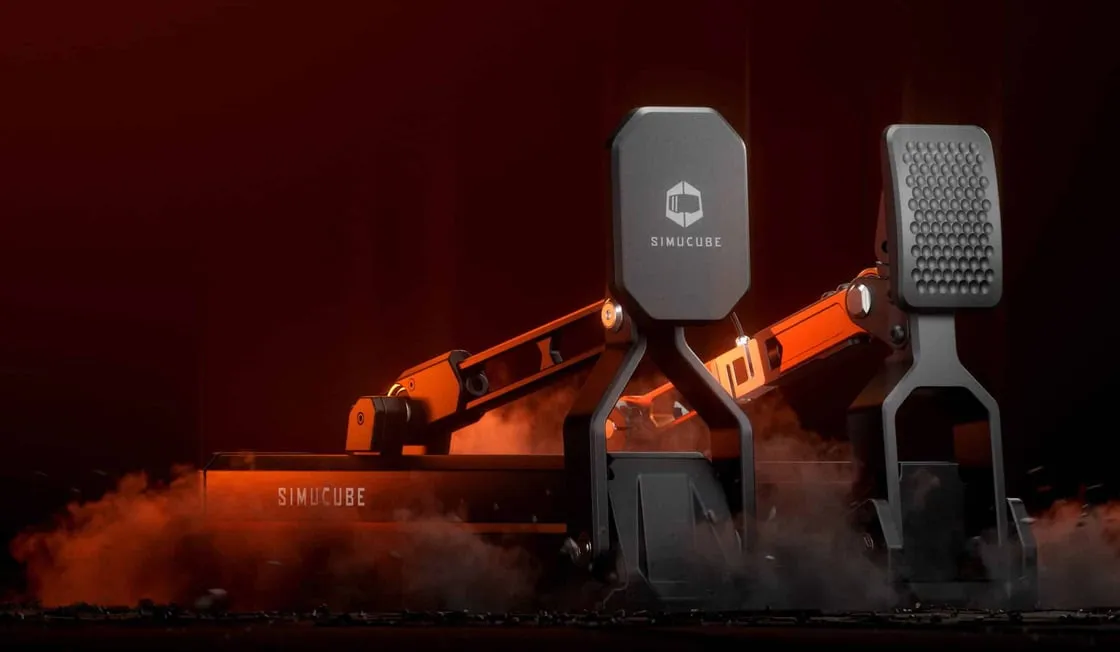
If one company opened this market, it was Simucube. And it is still the benchmark. The ActivePedal Ultimate set a standard that is hard to match. Everything about it feels industrial: the finish, the precision, the motor response, the smoothness of the movement, the quality of the software.
It is no surprise that many people describe it as the pedal equivalent of a high-end direct drive wheelbase.
ActivePedal Pro: the smart buy
Later came the ActivePedal Pro, a considerably more affordable version that keeps the experience almost entirely intact. And here is one of the biggest surprises: on paper it looks clearly inferior. In practice, not so much.
Maximum force drops from the Ultimate’s 1,700 N (170 kg) to 1,100 N (110 kg) on the Pro. That sounds like a serious cut. But most drivers will never sustain more than 80 kg of braking pressure. In other words, the Pro keeps virtually the whole experience for a lot less money.
That is why many now consider it the smartest purchase in the premium segment. And if the budget still does not work, the brand runs a refurbished programme with a full two-year warranty.
MOZA mBooster: the price disruptor

If Simucube represents excellence without compromise, MOZA has attacked from a different angle: price. The mBooster costs roughly half as much. That changes the rules of the game entirely. Suddenly active pedals stop looking like an unreachable product.
The technical package is surprising too. According to MOZA’s official specifications, it includes:
- High torque density servo motor with a ball screw
- Dual 200 kg load cell sensors
- 21-bit magnetic encoder (2,097,152 points of resolution)
- Full software configuration through Pit House
On paper it looks like a direct rival. In many respects it genuinely is. Our full verdict, with plenty of track time behind it, is in our in-depth MOZA mBooster review.
The compromises behind the price
Cutting the price that far means accepting some compromises. The most obvious one shows up before you even start driving: noise. The motor stays energised even when you are not using the simulator. It is not especially annoying, but it is there. Like the fridge you never remember exists until you try to sleep near it.
The haptic response also does not reach Simucube’s surgical clarity. It works very well, but the vibrations feel more diffuse, less defined, as if the information arrived slightly out of focus.
Even so, for the money it is probably the biggest shake-up this market has seen. MOZA’s official support documentation also confirms an important detail: it can be configured as brake, throttle or clutch, and it works with third-party wheelbases over USB.
Check the MOZA mBooster on the official store
SIMAGIC: a different route
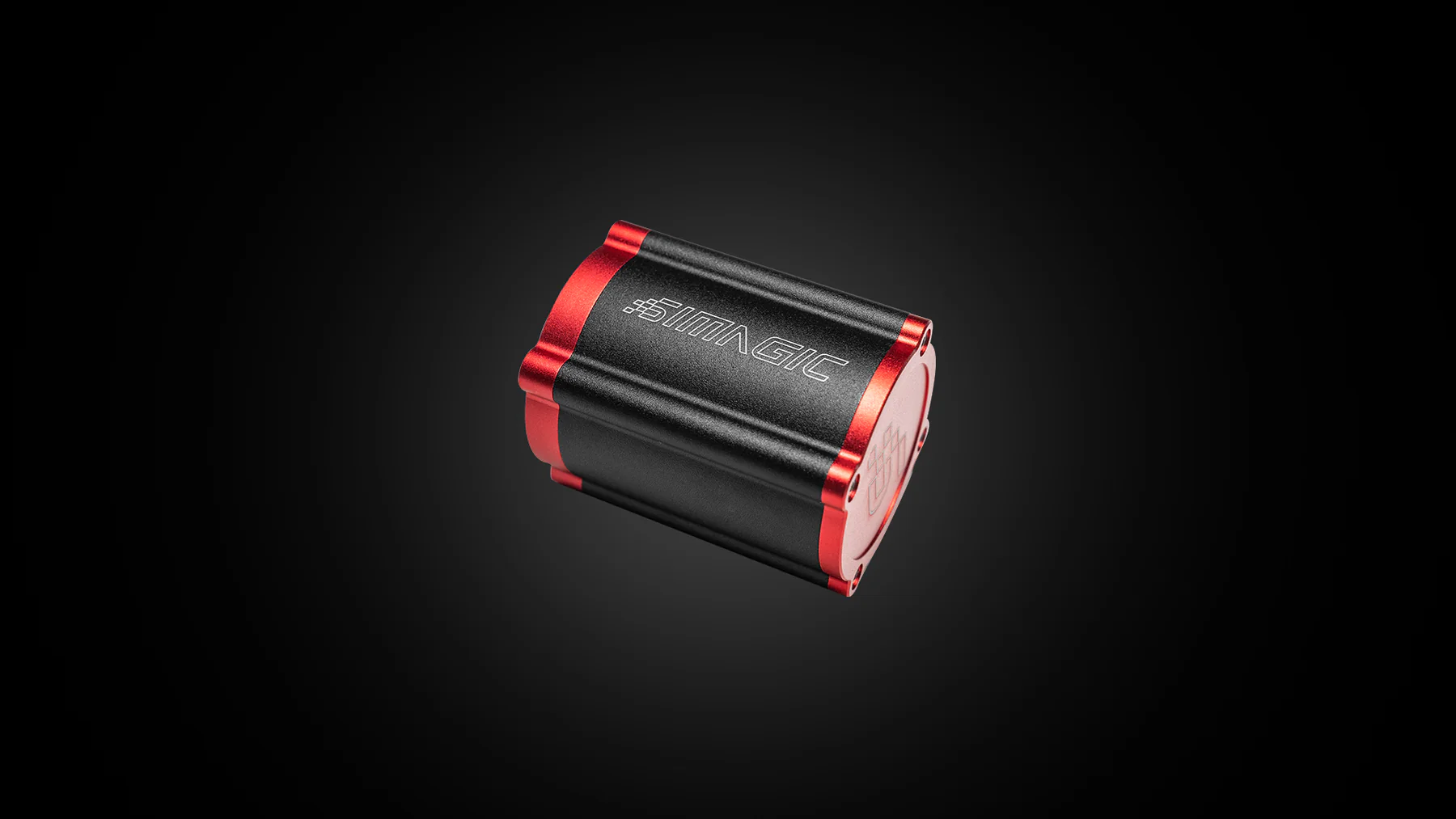
While other manufacturers were busy motorising the whole pedal, SIMAGIC took a different approach: keep a conventional pedal set and add haptic reactors.
In other words, the pedal still uses ordinary springs and elastomers, but it gains dedicated motors that generate extremely precise vibrations. They do not change the resistance. They do not alter the stiffness. But they do reproduce:
- ABS
- Traction control
- Engine vibration
- Grip loss
And they do it with surprisingly high quality. According to the official P-HPR product page, it is a patented linear motor whose vibration frequency and amplitude can be parameterised in SimPro Manager, compatible with the P500, P700, Simagic P1000 Pedals , P1000i and P2000 pedal sets as well as the TB-RS handbrake. Worth noting: SIMAGIC states the module is designed exclusively for its own products, and fitting it to another brand’s pedals voids the warranty.
For a lot of users this is an excellent solution, because it delivers a meaningful part of the experience for a much smaller investment. Meanwhile the brand has already shown prototypes of its own active pedal, so competition is about to get more intense.
Comparison table
| Simucube ActivePedal Ultimate | Simucube ActivePedal Pro | MOZA mBooster | SIMAGIC P-HPR | |
|---|---|---|---|---|
| Technology | Active pedal (servo motor) | Active pedal (servo motor) | Active pedal (servo + ball screw) | Passive pedal + haptic reactor |
| Maximum force | 1,700 N (170 kg) | 1,100 N (110 kg) | Dual 200 kg load cells | Whatever your pedal set does |
| Stiffness adjustable in software | Yes | Yes | Yes | No |
| ABS / TC / G-force effects | Yes, the most defined | Yes | Yes, slightly more diffuse | Yes, vibration only |
| Software | Simucube Tuner | Simucube Tuner | MOZA Pit House | SimPro Manager / SimHub |
| Depth of adjustment | Very high | Very high | Moderate, more accessible | Moderate |
| Investment | The highest on the market | High, but justified | Around half the Pro | The most contained |
| Best for | Professional rigs and endurance | The Simucube experience without the premium | Getting into active pedals affordably | Anyone already on SIMAGIC pedals |
Prices and availability change often. Always check each manufacturer’s official website before buying.
Do active pedals make you faster?
Here comes the million-dollar question. And the answer will probably disappoint anyone hoping for a miracle.
No. An active pedal does not hand you tenths. It does not turn a mediocre lap into a perfect one. The best drivers in the world still set incredible times on excellent load cell pedals. Speed still comes from the driver. Always.
But there is an enormous caveat. The difference is not in the perfect lap. It is in the fifty that follow.
The magic shows up when fatigue does
Picture an endurance race. After one hour. After two. After three. The elastomers start warming up. The materials shift slightly in behaviour. Your muscle memory is now working against a pedal that no longer responds exactly as it did at the start.
These are tiny differences. Millimetric. But enough to disturb your precision.
An active pedal removes that problem entirely. If it needs 65 kg to reach maximum braking today, it will need exactly 65 kg tomorrow. And in three years’ time as well. That consistency builds far more solid muscle memory.
Your foot becomes the main character
For decades sim racers have relied mainly on two senses: sight and the wheel. When the car locked a wheel, you had to interpret the sound, the force feedback or an on-screen indicator.
Active pedals add a third information channel. Your foot starts receiving data directly. When the ABS engages, you feel it. When the tyre starts sliding, you feel it. When the car loses stability, you feel that too.
And that information arrives before your brain has to interpret sounds or images. The reaction becomes far more natural. Almost instinctive.
How each sim responds
Not all of them offer the same experience, because active effects depend entirely on the telemetry each title exposes.
iRacing
iRacing is still the reference. Its telemetry reproduces lock-ups, G-forces and ABS behaviour with extraordinary precision. It is probably the environment where active pedals show their full potential.
Assetto Corsa EVO & Competizione
ACE & Assetto Corsa Competizione offers something different. The focus is on GT3 cars and their electronic aids. Here the ABS works far more continuously, producing a sustained vibration that tells you exactly when the system is intervening. On the throttle you can even feel traction control working.
Le Mans Ultimate
Le Mans Ultimate has come a long way. Early versions needed inelegant workarounds to access telemetry. Today it runs through a much more stable API, which allows profiles to switch automatically depending on the car and delivers far more complete haptic effects. In short, the experience is now on a par with the other major sims.
Software wins races too
There is another detail that often goes unnoticed: the hardware is only half the job. The other half is the software.
Simucube is still several steps ahead here. Its ecosystem lets you modify practically any parameter you can imagine: force curves, damping, travel, pressure points, frequencies and car-specific profiles, all with enormous depth.
MOZA takes a much simpler philosophy: fewer options, less complexity, a far gentler learning curve.
Each approach has its audience. If you enjoy fine-tuning down to the last detail, you will probably prefer Simucube. If you want to drive without losing an entire afternoon to settings, MOZA is very appealing.
The question to ask before buying one
Something tends to get forgotten here, and it matters a lot. Where are you going to mount that pedal?
Applying more than 100 kg of pressure to the brake means transmitting exactly that force into the cockpit. If the structure flexes, all that effort is lost.
That is why an active pedal effectively demands a rigid aluminium cockpit. Bolting one to a flimsy frame would be like fitting racing slicks to a shopping trolley. The tyres would be magnificent, but the rest of the package would still have exactly the same problem.
The same logic applies to the pedal plate. We looked at rigidity taken to the extreme in our Sim-Lab XP1 pedal review, and there are more options in our cockpits section.
Tip: if you are fitting an active pedal, check your seat and its mounting first. A seat that shifts under 100 kg of braking load undoes all the consistency you just paid for. Check the Next Level Racing ERS3 Hypercool seat.
They don’t buy speed, they buy confidence
After looking at every alternative, it is clear that active pedals are the next big technological leap in sim racing. Not because they automatically turn anyone into a champion, but because they completely change the relationship between the virtual car and the person driving it.
Simucube still leads the segment thanks to its mechanical refinement and extraordinarily advanced software. MOZA has democratised a technology that seemed reserved for very large budgets. And SIMAGIC proves there are still different routes to that experience through very convincing haptic solutions.
The question is no longer whether active pedals are better. They are. The real question is whether each driver will make use of everything they offer.
Because if all you want is one spectacular lap to show your friends, a good load cell pedal set is still more than enough. But if you enjoy refining every braking zone, building muscle memory, running long races and feeling the car talk to you through your foot, then active pedals stop looking like a technological indulgence. They start to feel like the component that, once you have tried it, makes going back surprisingly hard.
Frequently asked questions
Are active pedals worth it if I only race short events?
Less so than for endurance. The biggest advantage of an active pedal is consistency across very long stints plus the extra haptic information. In 15-minute sprints, a well-calibrated load cell set covers almost everything.
Can I use an active pedal with a wheelbase from another brand?
Yes. Both the Simucube ActivePedal and the MOZA mBooster present themselves to the PC as standard USB devices, so they work with any base. What does depend on the ecosystem is the tuning software and some advanced effects.
Do I really need an aluminium cockpit?
In practice, yes. An active pedal can generate more than 100 kg of force and that load goes straight into the structure. If the chassis flexes, you lose the precision and consistency you paid for.
Simucube ActivePedal Pro or Ultimate?
For the vast majority, the Pro. The main difference is maximum force (1,100 N versus 1,700 N) and very few drivers sustain more than 80 kg of braking pressure. The Ultimate makes sense in professional rigs or if you want to replicate the real loads of an LMP or formula car.
Are SIMAGIC haptic reactors the same as an active pedal?
No. The reactors add informative vibration (ABS, traction control, slip) but they do not change the stiffness or travel of the pedal, which still depend on springs and elastomers. They are a cheap way to get part of the experience, not a replacement.
Are active pedals noisy?
It depends on the model. The mBooster’s motor stays energised and produces a constant hum, mild but noticeable in a quiet room. MOZA quotes a 44 dB operating level in its specifications.
See you on the track!
This website uses affiliate links which may earn a commission at no additional cost to you.




Hey Alberto, I believe you’ve missed one or two points when it comes to active pedals. I can only speak for the Simucube Active Pedal I own and have never tested the other options.
First: Immersion. With active pedals, the throw and resistance could be changed without mechanical changes from car to car, even automatically per telemetry and linked profiles. For people trying to replicate the real feel as much as possible, this is a true game changer. It will make one slower at the beginning, but this is like the real world, too. No Formula 1 driver will be amongst the fastest when switching to a GT3 car (except Max Verstappen maybe…).
Second, depending an the car in sim, an active pedal could make people faster by clearly referencing the edge of traction or ABS. Additionally, the electrically/electronically generated resistance of active pedals gives the option to have a non-linear resistance progression, which is nearly imposssible to generate purely mechanical. That gives the option to dial in the resistance perfectly up to the threshold point of brake traction per car and will potentially result in better laptimes.
What I’m personally missing so far with active pedals is simulations making use of this technology. There’re so many options untouched like brake fading effects, brake wear over longer races or even brake disc wobbling after a hard emergency brake event. iRacing has announced that they will look into it as soon as more manufacturers offer such pedals, but I doubt that this will happen soon.
Hey! Thank you very much for taking the time to share such a detailed comment and your experience with the Active Pedal.
You’ve raised some really interesting points, and we’ll definitely keep them in mind for future articles. We’ll also follow up on the topic and take a closer look at all the points you mentioned, especially as active pedal technology and its integration with sims continue to evolve.
Thanks again for reading us and, above all, for taking the time to write and share your experience with us. Really appreciated!