
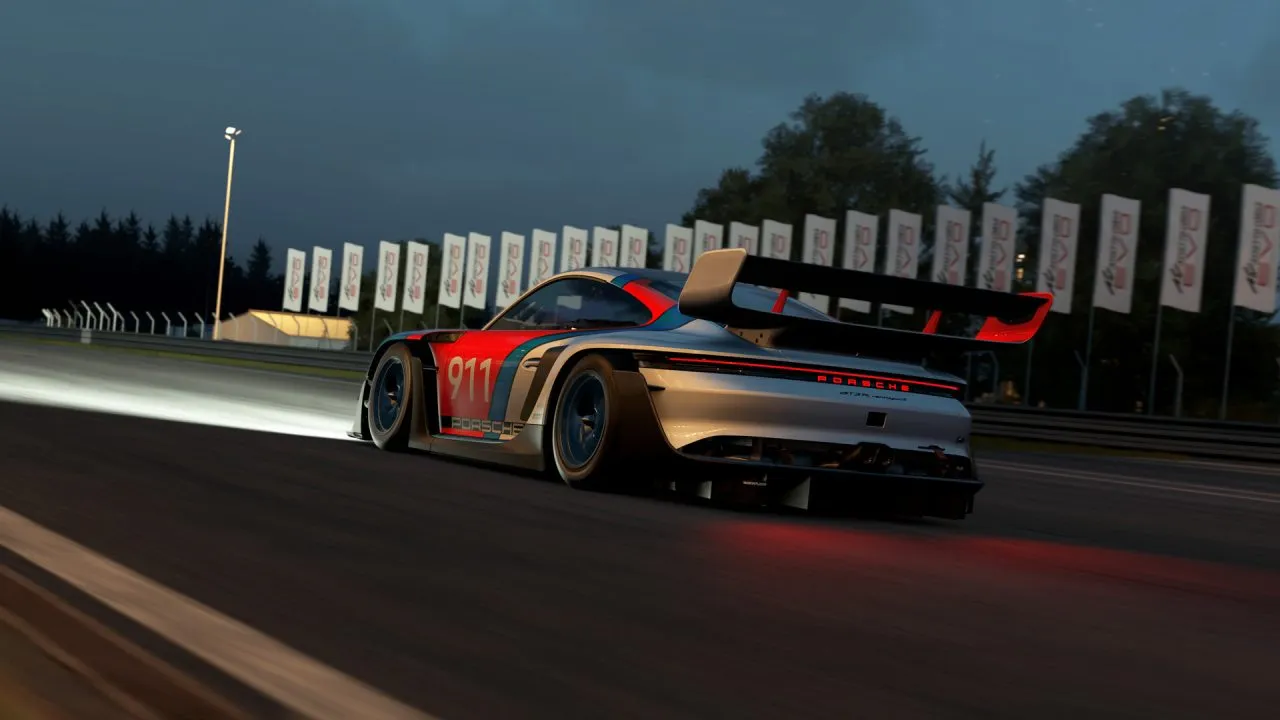

The 0.6 update for Assetto Corsa EVO has not simply changed car behaviour, but the way that behaviour is communicated to the driver. Force Feedback has stopped being a filtered interpretation and has become a direct projection of the physics, which means hardware can no longer “correct” the signal: it can only amplify it, distort it, or respect it. In this new scenario, configuration is no longer a surface-level adjustment but a structural element of the experience.
The immediate consequence is that each hardware ecosystem responds differently to the same signal. The difference lies not only in power output, but in more subtle parameters such as latency, motor response speed, and the way micro-oscillations are managed. For this reason, establishing optimal settings is not about copying universal values, but about understanding how each base interprets the physical model the simulator generates in real time.
Fanatec

The Fanatec ecosystem sits at a midpoint where available power and filtering capability allow the signal to be modulated with considerable precision. In the context of EVO v0.6, this translates into the need to contain the inherent aggressiveness of the new physical model without eliminating critical information. The key lies in applying light damping that stabilises the high-frequency signal without interfering with grip-loss events.
Recommended settings:
- FFB Strength (base): 60–100% depending on model
- FFB Gain (in-game): ~80%
- Natural Damper (NDP): ~15%
- Natural Friction (NFR): ~5%
- Interpolation Filter (INT): 1–2
- Force Effect Intensity (FEI): 100
One of the most frequent mistakes in this ecosystem is completely removing filters with the intention of obtaining a “pure” signal. In practice, this produces instability on straights and amplification of mechanical noise, especially with the new information density introduced in version 0.6. A slight intervention on the signal does not degrade realism; it makes it usable.
Simucube
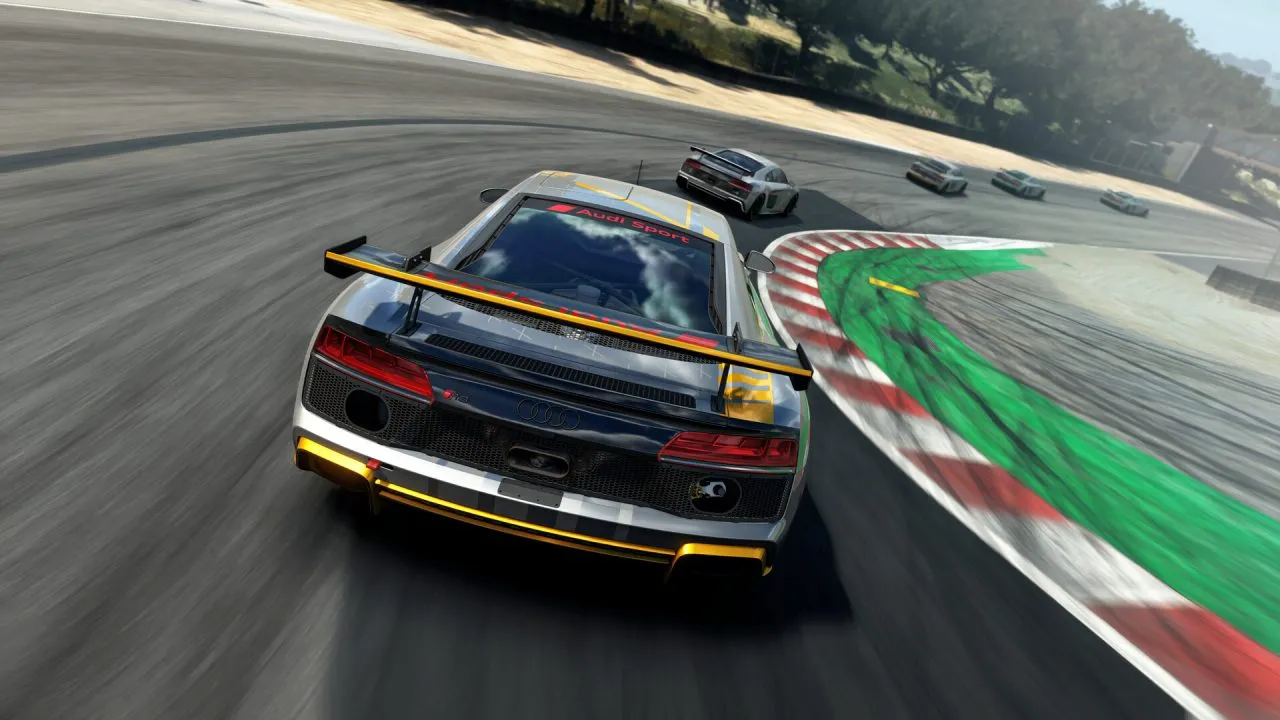
Simucube bases operate in a technical range where latency is practically non-existent and motor response speed allows torque variations to be reproduced across extremely short time scales. In this context, any additional filtering tends to degrade the original signal rather than improve it. EVO v0.6, with its analytical approach to tyre behaviour, fits this architecture with particular precision.
Recommended settings:
- Overall Strength: 100%
- FFB Gain (in-game): ~80%
- Reconstruction Filter V2: Level 1
- Damping: 10–15%
- Friction / Inertia / Static Force: 0%
- Slew Rate Limit: disabled
- Torque Bandwidth: unlimited
The most common mistake in this environment is trying to tame the signal with additional filters when the perceived behaviour feels demanding. However, that demand is usually a direct manifestation of the simulated physics, especially in limit situations such as the onset of lateral sliding. Introducing filtering at this point eliminates precisely the information that allows the driver to anticipate loss of control.
Moza
Moza represents a modern approach where the control software adds an additional layer of interpretation on top of the base signal. This can be beneficial on lower-inertia hardware, but it also introduces the risk of duplicating effects that the simulator already calculates. In EVO v0.6, where the physics generates sufficient information on its own, it is essential to reduce artificial interventions to a minimum.
Recommended settings:
- Torque (base): 90–100%
- FFB Gain (in-game): ~80%
- Road Sensitivity: 5–10
- Mechanical Spring: 0%
- Center Damper: 0%
- Damper: low or moderate
The most common failure in this ecosystem is leaving artificial centring systems active. These mechanisms generate a constant force towards centre that conflicts directly with the concept of simulated pneumatic trail. As a result, the wheel can transmit a false sense of grip even when the tyre has completely lost its capacity to generate lateral force.
Structural Differences Between Ecosystems
The divergences between Fanatec, Simucube and Moza are not explained solely by nominal power output, but by the way each system processes the signal. Fanatec introduces a balance between filtering and response, allowing the experience to be adapted to different user profiles. Simucube eliminates practically any intermediate layer, exposing telemetry directly and without compromise. Moza, for its part, offers additional tools that can enrich the signal if used in moderation, but that can easily overload it.
These differences become especially relevant in EVO v0.6 due to the greater information density generated by the physical model. The correct interpretation of events such as the onset of sliding, load transfer, or interaction with uneven surfaces depends directly on the system’s capacity to reproduce torque variations without distortion or delay.
The optimal configuration is not achieved by maximising every parameter, but by preserving the dynamic range of the signal. Keeping gain around 80% helps avoid saturation at load peaks, especially on circuits with pronounced compressions or uneven surfaces. Equally, reducing unnecessary filters facilitates the perception of micro-variations that are essential for anticipating vehicle behaviour.
Force Feedback in EVO v0.6 should be understood as an information channel, not an effect. Every adjustment modifies the way that information reaches the driver. Configuring hardware correctly does not mean making the wheel stronger or softer, but more comprehensible.
You can purchase Assetto Corsa EVO from our links for about 20 euros:
See you on the track!
This website uses affiliate links which may earn a commission at no additional cost to you.