
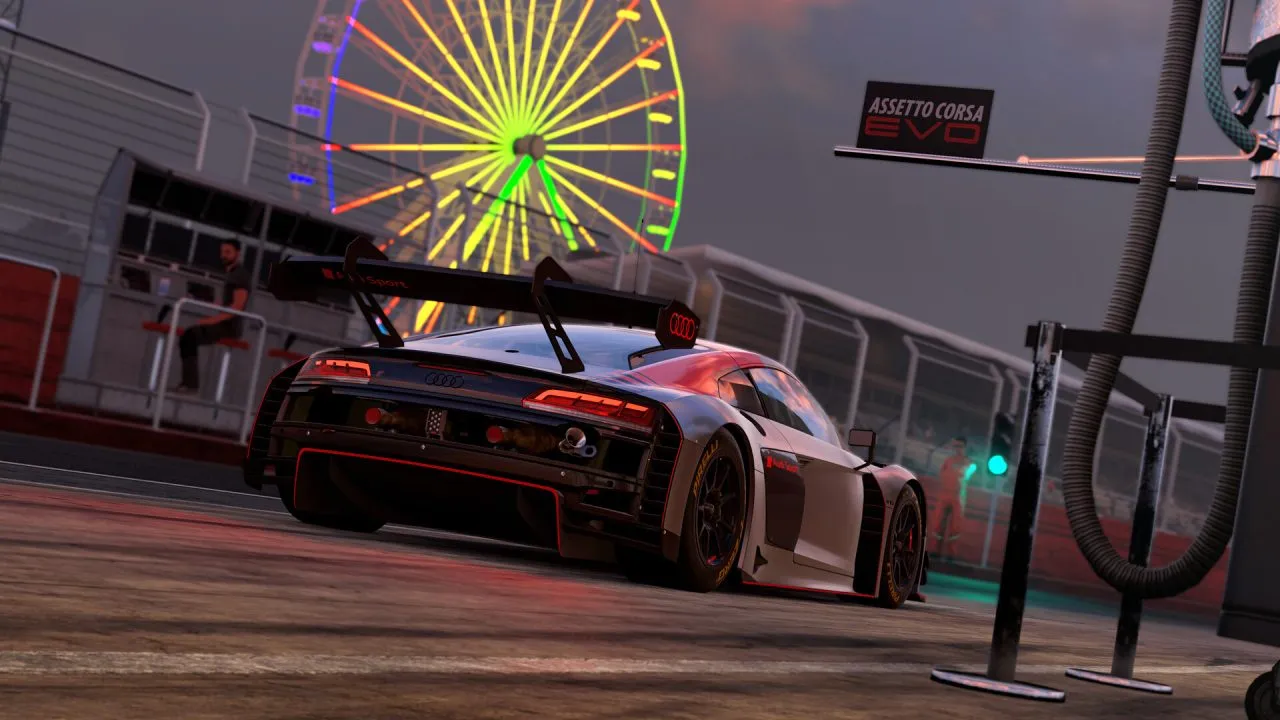

There is a very specific moment in Assetto Corsa EVO when you stop feeling like a driver and start feeling like a suspect. Not suspected of being slow we already knew that by turn two but suspected of having done something morally questionable with the brake pedal. You are driving a front-wheel-drive car, maybe a Hyundai i30N, maybe a Golf GTI, maybe a Mini with more personality than patience, and everything feels reasonable. The car turns in, the front end bites, the steering gives you a little confidence, and you naively think: “Alright, I’ve got this.”
Then you lift off the throttle.
Not dramatically. Not like you are ending a ten-year relationship. Just a small lift. Almost polite. And suddenly the rear of the car decides it wants independence. The car rotates, the world spins, your hands start doing things that were clearly never approved by the executive committee of your brain, and you end up facing the place you just came from with all the dignity of a shopping cart rolling downhill.
The first human reaction is to blame the game. That is natural. Healthy, even. Almost therapeutic. “This can’t be realistic,” we think. “A front-wheel-drive car shouldn’t oversteer like that.” And that sentence sounds convincing because, for years, we have been told that FWD cars understeer. They push wide. They go nose-first. They prefer going straight to becoming dramatic at the rear. But physics, unfortunately, never signed that agreement.
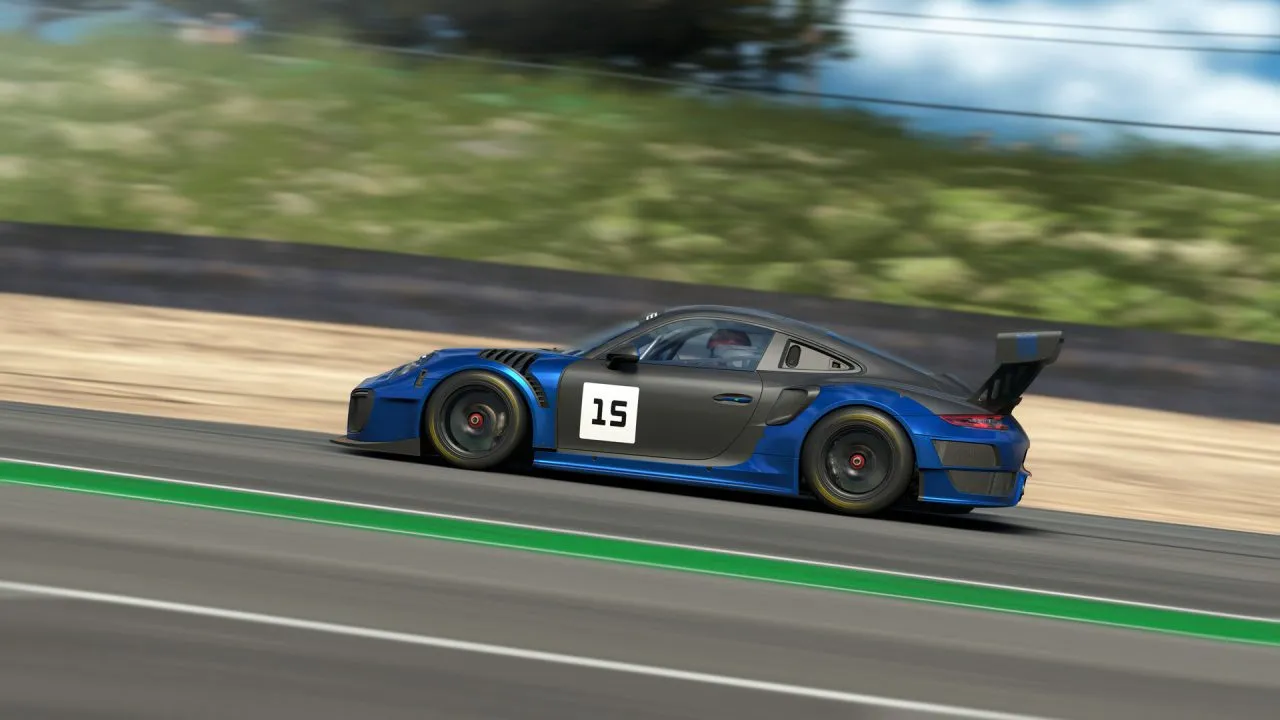
A front-wheel-drive car can oversteer. Not only can it oversteer, but in performance driving, you often want it to. The key is something as simple as it is cruel: weight transfer. When you brake or lift off the throttle while cornering, weight moves forward. The front tyres gain load, the rear axle becomes lighter, and if you are also asking the car to turn, the rear starts running out of authority. It is like a company meeting where the front axle gets the entire budget and the rear axle is told to make do with a folding chair and a cold coffee.
That is where lift-off oversteer appears. It is not a mystical bug in the physics engine or a practical joke from Kunos. It is the fairly logical result of asking a car to rotate while abruptly shifting its mass forward. In a FWD car, the front tyres already have too many jobs. They steer, brake, accelerate, and on top of that, they have to deal with our questionable decisions. If we ask them to do everything at once, sooner or later someone is going to resign.
What Assetto Corsa EVO seems to do and this is where the debate begins is remove some of the fantasy. Other simulators, or even habits inherited from older games, have taught us to expect a kind of invisible cushion. A little digital forgiveness. A polite safety margin that says: “You braked too late, turned too much, lifted at the wrong time, but fine, go ahead, I’m feeling generous today.” EVO seems to look at the same situation and reply: “Interesting. Now let’s see what happens in real life when you do that.”
And, of course, it hurts.
It hurts because many of us come from driving GT3 cars, rear-wheel-drive sports cars, cars with lots of aerodynamic grip, or machines that communicate the limit in a different way. We have built a very specific muscle memory: if the car oversteers, lift the throttle, countersteer, breathe, survive, and feel like a professional for three seconds. That reflex can work in certain cars, but in a front-wheel-drive car it can be exactly the recipe for making things worse. If the rear is already light and you lift even more, you are taking even more weight away from it. In other words, you see the rear stepping out and decide to help it leave with greater enthusiasm.
In a FWD car, the solution is often counterintuitive: maintain or reapply throttle to pull the car forward. This does not mean smashing the accelerator in every situation like a maniac. It means understanding that the front axle can drag the car back into stability. The throttle is not just a device for going faster; it is also a way to move weight, calm the rear and bring the car back into one shared direction. Put less technically: when the rear panics, the front has to act like the responsible adult.
The funny part or tragic, depending on the condition of your emotional safety rating is that modern hot hatches are not household appliances with spoilers. A Hyundai i30N or a sporty Golf GTI is built to be agile. These cars are not designed to simply go straight and safe like a taxi heading to the airport. They are meant to rotate, to turn in sharply, to let the driver play with the car’s mass. In real life, that liveliness is usually filtered through tyres, suspension, electronics and, most importantly, fear. Fear is a very underrated driver aid. In a simulator, we enter corners at speeds that would make us reconsider our life choices in the real world, brake with the subtlety of someone stepping on a cockroach, turn off assists because we are “purists”, and then act surprised when the car does not protect us like a mother.
This is one of the biggest misunderstandings: when we turn off stability control, traction control and modern assists, we are not driving “the normal car.” We are driving a stripped-down version, without a babysitter, without electronic management saving us from ourselves. In real life, many modern cars correct small acts of stupidity before they become headlines. In the simulator, if you decide to switch off those safety nets, the car looks at you and says: “Perfect. Then this is between you and Newton.”
And Newton rarely loses.
That said, blaming the driver for everything would be too easy. Assetto Corsa EVO also has to deal with a massive limitation: the absence of the body. In a real car, you feel the rear through your back, your hips, your stomach, through that internal system that cannot explain equations but absolutely knows how to say: “This is getting weird.” At home, however, you have a screen, a wheel, pedals and maybe a chair that moves slightly if your floor is bad. You are missing the famous seat-of-the-pants feeling, that physical information that arrives before your eyes understand the problem.
That is why many people feel the car goes without warning. Maybe it did warn you, but it warned you through a channel your body did not have access to. Force feedback can communicate many things, especially through the front axle, but if the rear of a FWD car is the part losing grip, the wheel will not always scream at you in time. In a rear-wheel-drive car, you may feel the driven axle load and unload differently. In a FWD car, the steering is busy telling you what is happening at the front, while the rear is quietly organizing a small revolution.
That sensory disconnection turns small reactions into huge corrections. You see the rotation late, steer too much, lift or apply throttle badly, and the car goes from a recoverable slide to a choreography of shame. It is not necessarily that the physics model is exaggerating; it is that you are driving with fewer senses than you think. It is like trying to dance salsa while hearing only half the music and then blaming the floor when you step on your partner’s foot.
Setups matter too. In EVO, changing the setup without understanding it may no longer cost you just two tenths. It can become an invitation to disaster. Lowering the car too much, stiffening it without a plan, using absurd tyre pressures or copying settings from another simulator can make the chassis work against you. If the suspension bottoms out under braking, if the rear is too free, if the brake balance does not suit the car, or if the car lacks enough stability in cornering, oversteer does not appear because the game is being dramatic. It appears because you built a trap and then drove into it wearing a helmet.

The solution starts with less ego and more listening. Brake straighter. Release the brake progressively. Do not lift off mid-corner as if there is a snake hiding under the throttle pedal. Understand that trail braking is a delicate tool, not an excuse for arriving late everywhere. Above all, accept that a fast FWD car is not mastered by fighting it, but by learning when to let it rotate and when to pull it forward again.
Assetto Corsa EVO does not seem to turn front-wheel-drive cars into impossible machines. It seems to remove their makeup. It shows us that these cars can be playful, nervous, sensitive and, if treated badly, quite vengeful. The controversy exists because we expected the simulator to confirm our habits, and instead it handed us a mirror. An uncomfortable mirror, with good resolution and very little mercy.
In the end, maybe the question is not whether FWD oversteer is exaggerated. Maybe the real question is whether we were ready for a simulator that forgives less. Because when the Hyundai snaps, when the Golf goes light, when the Mini decides the corner was optional, it is easy to shout: “Broken physics!” It is much harder to admit: “I treated a front-wheel-drive car like it was something else.”
And that is the beauty of it. Assetto Corsa EVO does not always feel friendly, but it does feel honest. Sometimes too honest, like that friend who tells you your new haircut is not doing you any favours. It can hurt, it can annoy you, it can make you restart the lap with the expression of a man attending a funeral. But once you start to understand it, once you stop fighting the car and start reading it, something rather beautiful happens: the FWD no longer feels possessed. It starts to feel alive.
It does not hate you. It is not broken. It does not want to humiliate you, although sometimes it does so with worrying efficiency.
It is simply telling you, corner after corner, that physics does not accept excuses. And that the right pedal, used at the right moment, can be less of an accelerator and more of a rope a rope to bring home a rear end that got a little too excited.
You can purchase Assetto Corsa EVO from our links for about 20 euros:
This website uses affiliate links which may earn a commission at no additional cost to you.