
There is an idea circulating around Assetto Corsa EVO that, honestly, makes a lot of sense: ranked multiplayer needs a license structure.
Not because every online race needs to feel like an air traffic controller exam, complete with forms, stamps, and someone peering at you over their glasses. No. The idea is simpler than that: if you are going to put twenty people on track, each with their wheel, their nerves, their ego, and their slight tendency to believe that “the gap was there,” perhaps some kind of order is in order.
And that is where the proposal to create a license progression comes in. Something that takes you from modest cars to more serious machines. From friendly hot hatches to GT3s, prototypes, or Formula 1. On paper it sounds perfect. In practice, the danger is obvious: Assetto Corsa EVO can benefit from a license system, but it should not become a copy of iRacing with an Italian accent. Because Assetto Corsa has always been something else.
A license system can be fantastic if it helps the player understand the path. You start with accessible cars, learn to race cleanly, build your reputation, and unlock more demanding categories. It is a logical progression. Almost natural. The problem appears when that ladder turns into a cage. If the system tells you: “first you do this, then this, then that, and until you pass the moral exam of not touching a barrier for three weeks you cannot try something faster,” then we are no longer talking about progression. We are talking about bureaucracy with tyres. And Assetto Corsa EVO should not feel like that.
The license should guide, not punish. It should open paths, not close them. The player has to feel they are growing, not that they are asking permission to have fun. Because, let us be honest, part of the charm of Assetto Corsa has always been that touch of slightly dangerous freedom. That feeling of jumping in, picking a car you do not fully understand, heading to a track you have not mastered either, and thinking: “well, what could go wrong?” Spoiler: everything. But that is also where the magic lives.
Copying iRacing Would Be Easy. Understanding Assetto Corsa Is Harder
iRacing arguably has the most recognizable competitive system in sim racing. Licenses, Safety Rating, iRating, progression, categories, seasons. It works because the entire game is built around that structure. It is an ecosystem. A university of competitive suffering. You pay tuition, materials, courses, and in the end you might just learn not to die at turn one.
But Assetto Corsa EVO comes from a different tradition. It is not just a racing simulator. Above all, it is a driving simulator. And that difference matters enormously. In other titles, the main question is usually: “what championship am I going to compete in?” In Assetto Corsa, the question is often more intimate, more absurd, and more beautiful: “what will it feel like to push this car to its limit?”
A Golf GTI. A Mini. An Abarth. A GR86. An MX-5. A Cayman. A Ferrari. A prototype. An F1 car. Everything fits, but not everything fits the same way. That is why copying the iRacing model without adapting it would be a mistake. Because iRacing revolves around organized competition. Assetto Corsa EVO should revolve around something broader: the relationship between the driver, the car, and the track.
Yes, that sounds intense. But then again, we are talking about people who argue for forty minutes about whether a car understeers 3 percent more than it should in third gear. Intensity comes standard here.
One of the most interesting aspects is the possibility of separating licenses between road cars and competition cars. At first glance it makes sense. On one side, road cars: sports cars, light sports, hot hatches, supercars, and hypercars. On the other, competition cars: MX-5 Cup, GT4, GT3, single-seaters, prototypes, F1. The problem is that, if not designed carefully, the community will do what it always does: head straight for the fastest, most famous, and most “serious” option. That is to say, GT3. Because in sim racing, GT3 is like a classic dish at a family dinner. It always shows up. Sometimes it probably should not, but it shows up. And when it does, everyone has an opinion.
The risk is that a Road Cars license ends up being seen as “the formality before reaching the good stuff.” And that would be a tremendous shame, because that is precisely where Assetto Corsa EVO could differentiate itself. Other simulators already cover pure competition very well. GT3, prototypes, single-seaters, official championships. But few have such a clear opportunity to make road cars genuinely matter.
A well-designed ranked mode with road cars could be Assetto Corsa EVO’s defining competitive identity.
Not as filler. Not as a tutorial. Not as the kiddie zone before you get on the big rollercoaster. But as a discipline in its own right.
Slow Cars Are Not Boring. You Are Boring
This needs to be said with kindness: a lot of people believe a race is only exciting if the car has wings, slicks, advanced telemetry, and a name that looks like a Wi-Fi password. But the best online races often do not happen in the fastest cars. They happen in the cars that force you to fight for every metre.
A well-driven hot hatch can produce spectacular racing. An MX-5 can teach you more about lines, patience, and respect than a GT3 in the hands of someone who treats ABS as a religion. A Toyota GR86 can turn an ordinary braking zone into a psychological duel. An Alpine A110 or a Honda S2000 can make a medium-speed corner feel like a conversation between you, the car, and your poor decisions.
Modest cars are perfect for learning racecraft.
They do not hide you behind aerodynamics. They do not forgive as much. They do not turn every mistake into a trip to the moon. They teach you to maintain speed, position the car, and overtake without turning your rival into roadside furniture. And they have something fundamental: they are relatable. Not everyone has driven a GT3. Surprising, I know. But many people understand what a sporty compact is, a lightweight rear-wheel-drive, or a road car pushed to its limits. That emotional connection could be pure gold for Assetto Corsa EVO.
Here is the key: if Kunos or any community-driven system designs a ranked progression, the road car branch should not sit below the competition branch. It should sit beside it.
It would not be:
- Hot hatch > MX-5 > GT4 > GT3 > prototype > F1
That is too linear. Too predictable. Too much “level up until you reach the final boss.”
It could be something more interesting:
- Hot hatch > light sports > track day cars > supercars > hypercars
And in parallel:
- MX-5 Cup > GT4 > GT3 > prototypes
And also:
- Junior single-seaters > regional single-seaters > advanced single-seaters > F1
That way each branch would have its own personality. The player would not feel that road cars are the corridor to walk through before reaching what matters. They would feel like a different way to compete. Because driving a road hypercar around the Nordschleife is no less serious than racing a GT3 at Spa. It is a different kind of madness. A more elegant one, perhaps. One where the car seems to say: “I can do this, but I am not sure you can.” And it is right.
The Safety Rating Should Not Be a Bouncer
The Safety Rating is necessary. Nobody wants to enter an online race and discover that the driver behind them treats braking as poetic suggestion. But there is an enormous difference between using the Safety Rating as a filter and using it as a wall. The Safety Rating should protect race quality, not hold content hostage. If someone has a history of contact, off-track excursions, and kamikaze attacks, it makes sense that they cannot jump straight into more delicate categories. Not to humiliate them, but because a fast single-seater in the hands of someone with no self-control is basically a blender with a sponsor logo.
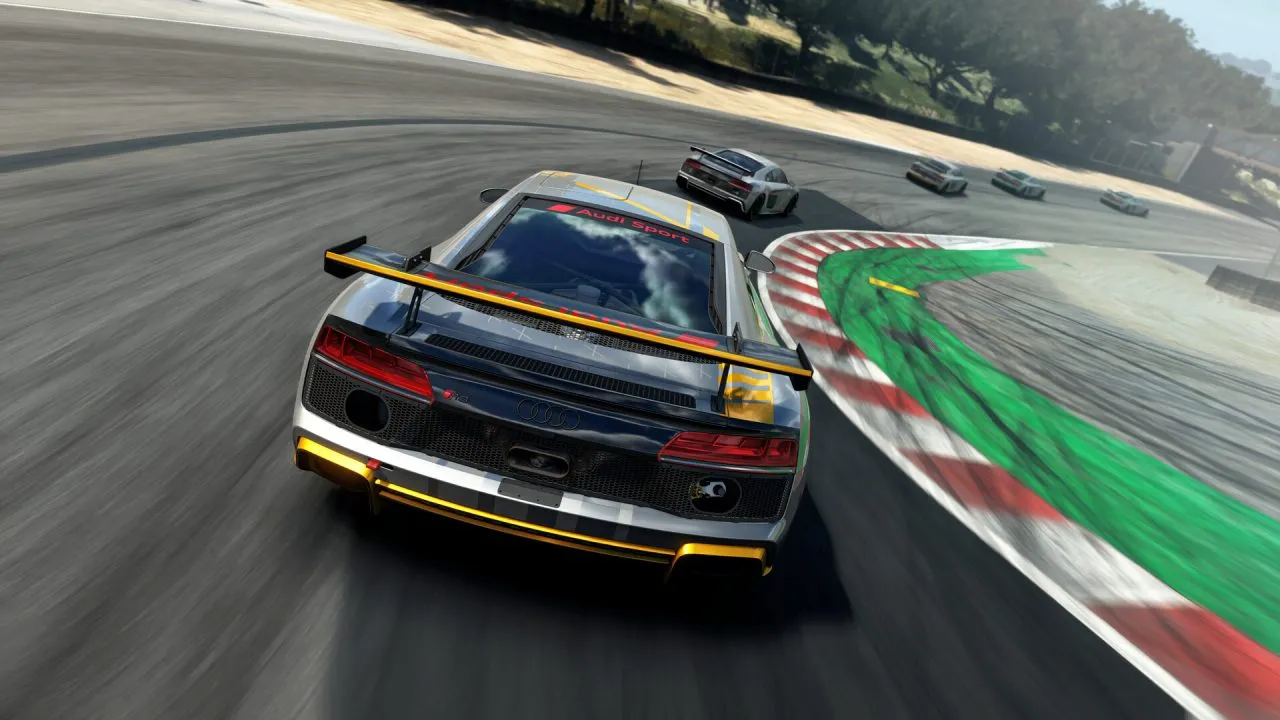
But the system should also avoid penalizing too harshly the player who is simply learning. In sim racing we have all had that moment where you misjudge a braking point, clip someone, and suddenly find yourself staring at the screen with the look of someone who has just run over the sport’s core values. The key is in distinguishing between a mistake, repeated clumsiness, and pointlessly aggressive driving.
A good license system should not only say: “you have been bad.” It should say: “here is what you need to improve.”
Clean laps. Braking control. Safe re-entries. Consistency. Respect in the opening lap. Those things matter far more than simply adding or subtracting numbers.
The Ideal Progression Should Feel Like an Academy, Not an Office
The original idea proposed that players go through an academy before entering ranked. That concept has enormous potential.
But, again, it all depends on execution.
A boring academy would be a tutorial with cones, long text blocks, and a voice saying “brake before the corner.” Thank you, professor. Never would have occurred to me.
A good academy would be something else entirely. It would be an introduction to the language of Assetto Corsa EVO.
It would teach you that a front-wheel-drive car is not driven the same way as a rear-wheel-drive. That a road car does not tolerate the same abuse as a GT3. That overtaking is not about sticking your nose in and praying. That defending position does not mean parking at the apex. That surviving the first corner already counts as contemporary art.
The academy should prepare the player to enjoy the game better, not just to unlock races.
That is where the system can be genuinely human. It is not about dividing the community into “good” and “bad.” It is about creating a path so that more people can compete without turning every race into a deleted scene from Mad Max.
Assetto Corsa EVO Needs Structure, But Also Soul
The easiest thing would be to make a list of classes, assign license numbers, and call it done.
- License 1: slow cars.
- License 2: less slow cars.
- License 3: serious cars.
- License 4: cars that cost more than your building.
- License 5: cars you should not touch even in your dreams.
It works, yes. But it would feel very un-Assetto Corsa. The ideal structure should respect the variety of the game. Not just order cars by speed, but by experience. Because competing in a Golf GTI is not the same as a Ferrari 296. An MX-5 Cup is not the same as a GT3. Surviving a single-seater is not the same as taming a road hypercar.

Each category tells a different story. And there lies the most important point: Assetto Corsa EVO does not need to copy anyone else’s ladder. It needs to build its own map. A map where road cars carry prestige. Where light sports are not a formality. Where GT3s do not absorb all the attention like that friend who always turns any conversation into a story about himself. Where single-seaters and prototypes are aspirational, yes, but not the only possible destination.
A linear system has one advantage: it is easy to understand. You start at the bottom and climb. Like in a classic video game. Like at work, but with more fuel and fewer meetings. But Assetto Corsa EVO has material for something richer.
It could have a progression where the player does not just climb, but chooses an identity. The one who loves road cars. The one who wants GT racing. The one who prefers single-seaters. The one who lives at the Nurburgring and probably needs to hydrate more. The one who just wants clean races in small cars because they have found inner peace in a battle between compacts. That would be far more interesting than funneling everyone toward the same endpoint.
Progression should not be a motorway. It should be a road network.
Some routes fast. Others technical. Others absurdly dangerous. But all of them with purpose.
You can purchase Assetto Corsa EVO from our links for about 20 euros:
See you on the track!
This website uses affiliate links which may earn a commission at no additional cost to you.