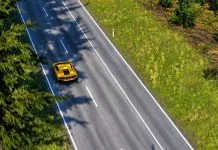

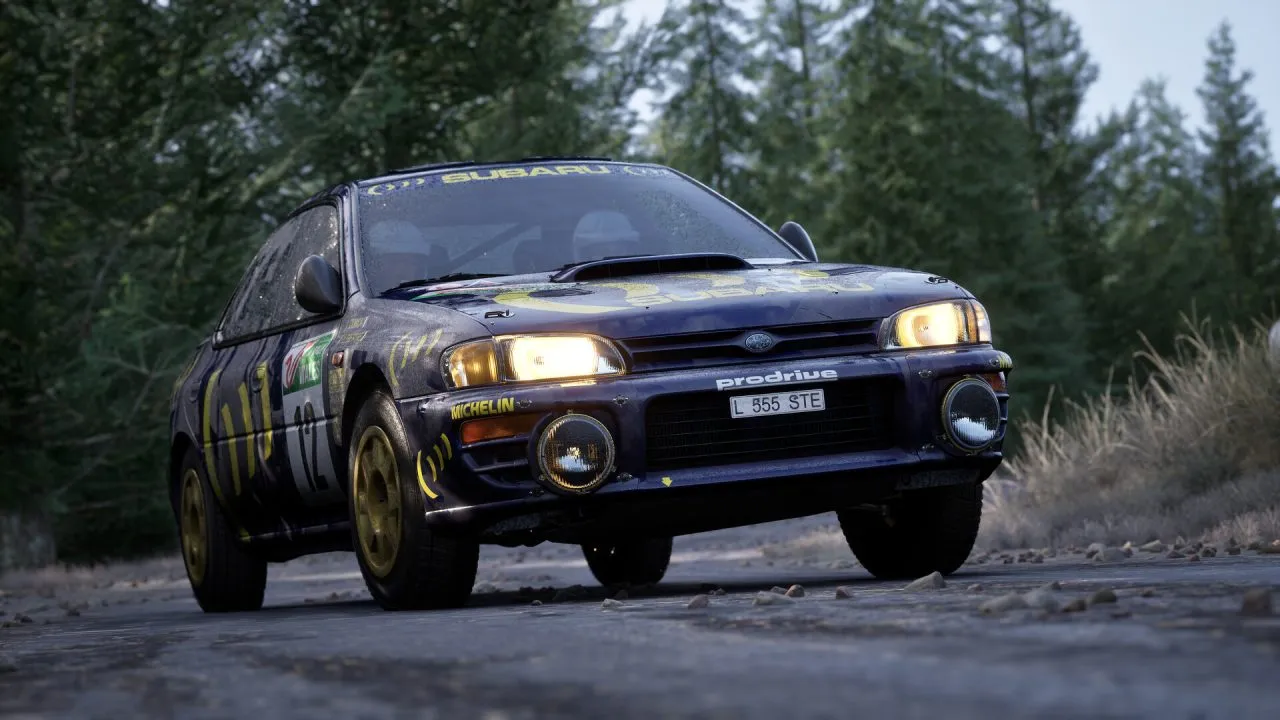

The Subaru Impreza S3 Group A is one of the most demanding cars in Assetto Corsa Rally v0.4. Its all-wheel drive, front boxer engine, and low center of gravity give it a very stable foundation, but also a clear tendency toward understeer, especially on corner entry and exit. To make it competitive, the setup must always pursue the same goal: getting the car to rotate without destroying traction.
Version 0.4 significantly changes how the car is configured. The new grip curve is less forgiving when the tyre saturates, snow introduces an experimental deformation component, and the thermal tyre model remains limited. This means setup must prioritize immediate performance, contact patch stability, and rotation capacity.
Below are three complete reference configurations: a Gravel Base setup, a Snow Safe setup, and a Tarmac Attack setup.
1. Gravel Base Setup
For Wales, wet dirt, broken gravel, and stages with crests
Gravel is the Impreza S3’s natural terrain. Here the car needs suspension travel, absorption capacity, and a rear end lively enough to help it rotate. The goal is not to make it stiff or precise like a circuit car, but to let the wheels follow the ground and allow the rear differential to help rotate the car with throttle.
| Area | Recommended Setting |
|---|---|
| Ride Height | High |
| Springs | Soft, with rear slightly firmer |
| Front ARB | Soft |
| Rear ARB | Medium or medium-stiff |
| Fast Bump | Soft |
| Fast Rebound | Medium |
| Slow Bump/Rebound | Medium |
| Front Toe | Aggressive toe-out |
| Rear Toe | Slight toe-in |
| Front Differential | Low power lock |
| Centre Differential | Slightly rear-biased |
| Rear Differential | High power, medium coast |
| Brake Bias | Slightly rearward, not exaggerated |
Technical explanation
- Ride height must be high because in gravel the main enemy is bottoming out. If the car strikes the ground on a compression or landing, steering response is lost instantly. The suspension must have enough travel to absorb ruts, rocks, crests, and bumps.
- Springs must be soft so the wheel stays in contact with the ground. However, it is worth stiffening the rear axle slightly relative to the front. This helps the rear lighten on corner entry and allows the car to rotate, compensating for the Impreza’s natural understeer.
- The front anti-roll bar must be soft to give independence to the front axle. If it is too stiff, the car will push through the nose. The rear can run somewhat stiffer to help close the line mid-corner.
- On damping, fast bump must be low. This allows the wheel to rise quickly when it hits a bump without launching the chassis upward. Fast rebound must be medium: enough to manage landings, but not so stiff that it prevents the wheel from returning to the ground.
- Geometry must be aggressive. Front toe-out significantly improves initial steering response, which is essential in an AWD car prone to understeer. At the rear, a touch of toe-in stabilizes the car when power is applied.
- On differentials, the front diff should be relatively open under acceleration to avoid understeer on throttle. The rear diff, however, can carry more power lock so both wheels push and help the car slide in a controlled way. The centre diff should favor the rear slightly, with a feel close to 40/60, so the car does not become a plough when accelerating.
2. Snow Safe Setup
For snow, ice, winter Wales, and Alsace
Snow in ACR v0.4 demands a different approach. Grip drops dramatically and traction loss is less progressive. The car must be more docile, more predictable, and less aggressive. Here the goal is not the fastest single perfect lap, but a setup capable of surviving the stage without spins or lockups.
| Area | Recommended Setting |
|---|---|
| Ride Height | High or very high |
| Springs | Soft |
| Front ARB | Very soft |
| Rear ARB | Soft |
| Fast Bump | Very soft |
| Fast Rebound | Soft-medium |
| Slow Bump/Rebound | Soft-medium |
| Front Toe | Moderate toe-out |
| Rear Toe | Moderate toe-in |
| Front Differential | Low-medium |
| Centre Differential | More stable, not excessively rear-biased |
| Rear Differential | Medium power, high coast |
| Preload | Higher than on gravel |
| Brake Bias | Close to neutral |
| Rear Wing | Slightly higher if the stage is fast |
Technical explanation
- On snow, any abrupt weight transfer can saturate the tyre. This is why anti-roll bars must be soft on both axles. An overly stiff ARB creates sudden traction loss because it prevents the car from transferring weight progressively.
- Suspension must be soft, but not uncontrolled. The car needs to sink, settle, and find grip in the deformable snow. Version 0.4 simulates part of that grip through an experimental deformation component: the tyre needs to bite into the snow, not bounce off it.
- Front toe should be less aggressive than on gravel. Too much toe-out would make the car nervous on straights and overly sensitive to small steering inputs. More toe-in at the rear helps stabilize the rear end under braking and acceleration.
- The key lies in the differentials. On snow, the greatest danger is lift-off oversteer: releasing the throttle transfers weight forward and the rear snaps away suddenly. To prevent this, the rear differential needs more coast lock and more preload. This keeps the rear axle more cohesive under engine braking and reduces the tendency to spin.
- Brake bias should approach a neutral distribution. Too far forward and the front wheels lock, making the car behave like a sled. Too far rearward and the rear steps out on every braking zone. Braking on snow must be progressive and very well modulated.
This setup is less aggressive than the gravel one, but far safer. It allows confident attacking, especially on long stages where a single mistake ruins an entire special.
3. Tarmac Attack Setup
For dry Alsace, clean asphalt, and precise driving
Tarmac is the most problematic surface for the Impreza S3. With a soft gravel setup, the car suffers what is known as the SUV effect: it rolls excessively, pitches, lifts inner wheels, and loses precision. To make it fast on tarmac, the car must be transformed entirely.
| Area | Recommended Setting |
|---|---|
| Ride Height | Low, at the functional minimum |
| Springs | Much stiffer than on gravel |
| Front ARB | Medium-stiff |
| Rear ARB | Stiff, but manageable |
| Fast Bump | Medium |
| Fast Rebound | Medium-high |
| Slow Bump | High |
| Slow Rebound | High |
| Front Camber | More negative |
| Front Toe | Light to moderate toe-out |
| Rear Toe | Slight toe-in |
| Front Differential | Medium-low |
| Centre Differential | More neutral or slightly front-biased |
| Rear Differential | Medium-high power |
| Brake Bias | Slightly more forward than on gravel |
| Rear Wing | More downforce if fast corners are present |
Technical explanation
- On tarmac, priorities change entirely. The suspension no longer needs to absorb large impacts; instead, the car must keep its body under control and the tyres flat on the ground.
- Ride height must be lowered as much as possible without the car touching the ground in compressions. This reduces the center of gravity and limits roll. Springs must be stiffened considerably compared to the gravel setup to prevent the car from diving under braking or leaning through sustained corners.
- Anti-roll bars must also be stiffened. The front cannot be as soft as on gravel, because tarmac generates far more lateral grip and the car needs a stable platform. The rear can be firm to help rotation, but overdoing it will introduce sudden oversteer in fast corners.
- Slow damping is critical. Slow bump and slow rebound must be high to manage the weight transfers caused by braking, throttle, and steering. On tarmac, time is gained through precision, not sliding.
- Geometry can use more negative front camber, since v0.4’s limited thermal model allows prioritizing maximum grip without worrying too much about wear or overheating. Front toe-out should be less than on gravel: enough to improve corner entry, but not so much as to make the car nervous at high speed.
- On differentials, the car must be less of a drifter and more of a tractor. An excessively rear-biased centre split can feel entertaining but is not necessarily fast. On tarmac a more neutral or slightly front-biased distribution is better for clean traction on corner exit. The front diff must not lock too much, as this would cause understeer under power.
- Brake bias can go slightly more forward than on gravel or snow. On tarmac there is more grip and harder braking is possible, but without locking the front axle. Trail-braking remains useful for rotating the car into corners, though it must be applied with greater precision.
Quick Comparison of the Three Setups
| Parameter | Gravel Base | Snow Safe | Tarmac Attack |
|---|---|---|---|
| Ride Height | High | Very high | Low |
| Springs | Soft | Very soft | Stiff |
| Front ARB | Soft | Very soft | Medium-stiff |
| Rear ARB | Medium-stiff | Soft | Stiff |
| Fast Bump | Soft | Very soft | Medium |
| Slow Damping | Medium | Soft-medium | High |
| Front Toe | Aggressive | Moderate | Light-moderate |
| Rear Toe | Slight toe-in | More toe-in | Slight toe-in |
| Front Diff | Low power | Low-medium | Medium-low |
| Rear Diff Power | High | Medium | Medium-high |
| Rear Diff Coast | Medium | High | Medium |
| Preload | Medium | High | Medium |
| Brake Bias | Slightly rearward | Neutral | Slightly forward |
| Style | Rotation and absorption | Safety and control | Precision and planted feel |
The best setup for the Subaru Impreza S3 is not a single one. It is a family of configurations adapted to each surface.
- On gravel, the car needs to breathe: high ride height, soft suspension, toe-out, and an active rear differential.
- On snow, it needs to survive: softness, stability, more coast lock, and more preload.
- On tarmac, it needs to transform: lower, stiffer, roll controlled, and unnecessary sliding reduced.
The key is understanding that the Impreza S3 is not configured to eliminate its character, but to exploit it. Its natural understeer tendency is countered with geometry, rear suspension, and differentials. Its all-wheel drive becomes an advantage only when the front axle is free to turn and the rear is helping to push.
Well set up, the Subaru stops being a heavy AWD that pushes through the nose and becomes a precise, aggressive, and tremendously effective machine on any surface in Assetto Corsa Rally v0.4.
You can buy the game through our affiliate link at a reduced price:
See you on the track!
This website uses affiliate links which may earn a commission at no additional cost to you.