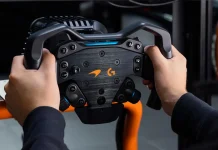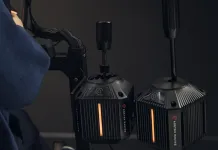

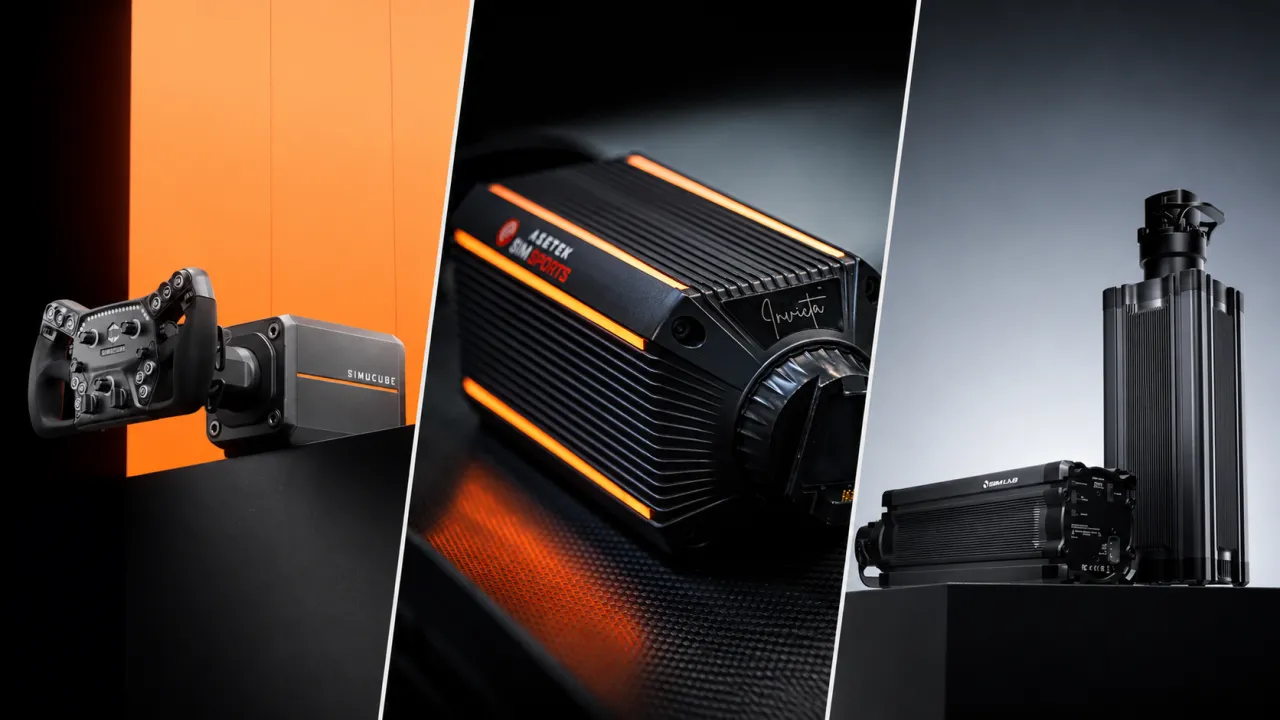

Three high-end direct drive bases, roughly the same money, three completely different philosophies. One ships today, one ships in October, and one is cheaper than both. Here is how they actually compare.
Sim-Lab opened pre-orders for the DDS TorqueSync on 1 August, and in doing so dropped a 26 Nm base at 1,499 euros into the most contested price bracket in sim racing. That figure lands almost exactly on the Simucube 3 Pro and sits above the Asetek Invicta, which means anyone with roughly 1,400 euros to spend now has a genuinely difficult decision.
These three are not variations on the same product. They disagree about power delivery, about encoders, about whether you should be allowed to bolt on someone else’s steering wheel, and about how long they will stand behind the thing. Let’s go through it properly.
The numbers, side by side
| Sim-Lab DDS26 | Simucube 3 Pro | Asetek Invicta | |
|---|---|---|---|
| Peak torque | 26 Nm sustained | 25 Nm peak | 27 Nm peak and holding |
| Price | €1,499 / $1,499 | $1,599 excl. tax | $1,349 excl. VAT |
| Real cost | QR included at launch | + Link Hub, approx. €180 | QR included |
| Encoder | 24-bit, approx. 16.7M counts | 23-bit, 8M steps | 22-bit, 4,194,304 steps |
| Power supply | Integrated 1,500 W, 350 VDC bus | External, control box included | External 400 W |
| Slew rate | Not published, 100 kHz torque loop | Not published | 9.4 Nm/ms |
| Weight | 11.1 kg | Not published for the Pro | 11.3 kg |
| Length | 380 mm housing | Not published for the Pro | 327 mm incl. QR |
| Third-party wheels | Open, Ø70 mm M5, USB passthrough | Lightbridge, no USB passthrough | QR adapter, 5-port USB-C hub |
| Warranty | 4 years | 3 years | 2 years |
| Availability | Ships late October 2026 | Available now | In stock |
| iRacing 360 Hz | Not at launch, promised by firmware | Supported, irFFB commonly used | Supported via RaceHub |
Two notes on reading that table. Simucube does not publish weight and dimensions for the Pro specifically, so those cells are blank rather than guessed at from the Sport figures. And the real cost row is the one to pay attention to, because it changes the ranking entirely.
Power delivery is the real dividing line
Ignore the torque figures for a moment. They are within two Newton-metres of each other and nobody drives at the ceiling anyway. The interesting divergence is in how each base delivers that torque.
Sim-Lab has gone somewhere nobody else in consumer sim racing has gone: a 350 volt internal bus, against the 48 V that almost everything else uses. Current makes torque, but voltage determines how fast you can change it. With more headroom above the motor’s back-EMF, torque stays available across a wider speed range and transitions get sharper. You notice that in exactly three places: catching a snap, hitting a kerb, and recentring after a save.
The cost of that decision is a power supply too big for a floor brick, so it lives inside the housing. One mains cable, no brick, fewer failure points, and 11.1 kg of base.
Asetek takes the conventional route with an external 400 W supply, but backs it with a genuinely fast 9.4 Nm/ms slew rate and the highest peak torque of the three. Simucube’s answer is architectural rather than electrical: every unit is laser-scanned into a digital twin inside the firmware, and the control algorithm was rewritten from scratch for the 3 series.
If you want the background on why any of this matters before comparing spec sheets, our explainer on why direct drive became the standard is the place to start.
The encoder question, and why it matters less than you think
On paper there is a clean hierarchy. Sim-Lab’s 24-bit encoder resolves roughly 16.7 million positions per revolution, Simucube’s 23-bit manages 8 million, and Asetek’s 22-bit delivers 4.19 million, or 0.000085 degrees.
Four times the resolution sounds decisive. In practice, all three are far beyond what a human wrist can perceive, and the encoder is only one input into a control loop. What actually separates them is how the loop uses that data. Sim-Lab claims TorqueSync runs over 100,000 updates per second on a multi-core DSP. Simucube’s Link Hub polls device status tens of thousands of times per second.
Treat encoder bits as a proxy for engineering seriousness, not as something you will feel on corner exit.
Hidden costs, which is where the real gap opens
This is the section that changes the ranking, and it is the one most comparisons skip.
- The Asetek Invicta arrives with its quick release in the box and a five-port USB-C hub built in, so your pedals and button boxes plug straight into the base. At 1,349 dollars it is the cheapest of the three before you add anything.
- The Simucube 3 Pro requires a Simucube Link Hub to talk to your PC, and it is not included. Budget roughly 180 euros on top. That pushes the real-world figure closer to 1,650 euros, which is the number you should be comparing, not the sticker price.
- The Sim-Lab DDS26 includes the Xero-Play Quick Release V2 with the launch Founders Edition run, which Sim-Lab normally sells separately. That is a meaningful chunk off the effective price, but only while the first batch lasts. You may still need a front or side mount bracket depending on your rig, and extra wheel-side adapters if you run multiple rims.
Whose wheels can you actually use?
Three different answers, and this may matter more to you than any torque figure.
- Sim-Lab is the most open. A Ø70 mm M5 bolt pattern, any third-party wheel, and full USB 2.0 data passthrough to the PC, with a dedicated 5 V rail delivering 2,500 mA for rims loaded with displays and encoders. That is five times what a standard USB port provides.
- Asetek sits in the middle. The Invicta quick release adapter lets you mount any wheel with a standard hole pattern, and the brand has partnered with several wheel makers who fit the Asetek QR at the factory. If you want to keep your options open, the Invicta quick release adapter is the part that unlocks it.
- Simucube is the most closed, deliberately. The Lightbridge system passes power and data contactlessly through the Link quick release, and there is no USB passthrough. In exchange you get a growing list of native partners, including the BavarianSimTec Delta Pro SC, with Ascher, GSI, Delta Sim Tech, P1sim and SimCore all in the ecosystem. Elegant if you buy in, restrictive if you already own wheels you love.
Warranty and track record
The warranty ladder runs in the opposite direction to the reputation ladder, which is the awkward part.
Sim-Lab offers four years, Simucube three, and Asetek two. Sim-Lab also makes the slipring user-replaceable from the front in about ten minutes, which means a wear part does not become an RMA and a 13 kg shipment across a continent.
But Sim-Lab has no track record with motors. This is their first, built in Italy with SOLO Motorcontrollers at an ISO-certified facility carrying TÜV SÜD approval, which is about as de-risked as a debut gets, and still a debut. Simucube has years of firmware iteration behind it, although the 3 series had a rocky start that was only fully resolved through firmware and hardware revisions by mid-2026. Asetek has an established RMA pipeline and manufactures in Denmark.
Longest warranty, least history. Shortest warranty, most history. Pick your risk.
Software and the iRacing question
If you race iRacing, read this bit twice.
Sim-Lab’s RaceDirector software includes a telemetry FFB view that overlays the incoming simulator signal against the motor’s actual torque output, which is a genuinely useful way to tune by data rather than by feel. But iRacing’s 360 Hz FFB mode is not in the day-one build. Sim-Lab says the control stack supports it and it will arrive by firmware update. It is not there yet.
Simucube 3 also needs working around iRacing’s 60 Hz feedback rate quirk, typically with irFFB or 360 Hz mode. Asetek’s RaceHub handles torque, force feedback tuning and profiles across the whole Asetek ecosystem, which is the tidiest option if you also run their pedals.
So which one should you buy?
Buy the Asetek Invicta if you want the most base for the least money, today. It is the cheapest of the three, has the highest peak torque, includes the quick release, and ships now. The two-year warranty is the weak point, and the 22-bit encoder is the lowest number here, though not in any way you will feel. Pair it with Invicta pedals and the ecosystem argument gets stronger. If 27 Nm is more than you need, the Forte at 18 Nm saves you a chunk without changing the experience much.
Buy the Simucube 3 Pro if you are building a Simucube rig for the long haul. The platform integration is the value proposition. If you already own or plan to own Simucube ActivePedals, the Link Hub stops being an annoying extra box and becomes the spine of your setup. Just do the maths with the Link Hub included, not without it. Our Simucube 3 Pro breakdown and the Ultimate entry cover the range in detail. If your budget is tighter, the 3 Sport at 15 Nm runs identical firmware with less headroom.
Pre-order the Sim-Lab DDS26 if you can wait until September and you value openness. The four-year warranty, the replaceable slipring, the USB passthrough for third-party rims and the integrated PSU add up to the most thoughtful total-cost-of-ownership package of the three. The deposit is refundable, which removes most of the downside. The catch is the wait, the missing iRacing 360 Hz mode, and the fact that nobody outside Sim-Lab has driven a production unit. Full specs and pre-order details are in our DDS TorqueSync launch coverage, and you can reserve a Founders Edition directly.
If you are upgrading from an entry-level base, any of these three will feel transformative and you will stop noticing the differences within a month. The gap between a 5 Nm belt drive and any of these is enormous. The gap between them is a matter of preference and ecosystem.
What will actually make you faster is pedals. If your brake is a potentiometer or a soft load cell, spend 400 euros there before you spend 1,500 here. Our guide to active pedals covers the top end, and the 2026 hardware overview puts the whole category in order.
One timing note before you commit. Gamescom runs from 26 to 30 August and SimRacing Expo Frankfurt follows in October, which is historically when this segment moves. Nothing suggests any of these three is about to be replaced, but if you are not in a hurry, the end of August will tell you more than the start of it. Everything currently discounted is in our August deals roundup.
See you on the track!
This website uses affiliate links which may earn a commission at no additional cost to you.