

For more than twenty years, Richard Burns Rally has held an almost sacred place in rally simulation. Its visuals belong to another era, its interface demands patience, and its ecosystem relies heavily on the community, but its physics model, especially with the NGP evolutions and in particular NGP7, is still considered by many virtual drivers to be the absolute reference point when it comes to vehicle dynamics on dirt.
The arrival of Assetto Corsa Rally v0.5 changes the tone of the conversation. This update doesn’t just add content, stages, or multiplayer features. Its importance lies in something deeper: a substantial revision of how the simulator interprets the relationship between tire, suspension, vehicle mass, and loose surface. In other words, ACR v0.5 doesn’t just want to look like rally; it wants to start behaving like rally.
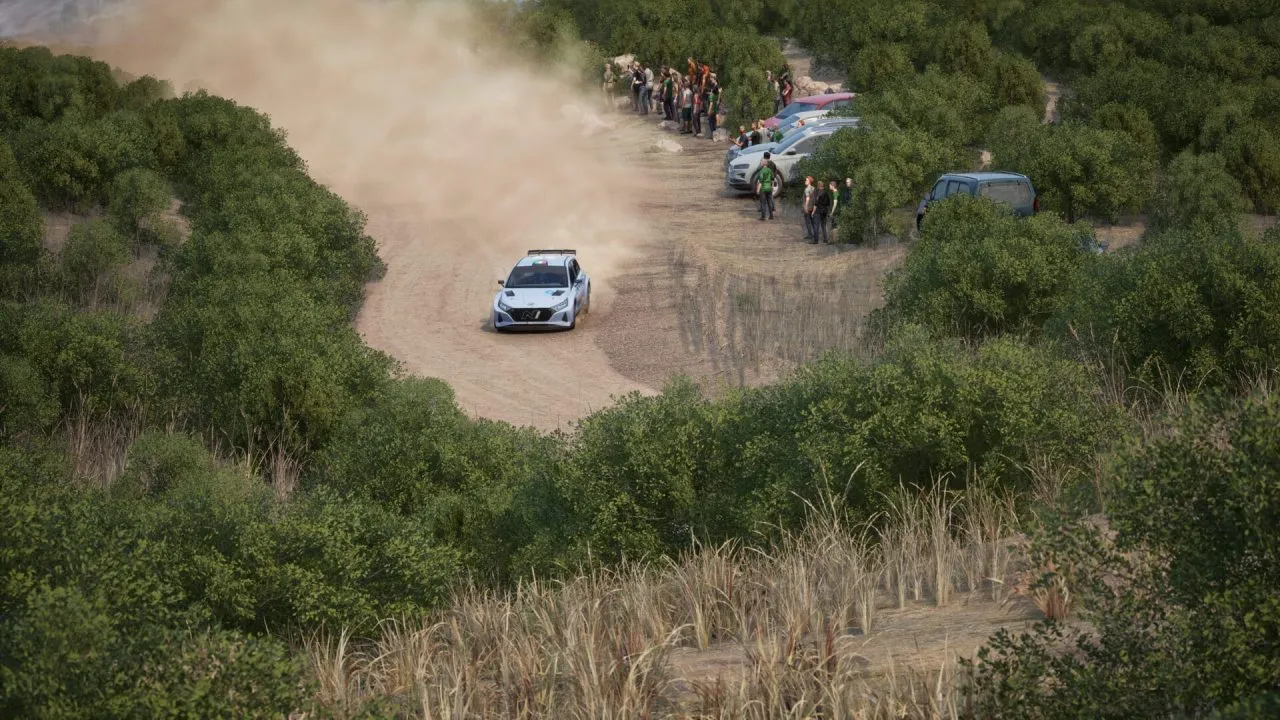
The great testing ground for this new stage is Greece. The Loutraki and Elatia stages, inspired by the abrasive character of the Acropolis Rally, offer exactly the kind of surface that best separates a convincing simulator from a merely spectacular one: dry gravel, dust, rocks, ruts, elevation changes, and zones where the tire shouldn’t simply slide over the ground but should sink into it, displace material, and generate grip through an interaction far more complex than simple friction.
The central question is inevitable: has Assetto Corsa Rally v0.5 managed to get closer to Richard Burns Rally NGP7’s physical standard on dirt? The short answer would be yes, much closer than before. But not in the same way. And that’s where it gets interesting.
Greece as a Physical Laboratory
Up through version 0.4, Assetto Corsa Rally had shown clear strengths in presentation, visual immersion, and technical ambition, but also notable shortcomings on loose surfaces. A floaty feeling, unconvincing braking on gravel, and a certain disconnect between car and terrain were recurring criticisms among more demanding users.
Version 0.5 introduces the Greek environment as a stress test for the new model. Loutraki, with its hairpins, ditches, stones along the margins, and broken rhythm, demands longitudinal traction, low-speed rotation capability, and precision on corner entry. It’s a stage that immediately reveals whether the front tire bites or simply slips.
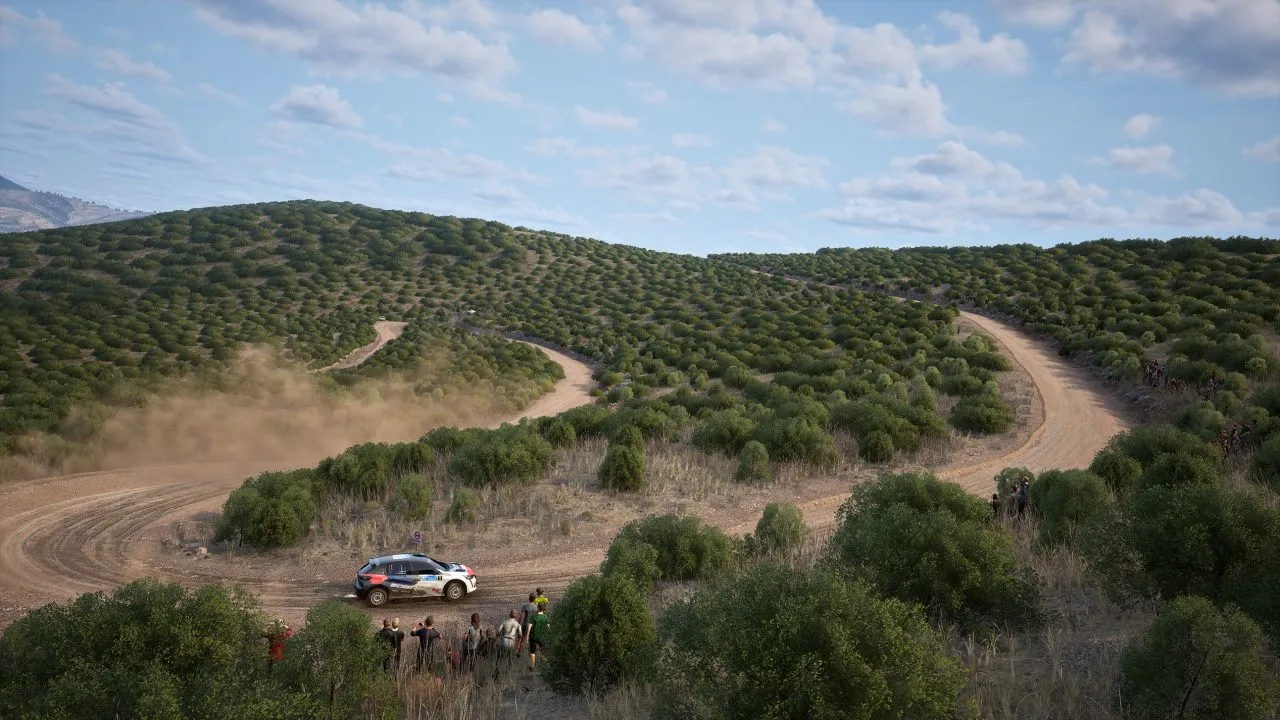
Elatia, on the other hand, poses a different kind of exam. Its faster, wider sections, scarred by deep ruts, force the physics engine to manage prolonged drift angles, hard compressions, and lateral retention at high speed. Here it isn’t enough for the car to “slide nicely”; it has to do so with mass, inertia, weight transfer, and consequences.
- Driving type: Loutraki is technical, choppy, and precision-focused; Elatia is fast, wide, and commitment-based.
- Main risk: Loutraki punishes ditches, stones, and tight hairpins; Elatia punishes ruts and exposed rocks at high speed.
- Physical demand: Loutraki tests traction and rotation at low speed; Elatia tests lateral stability during sustained sliding.
- What it reveals about the simulator: Loutraki shows braking and pivoting ability on gravel; Elatia shows the quality of weight support, suspension, and sliding behavior.
In this sense, Greece works as a perfect testbed: if ACR’s new model is solid, it should feel better both in a slow hairpin and in a fast corner taken with the car loaded laterally.
The Tire No Longer Floats, It Digs
The most important difference between Assetto Corsa Rally v0.5 and its previous versions is the introduction of more elaborate tire behavior on loose dirt. The key concept here is the so-called digging effect, or bulldozing effect.
On a gravel surface, the tire doesn’t simply rest on a rigid plate. The car’s weight partially sinks it into the material. When braking, accelerating, or sliding laterally, the wheel displaces gravel and dust, forming a kind of wedge in front of or alongside the tire. That buildup of material creates resistance and, under certain conditions, also grip.
ACR v0.5 attempts to model precisely this phenomenon. Under braking, the tire no longer behaves as if it were on ice. When the driver locks or half-locks the wheels on soft gravel, the car slows with more authority because the wheels “bite” into the substrate. This radically changes the driver’s confidence on corner entry.
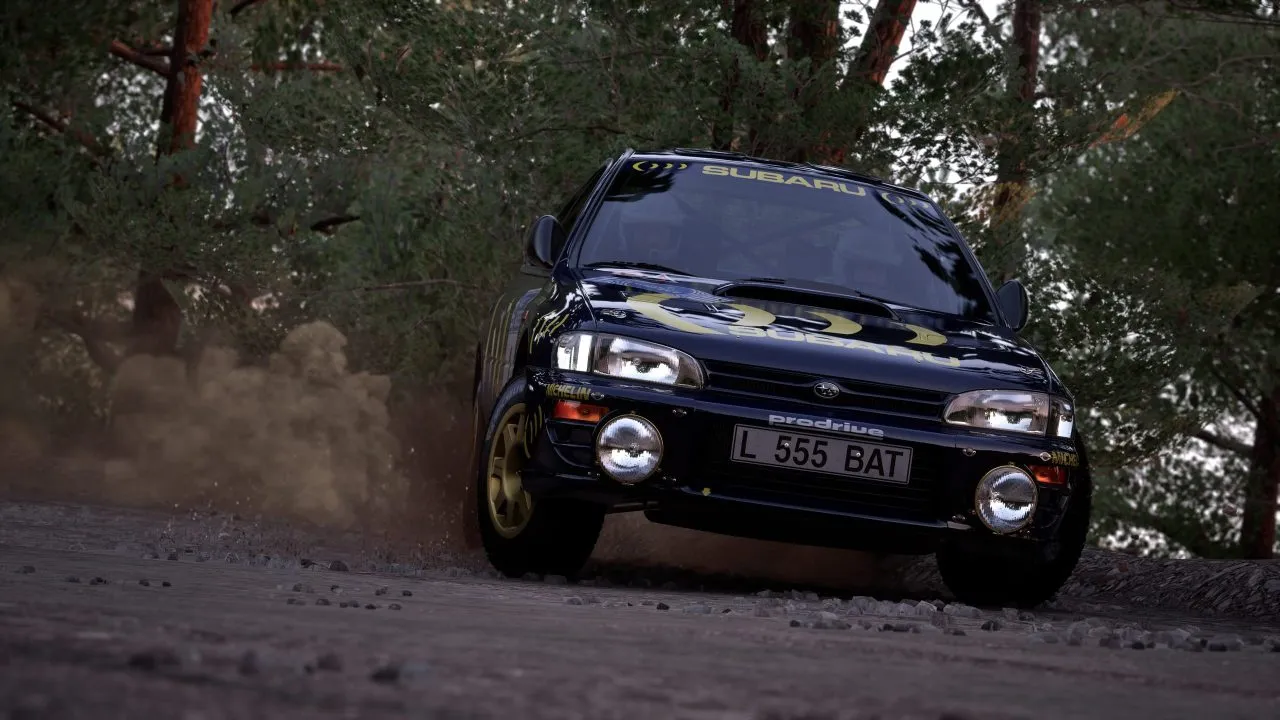
Something similar happens with lateral support. When sliding at an angle, the tire pushes earth toward the outside of its path. That accumulated mass acts like a small buttress that helps hold the car up. That’s why slides on dirt in ACR v0.5 feel more physical and less floaty than before. The car no longer seems to simply move across a uniform layer of low grip; now there’s a clearer sense of penetration, resistance, and support.
This change also has consequences for setup work. Excessive negative camber can reduce the effective area with which the tire pushes against the gravel, hurting both longitudinal traction and lateral grip. On asphalt, aggressive camber values can help maximize contact under load. On dirt, by contrast, the tire needs a more balanced relationship with the terrain in order to dig in and find proper support.
Less Spectacle, More Consequence
Richard Burns Rally NGP7 starts from a different philosophy. It doesn’t try to impress with particle effects, volumetric dust, modern lighting, or sophisticated visual deformation. Its strength lies in mathematical austerity.
In RBR, the feeling on dirt comes from a relentless combination of friction, weight transfer, suspension, differentials, and geometry. The car doesn’t turn because the player asks it to with the steering wheel; it turns only if the front axle has been properly loaded beforehand. If the driver enters a gravel corner without transferring weight forward through braking, trail-braking, or weight shift, the car will understeer straight on. There’s no invisible forgiveness.

This is one of the biggest differences between the two simulators. ACR v0.5 has greatly improved the tire-surface interaction, especially thanks to its new treatment of loose material. RBR NGP7, however, remains superior in the pure reading of the car’s mass. Every braking point, every weight transfer, and every correction is governed by very strict logic. The driver must use the pedals to move the car before asking the steering wheel to position it.
In RBR, techniques like trail braking, left-foot braking, or the Scandinavian flick aren’t advanced flourishes; they’re necessary tools. The simulator forces the driver to understand that a rally car on dirt isn’t steered with the wheel alone, but with weight, inertia, and anticipation.
Braking and Traction
One of the areas where ACR v0.5 comes closest to RBR is braking on dirt. In previous versions, the feeling could be too slippery, as if the tire couldn’t penetrate the surface at all. With the new model, the car stops in a more believable way, especially in slow and medium-speed sections.
This is very noticeable on stages like Loutraki. Approaching a hairpin, the driver can load the front axle, induce some rotation, and trust that the wheels will find resistance in the terrain. Braking becomes more informative and more useful as a tool for positioning the car.
RBR remains harsher. In Richard Burns Rally, braking hard on gravel is always a balancing act. The car can become misaligned, lose stability, or lock its wheels with immediate consequences. The physics doesn’t try to help the driver complete the maneuver; it simply exposes the outcome of what they’ve done. That’s why RBR can feel harder, even colder, but also more transparent for those who know how to read it.
ACR, for its part, offers a more modern and sensory experience. The gravel seems to have volume. Braking transmits more energy. The car feels more supported than before. But in some high drift-angle scenarios, especially with powerful all-wheel-drive cars, a certain irregular lateral retention or residual floatiness can still appear. It’s not the old problem in its most severe form, but it is an area where RBR keeps a precision advantage.

On dirt, sliding doesn’t mean losing control. In rally, a tire can generate grip while sliding. The key is staying close to the useful slip range: too little and the car won’t rotate; too much and it loses the ability to accelerate or hold its line.
Assetto Corsa Rally v0.5 makes that slide feel more physical than before. The lateral digging effect helps the car lean on the displaced gravel. This favors a more spectacular style of driving, especially in Elatia’s wide corners, where the driver can hold the car sideways with more confidence.
Richard Burns Rally, however, demands more surgical precision. The slide isn’t sustained by a broad sense of support, but by very fine modulation of throttle, brake, and steering. If the driver presses too early or too hard, the wheels spin without generating forward progress. If they lift off abruptly, the car’s mass can reposition violently. Everything happens within a narrower window.
The difference could be summed up like this: ACR v0.5 lets you feel the dirt working under the tire; RBR NGP7 forces you to feel the car working against its own mass.
Force Feedback
Force feedback is one of the areas where the comparison becomes most revealing.
Assetto Corsa Rally v0.5 goes for a rich, layered signal. The wheel communicates impacts, irregularities, stones, ruts, suspension compressions, and surface variations. In Greece, this produces a very immersive feeling. The stage feels alive. There’s vibration, texture, and mechanical noise. For many drivers, that sensory richness is key to believing in the environment.
The problem is that so much information can end up masking the single most important signal: the exact moment the front tire stops generating useful lateral force. In an ideal simulator, when pure understeer appears, the wheel should noticeably lighten due to the drop in self-aligning torque. In ACR v0.5 that information exists, but it can get partially diluted among terrain vibrations, impacts, and secondary effects.

Richard Burns Rally takes the opposite path. Its force feedback is drier, simpler, and less spectacular. But it’s also extremely clean. The signal comes straight from the virtual steering rack and directly communicates front-axle load, tire tension, and grip loss. There’s less surface noise, but a very clear reading of the limit.
- Philosophy: ACR v0.5 is immersive and textural; RBR NGP7 is pure and mechanical.
- Feel on straights: ACR v0.5 is rich in impacts and vibrations; RBR NGP7 is more sober and less decorative.
- Reading understeer: ACR v0.5 is good but somewhat filtered by surface noise; RBR NGP7 is very clear and immediate.
- Main value: ACR v0.5 prioritizes sensory realism; RBR NGP7 prioritizes dynamic precision.
ACR impresses more. RBR informs better. That may be the most important difference for competitive drivers.
Suspension and Terrain Reading
Suspension is another critical point. On dirt, a rally car needs to absorb, follow, compress, extend, and maintain contact with the ground under extremely variable conditions. Here RBR once again shows why it remains a benchmark. The way the car loads, unloads, rebounds, and breaks down after a bad landing has outstanding internal coherence.
ACR v0.5 has improved, especially by better connecting the tire to the surface, but it can still show somewhat violent reactions over certain dips or minor bumps. In some cases, the body seems to respond with more energy than expected, which suggests that the relationship between fast suspension movement, unsprung mass, and fine-grained terrain reading still has room to be refined.
This doesn’t mean ACR is weak in this area. Quite the opposite: the overall improvement is clear. But RBR maintains a naturalness that’s hard to match in how every landing error turns into an understandable physical consequence.
Damage
Although the damage model isn’t strictly part of tire physics, it completely shapes how a driver approaches dirt. In rally, fear is itself a physical variable. If a driver knows that hitting a rock can end the stage, they drive differently.
On this point, Richard Burns Rally remains far more forceful. A seemingly minor impact can bend the steering, break the suspension, damage the radiator, or compromise the engine. The result is constant tension. RBR doesn’t just simulate grip; it simulates consequences.
Assetto Corsa Rally, in its v0.5 state, offers a less decisive damage system. Hits punish visually and can affect the car, but they still don’t carry the same level of terminal mechanical threat. This allows for more aggressive, and at times more forgiving, driving. In terms of serious competition, this difference matters: if the terrain can be used as support without proportional penalty, the physics ends up partially undermined.
The Dynamic Racing Line
Where ACR v0.5 introduces an especially promising idea is in the dynamic evolution of the racing line. In real rally, the road changes as cars pass over it. The first driver clears loose gravel; the following ones find a more compacted line with more grip. ACR is starting to represent this phenomenon in Greece through an asymmetric, variable ideal line.
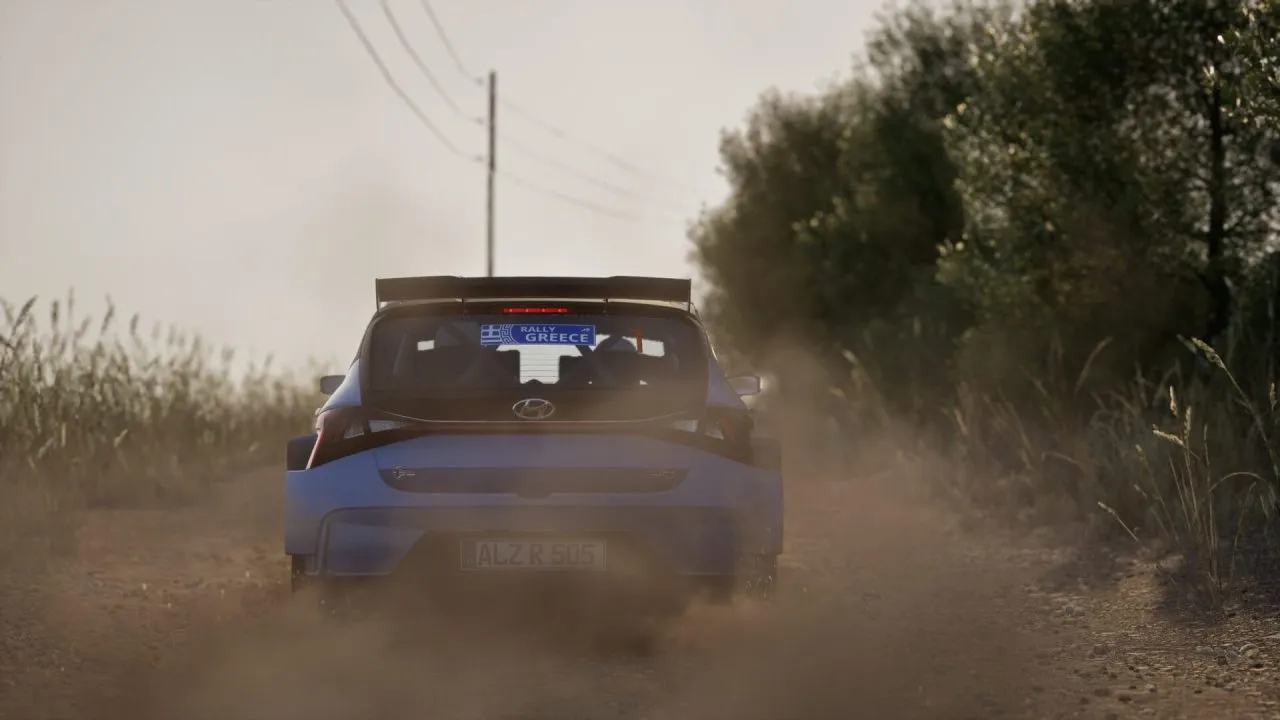
The width of the clean line can change depending on how many vehicles have passed and the angle at which they took the corners. In theory, this adds an extraordinary strategic layer: it’s not just where the corner is, but how the surface has evolved by the time you reach it.
RBR, even with its enormous community contributions and immense variety of stages and surfaces, doesn’t offer this same kind of modern, integrated presentation of visual and physical terrain evolution. Its strength lies in local precision of contact and mass; ACR is starting to stand out in the idea of a more alive, transformable environment.
Verdict
Assetto Corsa Rally v0.5 is a huge step forward. Its new treatment of dirt, the digging effect, improved braking, richer surface interaction, and the presentation of Greece as a living physical environment make it one of the most serious advances modern rally simulation has made in years.
On dirt, ACR no longer feels like a car floating over a low-grip texture. Now there’s volume, dust, resistance, and a far more convincing relationship between tire and substrate. The experience is more visceral, more spectacular, and much closer to what a driver expects from a gravel rally.
But Richard Burns Rally NGP7 keeps its crown in several essential areas. Its reading of weight transfer, its clean force feedback, its mechanical severity, and its refusal to forgive poor technique still set the standard for pure simulation. RBR doesn’t need to dazzle to convince. It convinces because every mistake has a physical cause and every correct adjustment produces a logical consequence.
The final difference isn’t simply about which one is “better.” It’s about what each one understands realism to mean.
- Assetto Corsa Rally v0.5 represents modern sensory realism: dirt with volume, a living environment, audiovisual immersion, and physics that is finally starting to speak the language of loose surfaces.
- Richard Burns Rally NGP7 represents classic structural realism: mass, weight transfer, geometry, friction, and consequences without decoration.
ACR v0.5 still doesn’t fully dethrone RBR as the clinical tool for understanding rally car dynamics. But it has narrowed the gap significantly. More importantly, it has shown that the new generation can aspire to something that for years seemed reserved for a 2004 simulator reshaped by an obsessive community.
You can buy the game through our affiliate link at a reduced price:
For the first time in a long while, the debate is alive again. And for rally simulation fans, that’s excellent news.
This website uses affiliate links which may earn a commission at no additional cost to you.