


When Jensen Huang unveiled DLSS 5 at the March 2026 GTC, the mass market’s reaction was one of outright rejection. Promotional videos accumulated disapproval rates hovering around 84%. The criticism was blunt: generative AI intrusion, loss of artistic coherence, frames that flicker in and out of existence. Popular consensus reduced it to an automatic filter, the so-called “AI Slop” applied on top of real artists’ work.
And yet, in specialized sim racing forums, the tone was different. Curious. Technical. Almost enthusiastic. That asymmetry is not a sociological anomaly, nor a matter of collective ignorance. It is the logical consequence of a geometric truth that the simracing community senses before it can articulate it: DLSS 5 was designed, unknowingly, for this.
The Problem That Destroys AI in Other Genres
To understand why simracing is the exception, you first need to understand why the general reaction was so visceral. The core of the rejection is not technical; it is anthropological.
Human beings are equipped with a neurological system extraordinarily sensitive to faces of our own species. Decades of cognitive neuroscience research confirm that there is a precise threshold, known as the Uncanny Valley, at which a nearly human facial representation produces more revulsion than a manifestly artificial one. A robot with a plastic face seems endearing. A face generated by AI that almost looks real, that almost has the depth of a gaze or the organic asymmetry of a wrinkle, produces an immediate and diffuse discomfort.

The integrated DLSS 5 demonstrations in titles like Resident Evil Requiem exposed exactly that. Observers detailed how AI-generated organic materials exhibited erratic behavior when transitioning between lit and shadowed areas. Not because the technology is inherently deficient, but because the acceptance threshold for rendered human skin is infinitely more demanding than for any other surface.
In simracing, that threshold does not exist. There are no faces.
The Main Cast: Polymers, Alloys, and Vulcanized Rubber
In a racing simulator, the main actors are objects. Not characters. The visual scene the engine must construct, and that DLSS 5 must enrich, is composed of a collection of materials that, by historical coincidence, are exactly the ones NVIDIA’s neural network handles best.
The DLSS 5 model operates semantically: it ingests the base color and motion vectors of each frame, identifies what type of material each pixel represents, and applies the corresponding physical lighting conditions. For this purpose it was trained extensively on rigidly structured geometries at the microscopic level. Which ones? Exactly those that populate any starting grid.
- Automotive paint: lacquer with clear coat, complex specular reflectivity over metallic base layers.
- Forged aluminum: machined surfaces with anisotropic micro-grooves, directional photon scattering.
- Carbon fiber: structured weave with a 2×2 twill pattern, dry gloss with no diffuse specularity.
- Vulcanized rubber: porous and absorptive surface, no reflections, high infrared absorption.
- Polycarbonate and glass: simultaneous refraction, transmittance, and specular reflection, demanding full path tracing.
- Wet asphalt: a mix of matte absorption and surface water reflections, highly variable with temperature.
All of these materials share a crucial property from the neural synthesis perspective: they are predictable in their optical behavior. The laws governing how a photon interacts with a surface of anodized aluminum are the same under any lighting condition. They do not change based on emotional state, narrative history, or the artistic intention of the moment. They are pure physics. And pure physics is precisely the terrain where models trained on massive datasets perform with the greatest consistency.
The Other Invisible Advantage
There is a second, less obvious reason why simracing is the ideal breeding ground for DLSS 5: the nature of its environments.
An open-world video game with generative ecosystems, procedural cities, and characters with emergent behavior presents any inference algorithm with a near-infinite state space. The neural network must learn to generalize across situations it has never seen, materials it does not know, unpredictable camera angles.
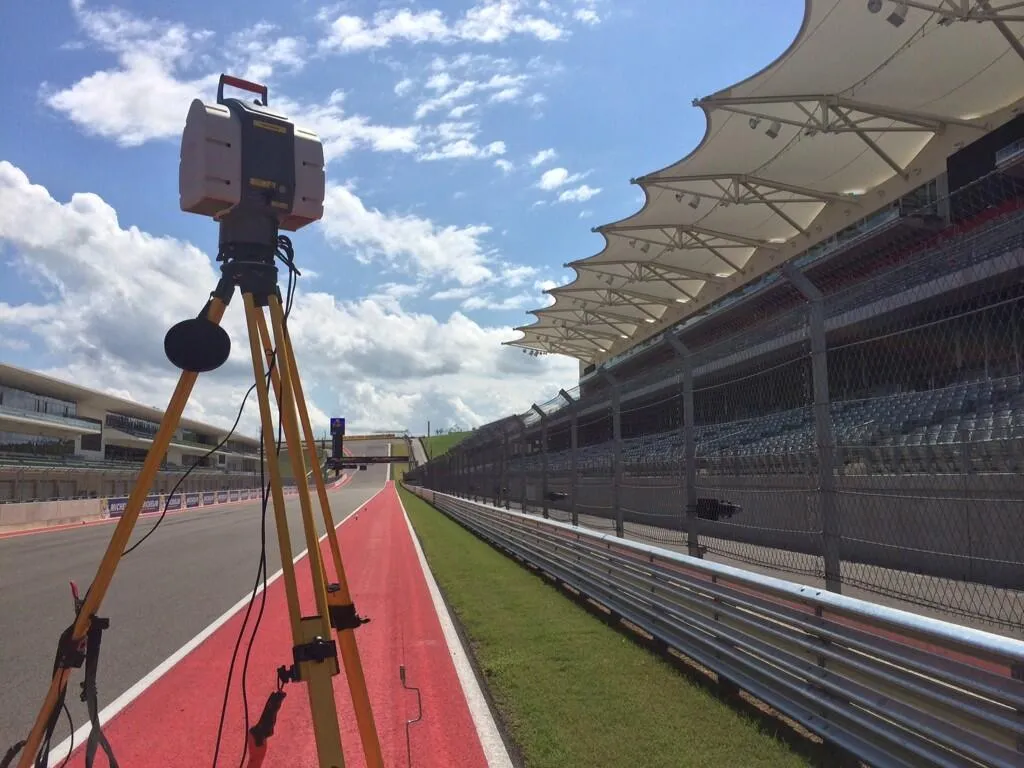
A racing simulator, by contrast, operates within a semantically bounded universe. Circuits are laser-scanned with millimeter precision. Vehicles are digital replicas of physical objects documented down to the last bolt. Lighting conditions are finite and reproducible. The sun rises in the east at Le Mans. Rain at Circuit Paul Ricard has a predictable asphalt temperature. The reflections of neon lights in a nighttime Le Mans 24 Hours paddock behave in a specific way on the carbon fiber of an LMP2.
DLSS 5’s semantic synthesis needs to recognize materials in order to apply the correct lighting conditions. In simracing environments, that classification is trivial: the geometry of a Michelin tire on wet asphalt is unambiguous. In a fantasy RPG with procedural materials, the model must infer whether a surface is leather, materialized magic, or enchanted oxidized metal. The difference in complexity spans several orders of magnitude.
Computational Load as a Solved Problem
The DLSS 5 alpha demonstrations presented at GTC 2026 revealed that NVIDIA used dual-GPU configurations: one RTX 5090 managing the conventional rendering pipeline, and a second dedicated exclusively to running the neural inference workloads. This has generated legitimate concern about the economic accessibility of the technology.
But there is an important nuance that mass coverage has overlooked: in simracing, the simulation GPU is already pushed to its limits for entirely different reasons. Tire physics engines calculate at frequencies exceeding 400 Hz. Suspension telemetry, fluid aerodynamics, and surface deformation compete with rendering for CPU and GPU cycles simultaneously. The dual-compute architecture that DLSS 5 demands is not an exotic overhead for simracing; it is the natural evolution of a discipline that has separated simulation threads from rendering threads as standard practice for years.
What the Rest of the Market Cannot See Yet
The controlled DLSS 5 demonstrations on surfaces such as metallic coffee machines and rocky pavement, read by the mass market as irrelevant marketing, turn out to be exactly the use cases of simracing. The uncanny photorealism the neural network infuses over static geometries and reflections is the promise of what a BMW M4 GT3 in the rain at the Nurburgring could look like in real time, without a render farm, without resolution compromise.

The simracing community senses this when it manually forces DLSS 4.5’s Preset M and L, documenting astonishing visual transformations in asphalt sharpness and specular reflections. It senses it when it reports that the second-generation model’s linear-space inference recovers the full chromatic range of sunlight on wet metal, something that previous logarithmic implementations systematically crushed. And it senses it when it argues that neural material generation could be the key to achieving, for the first time in real time, an image quality equivalent to high-end automotive photography.
The 84% dislikes on NVIDIA’s videos reflect a technology applied to the wrong use case. Simracing is the right one.
The ethical resistance to “AI Slop” has solid foundations when applied to artistic creation: generative synthesis of human faces or fantasy environments can supplant genuine creative work. But no texture artist has spent weeks painting the scattering of photons over anodized aluminum with the intention of conveying a poetic vision of the world. That is physics. And physics, delegated to a neural network trained to master it, does not displace art. It executes it.
The Question That Remains Open
None of the above resolves the most immediate problem: whether DLSS 5 can operate with tolerable latencies in Virtual Reality environments, where stereoscopic synchronization demands millisecond margins that no neural inference workload has yet demonstrated it can respect. Nor does it resolve the economic asymmetry that concentrates access to the technology in the highest hardware market tiers. Nor the systemic driver instability that today renders triple-monitor setups unusable on high-end systems.
What it does establish, with technical solidity, is this: when DLSS 5 matures enough to leave alpha demonstrations and land in the real simracing ecosystem, it will not encounter the visceral rejection it met in other genres. It will find a community that has been waiting for years for someone to finally solve the problem of real-time path tracing on metal, rubber, and asphalt.
And that, it turns out, is exactly what it was trained for.
This website uses affiliate links which may earn a commission at no additional cost to you.