


Introduction
If you have reached this article, it is probably for one of two reasons: either you are simply a steering wheel enthusiast who needs a cool quick-release system, just like in a real race car, or you are one of the early buyers of the Fanatec DD GT and are experiencing the, unfortunately well-known, issues of freezes/disconnections during use, which are incredibly annoying and frustrating. Now all the current units come with QR2 installed:
- Gran Turismo® DD Pro Wheel Base (8 Nm) – €499.95
- Gran Turismo® DD Pro (5 Nm) – €649.95
- Gran Turismo® DD Pro (8 Nm) – €749.95
Since that is my case as well, you might be wondering if upgrading to the Fanatec QR2 Base Side (Type C) would solve your problem. Well, below we will discuss both cases to give you a clear overview of what this is all about and help you decide whether this upgrade is worth it.
What are you talking about?
First of all, let’s start by explaining what the QR1 and QR2 actually are, in case you have heard of them but aren’t entirely sure what this is all about. The QR1 is the name of the first version that came with many Fanatec steering wheels on the part responsible for connecting the wheel to its corresponding base, consisting of a plastic threaded collar-type mounting installed on the wheel side.

The QR2, on the other hand, uses a quick-release system very similar to that of real race cars.
If you belong to the first group, there is not much more to say. The Fanatec QR2 Wheel Side solution is excellent and stylish, but it is not cheap, as the pack price is around €60 for the base side and then about €90 for each steering wheel rim we want to use with this system. If, on the other hand, you are in the second group, I will go into detail in the article where I will share my own experience after deciding to make the switch and assess whether the upgrade was worth it.
Buying the set
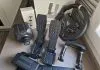
Once you buy the set, you must keep in mind that you have to order two separate products: the part mentioned earlier to replace the base shaft, as well as the part mounted on the steering wheel with the quick-release system. You will receive something like this:

Fanatec provides various options that are compatible depending on the base you own, offering the following compatibility:
QR2 – Wheel Options
| Product Name | Material | Standard equipment on | Compatibility |
| QR2 Pro Wheel-Side | CNC-machined aluminium | Podium Steering Wheels | All CSL, ClubSport, and Podium Steering Wheels with an exchangeable QR (see list below) |
| QR2 Wheel-Side | Diecast aluminium | ClubSport Steering Wheels | All CSL, ClubSport, and Podium Steering Wheels with an exchangeable QR (see list below) |
| QR2 Lite Wheel-Side | Carbon fibre-reinforced composite | CSL Steering Wheels | All CSL Steering Wheels with an exchangeable QR (see list below) and ClubSport Steering Wheel F1® Esports V2 |
QR2 – Base Options
| Product Name | Material | Compatibility |
| QR2 Base-Side (Type-C) | Diecast aluminium | CSL DD Wheel Base, Gran Turismo DD Pro Wheel Base |
| QR2 Base-Side (Type-M) | CNC-machined billet aluminium | Podium Wheel Base DD1, Podium Wheel Base DD2, Podium Wheel Base DD1 PS4 |
Disassembling and beyond
Once in our hands, the long-awaited moment to get to work and swap the parts arrives. First of all, it is worth noting that it comes with simple instructions and even links to YouTube videos from Fanatec itself, ensuring that at no point will we feel anxious or doubt what we are doing. It does not matter which side you start with, so I will begin by explaining what is involved in changing the wheel side, which is the simplest part. Quite simply, we need to take our steering wheel and remove the screws holding the plastic threaded collar to the wheel. Once removed, we take off the collar, leaving the wheel like this:

We will also remove that metal washer along with its two small screws to leave the part completely bare, as you will notice that the new version comes with its own slightly different metal washer. Once fully disassembled, we mount the new piece, leaving it looking like this:

Once finished with the wheel rim, it is time to work on the base. We will start by removing the black clamp from the shaft itself, and once removed, we manually pull the shaft outward. You will see that the shaft comes out easily, leaving the base looking like this:

Now, we proceed to insert the new shaft that comes with the QR2 and secure it by replacing the old single-screw clamp with this two-piece assembly featuring two overlapping screws. In this step, it is extremely important that, when tightening, the placement of these two pieces is perfectly aligned with the shaft notch, as shown below, so that it can exert the maximum possible clamping force:

Once completed, it should look something like this. Looks cooler, doesn’t it?:

Testing it
Well, once everything is mounted, we just have to test it and see if we feel anything different or if it is exactly the same as before but prettier. I have to say that even the initial impression is very positive; I don’t know how to describe it precisely, but you notice that the entire assembly feels sturdier and firmer. Because of the disconnection issues I had been suffering from, I had to lower the force feedback on the base significantly to try to minimize them, but now I quickly feel confident enough to gradually turn it back up in the wheel settings to see if I can reproduce the problem. Since I have the base with the 8Nm boost kit, I finally decide to set it to the maximum as an ultimate test to see if my problems have completely vanished and to once and for all get rid of the fear of racing in serious competitions again. At this point, I must say that, so far, those disconnects have not occurred again, which finally calls for some tears of joy with absolutely no shame—those of us who have suffered from this issue will understand completely.
Is it worth it?
My final conclusions are as follows: after acquiring the QR2, you don’t just feel like you have spent money on something that solves the issue you have suffered from so much. What you actually feel is that the steering wheel has received an upgrade that makes it better than it was, and you can feel that every time you drive and the more hours you put into it. Therefore, I can say without a shadow of a doubt that this upgrade to QR2 is completely worth it and that you can once and for all eliminate the fear of whether your base had become the most expensive paperweight in history, or whether you would be able to keep enjoying it as much as you did since that happy moment you bought it.
And with these combinations in mind, let’s go straight to the prices:
- QR2 base Type-M 119,95 euros
- QR2 base Type-C 60,95 euros
- QR2 Pro Wheel 199,95 euros
- QR2 Wheel 89,95 euros
I hope this article helps resolve your questions, and I can only thank you for reading this far and to Fanatec for allowing us to make this test.
This website uses affiliate links which may earn a commission at no additional cost to you.