
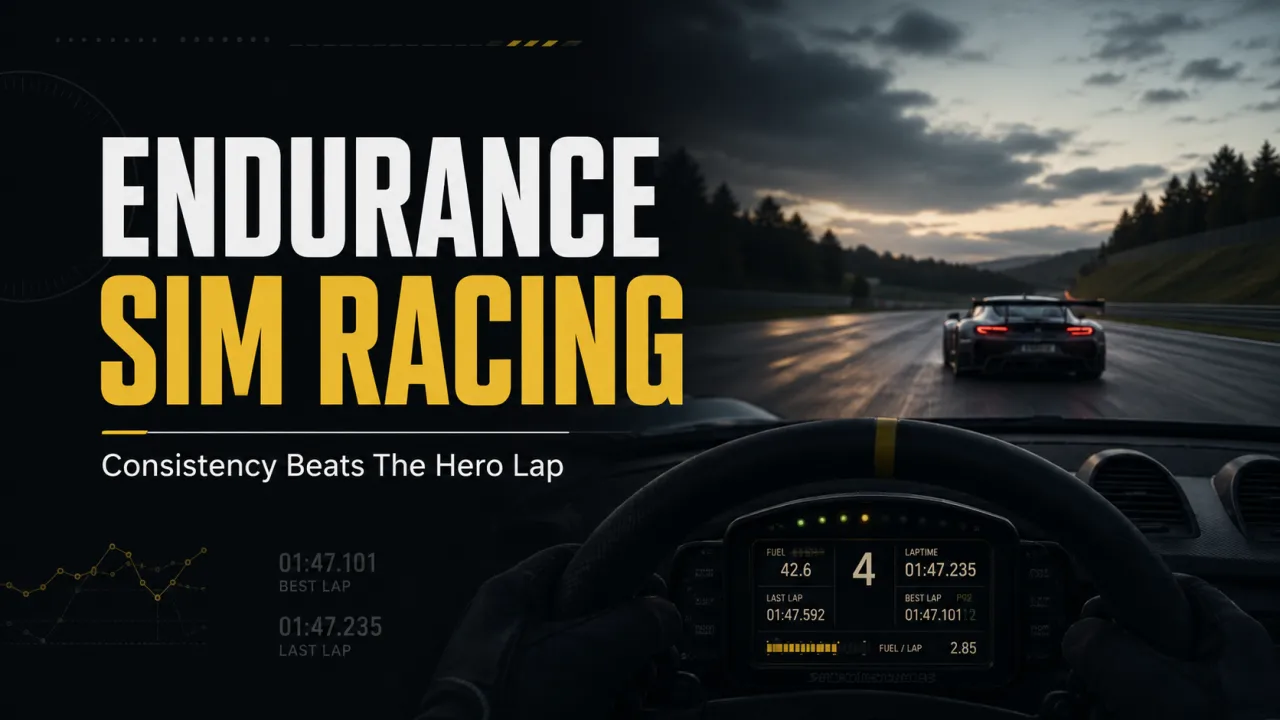

Endurance sim racing exposes a truth that hotlap culture can hide: pace only matters if it can be maintained. A driver can set one beautiful lap, then lose three tenths every circuit as their concentration starts to falter.
The best long-race drivers see earlier, use less emotional energy, and keep their inputs repeatable under changing conditions. A PLOS ONE simulator study on racing and non-racing drivers found differences in lap time, steering activity, racing line, gaze behavior, and perceived workload, matching what sim racers feel during a stint: consistency is visual, physical, and mental.
The Long Game Across Competitive Formats
Endurance racing is not only about being quick for one lap. It is about protecting attention through fuel load changes, tire feel, traffic, pressure from cars behind, and the fatigue of repeating precise inputs. The same long-game pattern appears in other places too, and looking beyond the racing world can help us understand it better. Take, for instance, the sustained concentration necessary in poker and structured table formats, where the most revealing decisions often arrive after many ordinary ones. Yes, the setup is very different, but the need for endurance and a steady approach remains the same.
If you want to see that idea in practice, this official casino online page presents poker alongside formats such as blackjack, roulette, baccarat, live casino, and pokies, with practice modes available so people can get familiar with games before paying for them. This is a useful example because it lets the reader observe tempo across formats: when to wait, when to act, and how pressure changes the feel of a choice. It also lets you see what happens if you don’t sustain your focus and only pay attention to a flashy hand or two – you won’t do particularly well in many cases.
Poker might seem like a very different kind of game, but for players who know that they struggle with endurance, it can be a good way to test how well your stamina holds out across multiple decisions, without other racing game factors distracting you from the one core skill you are trying to train. You won’t run into cases where you managed to maintain your concentration but slipped up on some other skill and therefore felt negative about the outcome despite improving.
Why Pace Drops Before the Mistake Appears
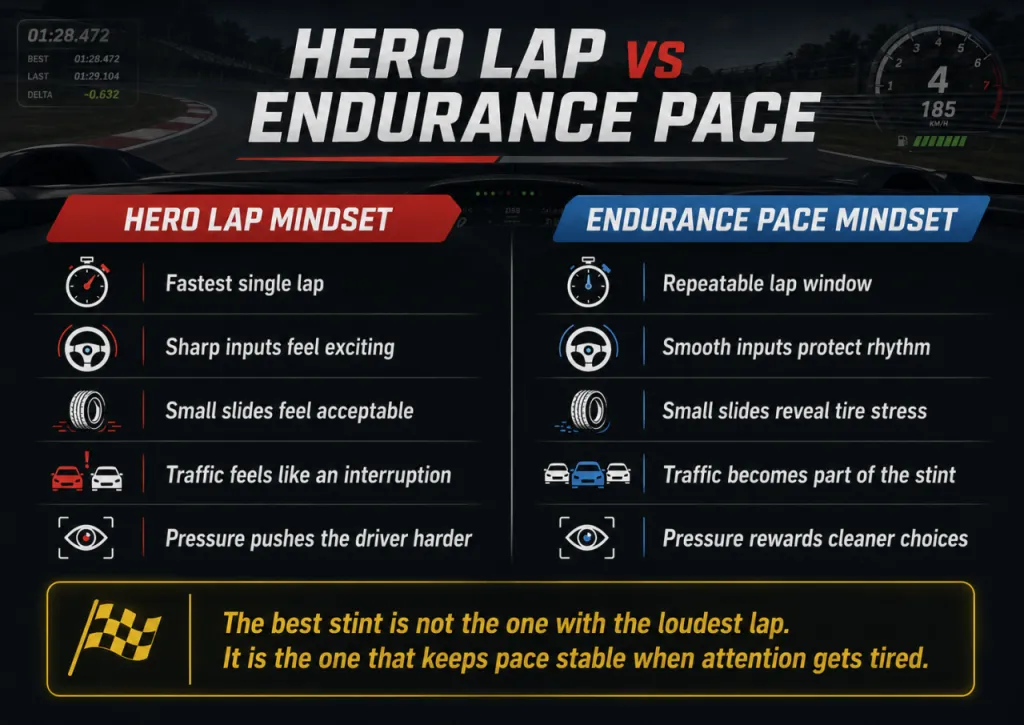
Most sim racers imagine lost pace as something obvious: a spin, a lock-up, a track limit warning, or contact in traffic. More often, decline arrives as texture. Your braking point drifts by a few meters. Your steering becomes less fluid. You open the throttle half a second too early. Nothing dramatic has changed, but bit by bit, those small errors add up.
This is why endurance racing punishes drivers who chase the sensation of speed, rather than the structure of speed. Clean endurance pace often feels almost restrained from the cockpit, because the driver is giving themselves the margin to repeat the same choices on later laps.
Stint Signal | What People Think It Means | Better Interpretation |
The best lap is impressive, average lap is important | Pace depends on perfect rhythm | Being consistent is a better way to win than being fast near the start |
Braking gets later each lap | The driver is taking risks to get ahead | The driver’s concentration is slipping, and they are struggling to judge distances as well as they did |
Small slides become more frequent | Tire use is becoming messy | Maintaining smoothness is now more important than raw speed |
The table matters because endurance consistency is not about a single skill. It is a stack of small aspects that you need to focus on. You protect the entry so that the middle of the corner stays calm. You protect the exit so the next straight is not compromised. You protect the stint by refusing to turn every nearby car into an emotional event.
Consistency Is a Pace Skill
You can improve your endurance performance by separating maximum pace from maintainable pace. Maximum pace is what you can do when the car, tires, traffic, and concentration are aligned. Maintainable pace is what you can manage throughout the match. Long races are decided by that second number far more often than drivers admit.
That shift changes how practice feels. Instead of asking only how fast the best lap was, look at how narrow the normal lap window became. A driver who can repeat clean laps within a small band is building something more durable than a driver with one spectacular sector and several recoveries.
Late-race judgment also feels different from early-race judgment. Near the start, players who show the most patience can feel passive. Later, patience becomes control, because refusing a weak fight protects the rest of your run. Letting a faster car go ahead, waiting for a cleaner exit, or avoiding a desperate move can be the strongest racing decision available. You see the same elements in poker and other strategy games; the late moves are often key to determining who comes out on top, and endurance is therefore a critical trait.
The Stint Is the Real Test
The long game in sim racing is built from small choices that look ordinary until they accumulate. Endurance racing teaches that consistency is not the absence of ambition. It is ambition with timing. A calm stint still contains attack, defense, recovery, and speed, but arranged around the whole race, rather than the next corner alone. Research around gaming and cognition supports that view: a meta-analysis on action video game play and cognitive skills found positive links between perception, attention, and spatial skills, so the best virtual drivers often look less frantic, not more.
This website uses affiliate links which may earn a commission at no additional cost to you.