

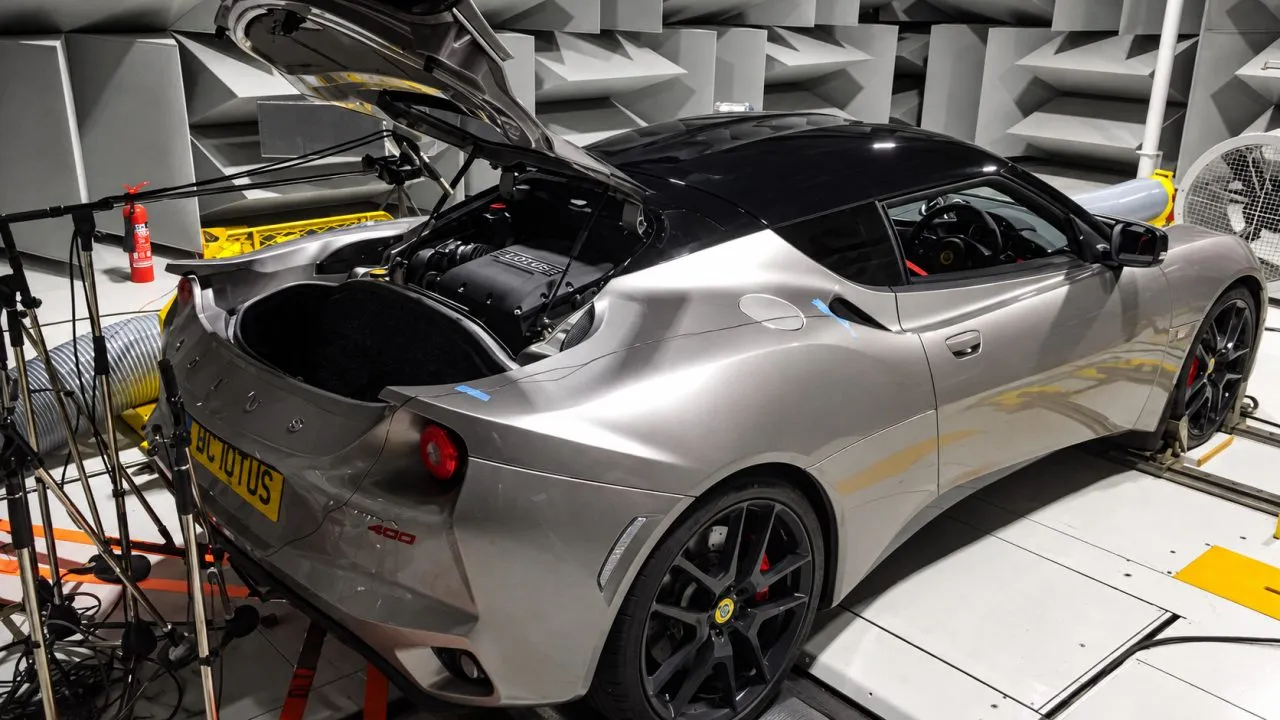

A new technical presentation from Polyphony Digital has revealed that the Gran Turismo audio team recorded both a Lotus Evora 400 and Mercedes-AMG ONE. Neither car is currently available in Gran Turismo 7, making the images particularly interesting ahead of the game’s major Spec IV updates, although the recording sessions should not be treated as confirmation that either model is coming to GT7.
The images appeared in Interactive Sound Design in Gran Turismo, a presentation given by Polyphony Digital audio engineer Takashi Minagawa at the 156th meeting of the Acoustical Society of Japan. Daisuke Takeuchi, Masao Kimura and Tatsuya Akita were also credited on the presentation, which provides a detailed look at how Polyphony records, processes and reproduces vehicle sounds in Gran Turismo 7.
While most of the presentation is focused on sound technology, two of the photographs immediately stand out. One shows a Lotus Evora 400 being recorded on a chassis dynamometer, while another shows the rear of a Mercedes-AMG ONE equipped as part of what appears to be an on-track recording session.
Polyphony does not state when those recordings took place or why the two cars were selected. More importantly, the presentation does not identify either vehicle as future Gran Turismo 7 content.
Lotus Evora 400 Recording Raises an Obvious Question
The Lotus Evora 400 is arguably the more intriguing of the two discoveries because Lotus is currently absent from Gran Turismo 7. The British manufacturer has appeared in previous Gran Turismo titles, including versions of the Evora in GT5 Prologue, Gran Turismo 5 and Gran Turismo 6, but the marque did not return for GT Sport or GT7.
Polyphony’s presentation shows an Evora 400 inside an acoustic testing environment with its engine compartment exposed and microphones positioned around the vehicle. The slide is being used to demonstrate chassis dynamometer recording, a method that places the car’s wheels on rollers while its engine and drivetrain are operated under controlled conditions.
The chassis dynamometer does have a disadvantage for audio work because tyre noise from the rollers can contaminate the recording. Polyphony also uses hub dynamometers, which connect directly to the car’s wheel hubs and reduce that problem, depending on the vehicle and facilities available.
The fact that Polyphony has recorded an Evora 400 therefore confirms that the studio has captured real audio data from the car. What it does not establish is whether that data was created for a future GT7 model, an internal reference library or another Gran Turismo project.
Polyphony Has Also Recorded the Mercedes-AMG ONE
The second notable vehicle is even more exotic. One of Polyphony’s slides showing its circuit recording process includes the Mercedes-AMG ONE, with recording equipment positioned around the rear of the hypercar.
The AMG ONE has never been included in a Gran Turismo game. Its appearance in Polyphony’s technical material is therefore notable, particularly given the existing relationship between Mercedes-AMG and Gran Turismo, but again there is no announcement tying the recording to an upcoming GT7 update.
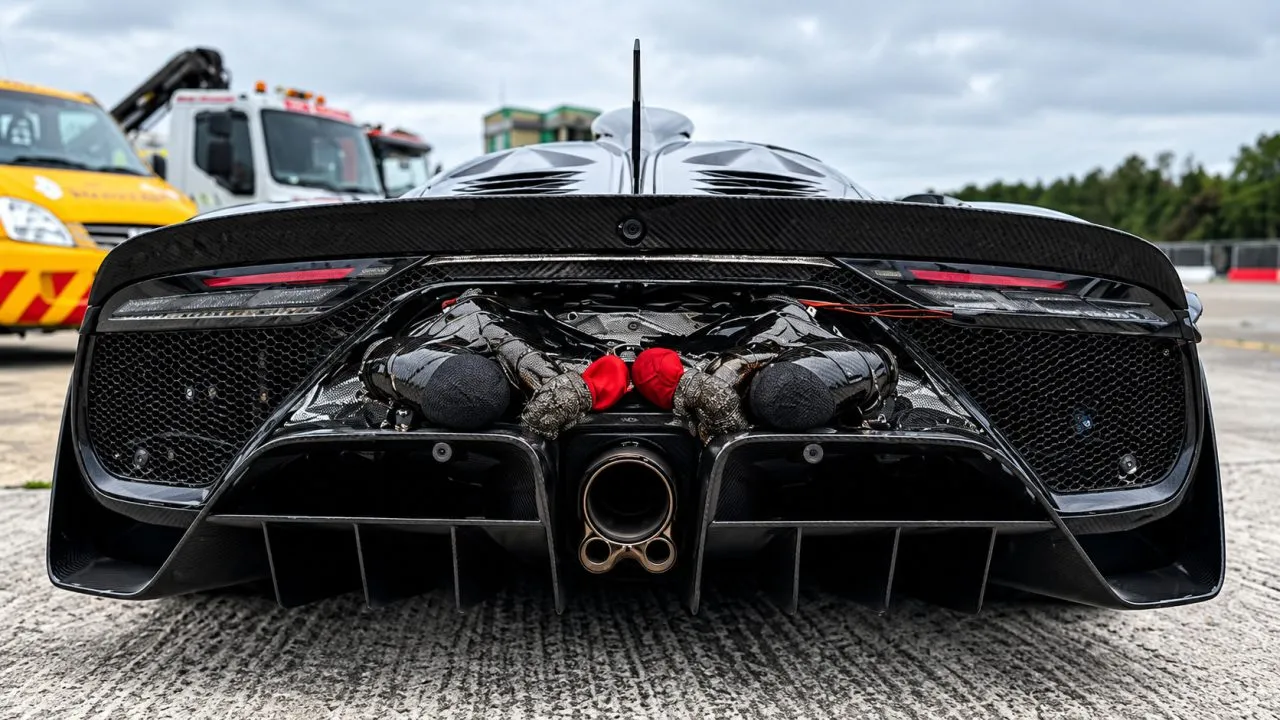
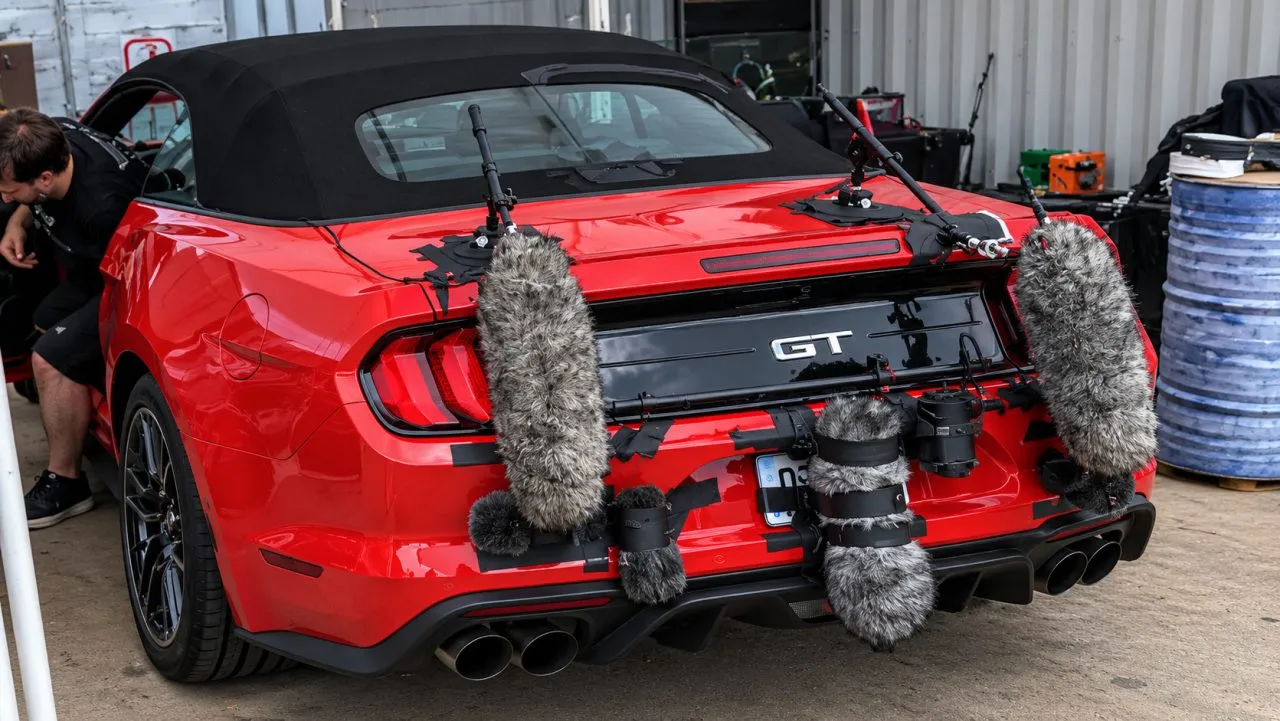
Track recording is used when putting a vehicle on a dynamometer is difficult or when the audio team wants to capture the car under real driving conditions. According to Polyphony’s presentation, microphones can be fixed to the vehicle using suction mounts, tape and cable ties before the car is driven around a circuit while the various audio channels are recorded.
That approach allows the team to capture sounds from different parts of the vehicle under actual load, rather than relying on a stationary engine recording.
How Polyphony Records Gran Turismo’s Engine Sounds
The presentation also provides an unusually detailed look at how Gran Turismo’s vehicle audio is produced. Polyphony records several different sources separately, including the intake, engine bay, interior and exhaust.
For the exhaust, microphones are positioned at different distances. Polyphony lists a close microphone at approximately 30 cm and another at around five metres, allowing the sound team to capture both the detailed exhaust note and how the vehicle sounds from further behind.

The cabin itself is also measured. Polyphony records its acoustic impulse response so that the game can reproduce how engine and exhaust sounds are altered by the physical interior of each vehicle rather than simply playing the same external recording at a lower volume.
When conditions allow, this is measured using an exponential sine sweep played through a speaker. When time or equipment is limited, Polyphony can even use a short impulse such as a balloon being popped inside the cabin to capture information about its acoustic response.
Gran Turismo Engine Sound Combines Multiple Recordings
Once recorded and cleaned, the material is brought into Polyphony’s internal Gran Turismo Engine Sound, or GTES, system. The software connects the sound-design tools running on a PC directly to the game runtime, allowing the audio team to adjust vehicle sounds while hearing the results in the game environment.
Recordings at different engine speeds are turned into loops, with GTES estimating their corresponding RPM through pitch analysis. The system then crossfades and adjusts those recordings dynamically as engine speed changes.
Additional parameters can modify individual audio layers according to throttle position, engine behaviour and other vehicle data. Camera position is also considered, allowing the same car to sound different from inside the cockpit, behind the vehicle or from another external viewpoint.
Polyphony also operates a physically based engine sound synthesizer for vehicles that cannot easily be recorded. Instead of starting with conventional samples, this system simulates elements such as combustion pulses, cylinder configuration, exhaust manifold behaviour and resonance through a virtual exhaust system before feeding the resulting audio back into GTES.
Are the Lotus Evora and AMG ONE Coming to Gran Turismo 7?
At this stage, there is no confirmation that either car is coming to Gran Turismo 7. A vehicle appearing in a Polyphony recording session is evidence that audio material exists, but it is not equivalent to a content announcement.
There is precedent for caution. Polyphony maintains an extensive archive of automotive data and can record cars for research, reference or potential future use without those vehicles necessarily appearing immediately in a released game.
The timing nevertheless makes the discovery particularly interesting. Gran Turismo 7’s Spec IV expansion begins in October 2026 and continues with a second major update in December. Polyphony has already confirmed that the two updates will introduce a combined 12 new cars, alongside Sportsland SUGO, Autumn Ring and a substantial collection of new game features.
Polyphony has not yet revealed the complete 12-car lineup. That naturally leaves room for speculation around the Evora 400 and AMG ONE, but neither should currently be included on a confirmed Spec IV car list unless Polyphony announces them separately.
The presentation is therefore more useful as a rare look behind the scenes than as a conventional car teaser. We now know that Polyphony has recorded both the Lotus Evora 400 and Mercedes-AMG ONE; whether players eventually hear those recordings from behind the wheel in Gran Turismo 7 remains an open question.
You can purchase Gran Turismo 7 by clicking here for the PS4 version and here for the PlayStation 5 Pro and PS4 versions. Additionally, there’s the 25th Anniversary Edition available for PS5 and PS4.
See you on the track!
This website uses affiliate links which may earn a commission at no additional cost to you.