


The arrival of iRacing Apple Vision Pro marks a major turning point in the world of motorsport simulation. It sounds bold, sure, but this time it is not just marketing hype.
We are looking at a collaboration between three major technology brands: Apple, NVIDIA, and iRacing. This combination does not simply improve graphics or performance, although it certainly does that. It changes the way racing simulation is experienced from the ground up.
With this setup, you are no longer just looking at a screen. You are inside the car.
The key lies in spatial computing, where the physical world and the virtual world blend together in a way that feels surprisingly natural. Your real steering wheel matches the one inside the simulation. Your actual hands remain visible on that wheel. That single detail changes everything, because it keeps the driver connected to the real racing rig while enjoying a deeply immersive digital cockpit.
This new experience puts iRacing Apple Vision Pro at the center of a new chapter in sim racing, one where realism is no longer limited to force feedback, pedal feel, or screen size. Instead, it becomes a complete sensory experience designed around immersion, fidelity, and interaction.
The Evolution of Sim Racing
Sim racing has come a long way over the years. What once started with keyboards, gamepads, and simple monitor setups gradually evolved into dedicated racing rigs with direct-drive wheels, load-cell pedals, motion platforms, and triple-screen displays.
Then virtual reality entered the conversation and promised a major leap forward. In many ways, it delivered. Drivers could finally look into corners, judge depth more naturally, and feel more present inside the cockpit. Yet traditional VR also came with compromises that many racers found hard to ignore.
- Resolution often felt limited
- Visual clarity could be inconsistent
- Latency issues sometimes reduced comfort
- Users often felt disconnected from their real controls
That last point matters more than many people realize. Racing in VR can feel immersive, but it can also make a driver feel detached from the physical setup. When you cannot see your own hands, buttons, or wheel in the right way, the illusion cracks.
This is where spatial computing changes the formula. Apple Vision Pro and CloudXR push the sim racing experience beyond traditional VR and into a more integrated XR model. Instead of isolating the driver from reality, the system allows the physical rig and the digital car interior to coexist. It is a smarter, more refined direction for simulation technology.
What Apple Vision Pro Is
Apple Vision Pro is not just another headset. It is a spatial computing device designed to merge digital content with the real world in a seamless and visually rich way. That distinction matters, because its purpose goes beyond entertainment alone.
For sim racing, Apple Vision Pro brings several important capabilities to the table:
- Ultra-high-resolution displays
- Advanced eye tracking
- Natural hand interaction
- Real-time blending of physical and digital environments
These features make the headset especially attractive for high-fidelity applications like iRacing Apple Vision Pro. Instead of treating the user as someone locked inside a separate virtual box, the system recognizes the real environment and incorporates it into the experience.
That makes it possible to maintain spatial awareness while still enjoying a convincing virtual cockpit. In a racing context, that means the driver remains connected to the wheel, controls, and physical posture of the rig while receiving a sharp, immersive visual presentation that can go far beyond what standard displays or traditional VR setups usually offer.
The Role of NVIDIA CloudXR
This is where the technical magic really happens. NVIDIA CloudXR 6.0 is the bridge that makes high-end PC simulation possible on Apple Vision Pro without forcing the headset itself to handle the heaviest graphical workload.
Here is the basic idea:
- Physics calculations and rendering happen on a PC with an NVIDIA RTX GPU
- The visual output is encoded in real time
- The content is streamed wirelessly to Apple Vision Pro over Wi-Fi
That means the headset does not need to be a giant gaming computer strapped to your face. Instead, the heavy lifting is done elsewhere, while the headset becomes the display and interaction layer for the experience.
This approach is especially important for demanding simulations. Titles like iRacing rely on fast updates, precise physics, and detailed rendering. By using CloudXR, iRacing Apple Vision Pro can take advantage of RTX-powered systems while keeping the visual experience untethered and highly immersive.
It is a clever setup, and frankly, it solves one of the biggest challenges in modern XR: how to deliver top-tier graphics without sacrificing comfort or freedom of movement.
Integration Between Apple, NVIDIA, and iRacing
This collaboration is not a shallow brand partnership. It is a deep technical integration built around the strengths of each company.
- Apple provides the Vision Pro hardware and visionOS platform
- NVIDIA brings CloudXR 6.0 and RTX-powered rendering
- iRacing supplies the simulation engine, physics, and motorsport content
When these layers come together properly, the result is a racing experience that feels coherent rather than stitched together. That is important because high-end simulation falls apart quickly if one part of the system lags behind the rest.

In this case, the integration is designed to preserve immersion at every stage. The visuals are sharp. The cockpit aligns with the physical setup. The streaming is optimized using foveated techniques. The result is a polished experience that feels like a genuine step forward rather than an experimental side project.
That is why iRacing Apple Vision Pro stands out. It is not just iRacing displayed in a new headset. It is iRacing reshaped for a new computing model.
Immersive Simulation Experience
Imagine sitting in your racing rig, putting on the headset, and suddenly finding yourself inside a lifelike cockpit with convincing depth, scale, and detail. There are no monitor bezels, no awkward edges, and no need to mentally fill in the gaps. It just feels present.
This is the real promise of iRacing Apple Vision Pro. It is not merely about looking better. It is about feeling more connected to the act of driving.
The blend between your physical rig and the digital cockpit creates something that conventional display setups struggle to achieve. Your steering wheel is where it should be. Your hands are where you expect them to be. The environment feels less like a simulation displayed in front of you and more like a space you occupy.
That kind of immersion matters for both enjoyment and performance. In racing, confidence often comes from visual clarity and spatial awareness. When the world feels believable, the driver can focus more naturally on braking points, apexes, weight transfer, and racecraft.
Foveated Streaming Explained
One of the key technologies powering this experience is foveated streaming. At first glance, it sounds highly technical, but the concept is quite simple.
The system delivers the highest visual fidelity to the part of the image you are directly looking at, while reducing detail in peripheral areas where the eye is less sensitive. This helps achieve two important goals at once:
- Sharper visuals where it matters most
- Better performance and bandwidth efficiency overall
In practical terms, this means drivers get crisp detail in the exact region they are focusing on, whether that is the apex of a corner, a braking marker, or a rival car ahead. Meanwhile, the system avoids wasting resources on areas that do not need maximum detail at that moment.
For iRacing Apple Vision Pro, that is a major advantage. Racing demands visual precision, especially at speed. Foveated streaming helps maintain that precision without overwhelming the hardware or network connection. Better yet, it happens in a way that feels invisible to the user. You do not think about the technology. You simply experience the benefits.
Physical and Virtual Alignment
One of the most impressive elements of this setup is the alignment between the physical racing rig and the virtual cockpit. This might seem like a small detail on paper, but in practice, it is one of the features that most clearly separates this experience from older VR solutions.
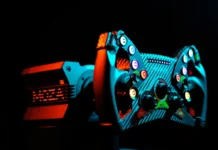
With iRacing Apple Vision Pro, your real steering wheel aligns with the wheel in the simulation. You can also see your actual hands on that wheel, which creates a stronger and more intuitive sense of control.
This matters because sim racing is built on muscle memory. Drivers reach for paddle shifters, rotary switches, and wheel buttons instinctively. When those movements line up naturally with what the eyes are seeing, immersion becomes more believable and control becomes more confident.
It is the kind of thing that sounds obvious only after someone gets it right. For years, VR users had to accept a degree of disconnection between what they felt and what they saw. Here, that gap is significantly reduced, and the result feels far more natural.
Real-Time RTX Rendering
NVIDIA RTX technology plays a central role in delivering the visual quality needed for a premium simulation experience. Thanks to RTX-powered rendering, iRacing Apple Vision Pro can benefit from realistic lighting, improved reflections, more convincing shadows, and stronger overall scene fidelity.
These details are not just cosmetic. They influence how believable the environment feels and how readable the track becomes. In motorsport simulation, visual information matters. The way light hits a braking zone, the visibility of a curb, or the subtle contrast in a cockpit can all affect immersion and, in some cases, performance.
Because rendering happens on a dedicated PC with an RTX GPU, the system can handle the heavy graphical load more effectively than a self-contained headset alone. This helps preserve a premium visual experience without compromising the untethered nature of the headset itself.
The result is a racing world that does not just look attractive. It looks credible, and that makes a real difference.
Latency and Performance
Latency is one of the most important issues in any streaming-based simulation environment. In racing, a small delay can turn a great concept into a frustrating experience. Steering, braking, and throttle inputs all depend on precise timing, so any noticeable lag can break immersion and reduce competitiveness.
That is why low-latency performance is absolutely essential for iRacing Apple Vision Pro. CloudXR is designed to keep response times fast enough for demanding applications, and that gives this platform a far stronger foundation than many people might expect from wireless streaming.
When the system works as intended, the experience feels smooth, immediate, and comfortable. That is critical for long driving sessions, competitive racing, and overall user confidence. Nobody wants a beautiful simulation that feels half a step behind their actions.
In this case, performance is not just about frame rates or technical benchmarks. It is about trust. If the driver trusts the system, the system can disappear into the background, and that is when immersion truly takes over.
Multiplayer in XR
iRacing has built its reputation on organized online competition, structured championships, and a deeply engaged global racing community. Bringing that multiplayer DNA into spatial computing makes the experience even more compelling.
With iRacing Apple Vision Pro, the online racing component becomes more than a competitive feature. It becomes an immersive social and sporting environment where every race feels more immediate and intense.
Competing against drivers from around the world while sitting inside a high-fidelity XR cockpit could elevate the emotional side of racing in a meaningful way. Passing, defending, qualifying pressure, and wheel-to-wheel action all become more vivid when the driver feels physically present in the car rather than simply observing the race through a display.
That added sense of presence may not change the rules of racing, but it certainly changes how those rules feel in action. And honestly, that is a big deal.
Realistic Physics in iRacing
Even before this Vision Pro integration, iRacing was already known as one of the most respected simulation platforms in motorsport. Its strength has always come from its commitment to realistic physics, licensed content, and structured online competition.
The simulation models vehicle behavior in a way that rewards precision, discipline, and consistency. Weight transfer, tire behavior, braking balance, and track conditions all matter. Drivers cannot simply throw the car around and expect forgiving arcade logic to save them.
That is why iRacing Apple Vision Pro has such strong potential. The realism was already there in the software. What this new platform adds is a more convincing way to experience that realism visually and spatially.
When the physical sensation of using your racing rig matches the visual sensation of sitting inside the cockpit, the underlying simulation becomes easier to appreciate. The physics do not change, but the way the driver perceives them becomes more immediate and more engaging.
Cars and Tracks Catalog
One of iRacing’s strongest advantages is the breadth of its content. The platform includes a wide range of cars and tracks covering many of the most important disciplines in global motorsport.
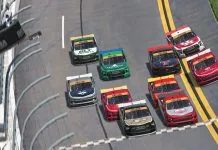
That content range gives iRacing Apple Vision Pro plenty of room to shine. Whether a driver prefers stock cars, open-wheel machines, endurance prototypes, GT cars, or other categories, the immersive XR presentation can add a fresh layer of realism to each discipline.
Likewise, official circuits gain new life when experienced at full scale inside spatial computing. Elevation changes, corner geometry, and trackside detail all feel more tangible when the world around the driver has convincing depth and presence.
This is one of the reasons the platform feels so promising. It is not launching with a thin content library. It is building on an already mature simulation ecosystem filled with recognized vehicles and venues.
Official Licensing
Authenticity matters in motorsport simulation, and iRacing has long benefited from official partnerships with major organizations and manufacturers. These relationships help bring real cars, real brands, and real motorsport culture into the simulation with greater legitimacy.
Among the notable licensed partners mentioned are:
- FIA
- NASCAR
- INDYCAR
- IMSA
- BMW
- Porsche
- Ferrari
- Mercedes-AMG Petronas F1 Team
For iRacing Apple Vision Pro, these partnerships matter because they reinforce the idea that this is not a generic driving game wrapped in fancy hardware. It is a premium simulation platform working with recognized names across professional motorsport.
That kind of authenticity adds value for dedicated sim racers, esports competitors, and motorsport fans alike. It helps the whole experience feel grounded in the real racing world rather than just inspired by it.
Applications Beyond Gaming
Although iRacing is a racing simulation, the broader technology stack behind this launch clearly extends beyond gaming. Apple Vision Pro and NVIDIA CloudXR are also being used for professional design, industrial simulation, digital twins, and collaborative visualization.
This matters because it shows that the technologies behind iRacing Apple Vision Pro are not niche gimmicks. They are part of a wider movement in spatial computing that is already influencing industries such as:
- Automotive design
- Healthcare planning
- Aviation simulation
- Factory visualization
- Infrastructure management
When the same platform can support immersive racing, design review, and industrial workflows, that is a sign of genuine technical maturity. It also means sim racing benefits from advancements being pushed by enterprise demand, which could accelerate innovation across the board.
Impact on Esports
Esports and sim racing already share a close relationship, and iRacing has been a major part of that story for years. Bringing a more immersive XR experience into competitive racing could shape the next stage of that evolution.
iRacing Apple Vision Pro may eventually influence how drivers train, how events are presented, and how spectators think about the relationship between virtual motorsport and real racing. Greater immersion can mean stronger focus, improved spatial judgment, and a more emotionally engaging driving environment.
There is also a branding dimension to consider. High-end XR racing has the potential to make sim racing look even more premium and futuristic, which could be valuable for sponsors, organizers, and automotive partners looking to align with advanced technology experiences.
Whether it becomes the standard or remains a premium niche, the impact on sim racing culture could still be significant.
User Experience
The most telling reaction many people may have to this platform is simple: this does not feel like just another game setup. It feels closer to actual driving.
That is the heart of the user experience in iRacing Apple Vision Pro. Everything points toward reducing friction between the driver and the simulation. The visuals are cleaner. The cockpit feels more present. The hands remain visible. The rig stays relevant. The interface between human and machine becomes less awkward and more intuitive.
For many sim racers, that could be the difference between being impressed for ten minutes and wanting to race for hours.
Comparison With Traditional VR
| Traditional VR | Apple Vision Pro Experience |
|---|---|
| Often isolated from the physical setup | Integrated with the real racing rig |
| Lower visual clarity in many cases | Ultra-high-resolution presentation |
| Limited visibility of real-world hands and controls | Physical hands remain visible on the wheel |
| Can feel more disconnected | Feels more spatially natural |
This comparison does not mean traditional VR becomes irrelevant overnight. It still offers strong immersion and remains more accessible in many cases. Still, iRacing Apple Vision Pro presents a more refined version of the concept, especially for users who care about clarity, alignment, and real-world integration.
Advantages Over Classic Setups
Classic sim racing setups built around single monitors, ultrawide screens, or triple displays still work well and remain popular. They are proven, practical, and familiar. Yet spatial computing introduces some advantages that are hard to ignore.
- Greater immersion without relying on multiple large displays
- Reduced physical space requirements compared with triple-screen rigs
- Improved sense of depth and cockpit scale
- More natural blending of physical controls and digital visuals
For drivers who want an elite immersive experience but do not want a room dominated by giant display hardware, iRacing Apple Vision Pro could become an appealing alternative. It offers a more compact path to high-end immersion, even if it comes with its own cost and hardware requirements.
Security and Privacy
Whenever eye tracking enters the conversation, privacy concerns naturally follow. Apple and NVIDIA have emphasized that approximate gaze data used for foveated streaming is handled in a privacy-conscious way and is not exposed directly to applications.
That matters, because trust is essential in any device that relies on sensitive biometric-style inputs. Users want the benefits of optimized rendering without feeling like their gaze behavior is being unnecessarily collected or shared.
For iRacing Apple Vision Pro, this privacy stance supports the broader premium positioning of the experience. High-end technology is not just about power and visuals. It is also about confidence in how the system behaves behind the scenes.
Developer Ecosystem
Another important point is that CloudXR 6.0 is being made available to developers as a native streaming framework for Swift. That opens the door for more applications built specifically for visionOS and related Apple platforms.
This matters because iRacing Apple Vision Pro is not arriving in isolation. It is part of a wider ecosystem where developers can create high-fidelity consumer and enterprise apps using familiar Apple development tools like Xcode.
The more mature the developer ecosystem becomes, the more likely it is that users will see continued growth in simulation content, utility apps, immersive tools, and new experiences that build on the same technical foundation. That gives the entire platform more momentum.
Industrial Use Cases
One of the strongest signs that this technology has staying power is the list of industries already using the same framework. Automotive companies, healthcare organizations, manufacturers, and data center operators are adopting CloudXR for visionOS to visualize complex models and workflows in full fidelity.
Companies such as BMW Group, Kia, Rivian, Volvo Group, Roche, Foxconn, and Switch are part of this broader story. Their use cases include:
- Design reviews at full scale
- Factory walkthroughs before construction
- Biofluid lab planning
- Digital twin visualization
- Real-time simulation analysis
For sim racers, this may seem far removed from lap times and race starts, but it is actually very relevant. It means the same technological backbone supporting iRacing Apple Vision Pro is being validated in demanding professional environments. That kind of cross-industry relevance usually leads to stronger long-term development and refinement.
The Future of Simulation
Looking ahead, it is hard not to see this as part of a larger shift in how simulation will be delivered and experienced. We are moving toward a future where visual fidelity, spatial awareness, and flexible hardware integration matter more than raw local display size alone.
iRacing Apple Vision Pro represents a glimpse of that future. It suggests a world where simulation rigs become smarter rather than simply bigger, where wireless streaming can support premium experiences, and where XR becomes a serious platform for both play and professional work.
There will still be room for monitors, traditional VR, and hybrid setups. But spatial computing now looks like a meaningful contender rather than a distant experiment.
Current Limitations
As exciting as this development is, it would be unrealistic to ignore the current limitations.
- It depends on a strong Wi-Fi connection
- It requires access to an NVIDIA RTX-equipped PC
- Apple Vision Pro remains a premium-priced device
- Widespread adoption may take time
These are not small barriers. For some users, they will be decisive. Not every sim racer is ready to invest in a premium headset plus a suitable PC environment for cloud-based or streamed XR simulation.
Still, early-stage premium technology often starts this way. The important question is not whether it is instantly mainstream, but whether it points in a convincing direction. In the case of iRacing Apple Vision Pro, the answer appears to be yes.
Frequently Asked Questions
What is iRacing Apple Vision Pro?
It is a spatial computing version of iRacing designed to work with Apple Vision Pro, using NVIDIA CloudXR and RTX-powered PCs to deliver immersive racing simulation.
Do I need a powerful PC?
Yes. The experience relies on a PC equipped with an NVIDIA RTX GPU to handle rendering and simulation workloads before streaming them to Apple Vision Pro.
Can it work wirelessly?
Yes. The setup is designed to stream content wirelessly over Wi-Fi using CloudXR technology.
Is it better than traditional VR for sim racing?
In several ways, yes. It offers higher visual fidelity, better integration with the physical rig, and visible real-world hands on the wheel, all of which can improve immersion.
When will it be available?
It is expected to arrive later in spring 2026 alongside visionOS 26.4 and NVIDIA CloudXR 6.0 support.
What makes it different from a normal racing setup?
The main difference is the blend of physical and digital space. Instead of just looking at a monitor, the driver experiences a spatial cockpit that aligns with the real racing rig.
- Remember, you can join iRacing by clicking here.
See you on the track!
This website uses affiliate links which may earn a commission at no additional cost to you.



Buy Apple Vision Pro
From $3499 or $291.58/mo. per month for 12 mo.months footnote *
hahahahahahaahah
Too much for my humble taste.
Agreed….