
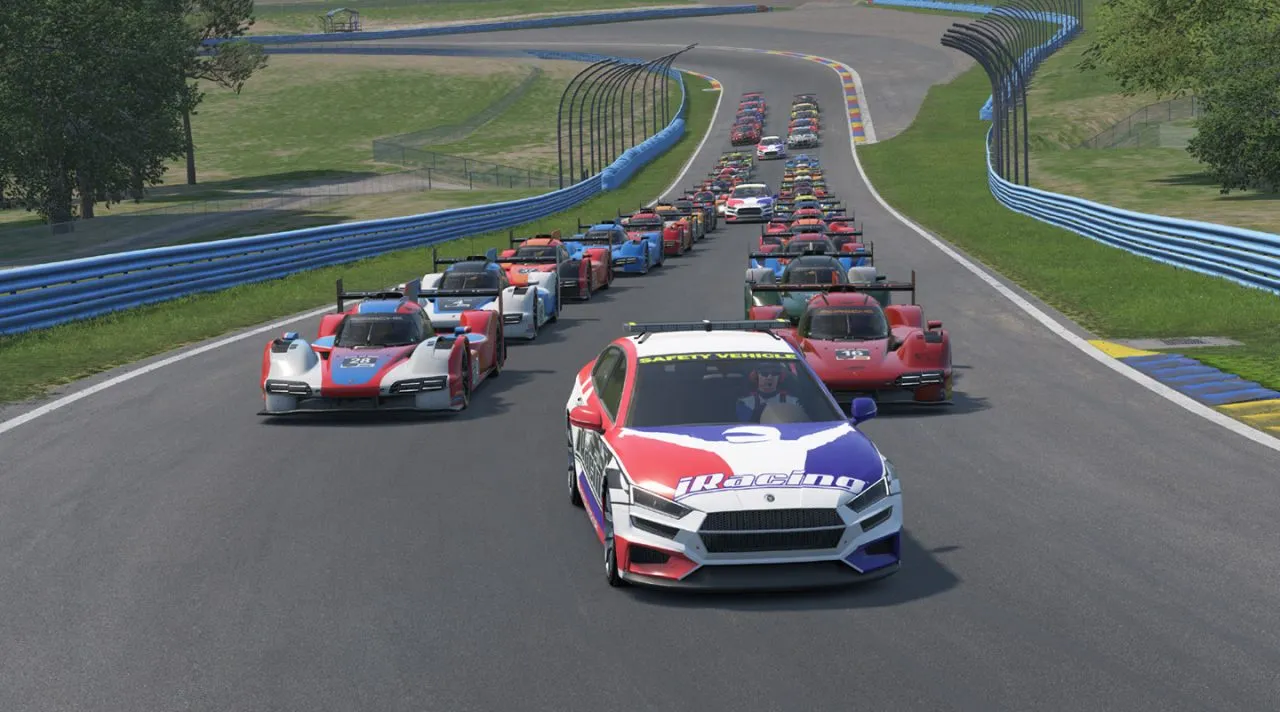

The long-standing problem with iRacing’s multiclass starts has a potential fix, and it’s being tested right now. Starting this week, the iTested Series is running a new multiclass procedure where each class gets its own pace car and its own independent green flag — a change that attacks one of the most frustrating aspects of mixed-grid racing head on.
Don’t forget that you can sign up for iRacing by clicking HERE and receive a 30% discount if you’re a new user.
How multiclass starts work now
Under the current system, classes are ordered on the grid with the fastest in front. A single pace car leads the entire field, and the class leaders set the pace for their group through an unwritten gentleman’s agreement. The GT3 leader controls the speed for the GT3 pack, the LMP2 leader does the same for their group, and so on. Each group manages its own gap to the class ahead — it works in theory, but it’s fragile.
There’s only one green flag, so the fastest class crosses it first and is already on racing pace while the slower classes are still building speed behind them. The result is predictable: by the time the GT3 pack gets a proper run, the leaders are long gone. The gaps are enormous from the very first corner, and the slower cars end up chasing tail lights for half the race. Drivers complain about it every season, and forums fill up with the same arguments every weekend.
What’s different this time
The new procedure, first mentioned in iRacing’s May 2026 development update, assigns a pace car to each class. Classes are released with a calculated delay between groups, and each group gets its own green flag. The idea is simple: every class starts on its own terms, at its own pace, without being held back by the pace of a different machine.
It sounds straightforward, but the execution is where it gets tricky. Get the delay between releases wrong and you create exactly the kind of incident the system was designed to prevent — LMP2 launching into a still-settling GTP pack at Turn 1, for example. Or make it too long and slower classes lose the momentum they need for a proper rolling start. iRacing’s own language in the development update was honest about this: they’re “testing the heck out of this before we’re ready to commit to the release.”
What’s on the track
The iTested series this week (July 21-26, 2026) is using IMSA GTP, LMP2, and GT3 machines at Watkins Glen International — specifically the Boot configuration. Races are 30 minutes long, running every hour on the half hour. That timing makes it easy to drop in between other commitments without committing to a full session.
Incident points without iRating impact
A secondary feature being tested alongside the start procedure is an option for official races where incident points count toward your safety rating, but the session does not affect your iRating. This lets drivers participate meaningfully — earning the rare iTested Award for involvement — without the risk of dropping their competitive standing if something goes sideways during the test.
What to watch for
The real question is whether the timing between class releases feels natural or forced. If the gaps between group launches are too wide, the faster classes converge on the slower ones dangerously early. If they’re too tight, the slower groups race in isolation and lose the competitive tension that makes multiclass interesting in the first place. The gentleman’s agreement that currently holds multiclass starts together is being replaced by a system, which is the right instinct — but systems only work if they’re tuned right.
How to participate
Anyone can join the iTested Series at any point during the week. Participation earns the iTested Award, and drivers who’ve already collected one can earn another. The official feedback and bug report thread on the iRacing forums is the right place to report issues, and iRacing is asking participants to save replay files from any sessions they run — those recordings are how they’ll evaluate what actually happens in practice.
The honest take
Per-class pace cars are the right direction. The current system relies on drivers self-regulating gaps between classes, which works about as well as any unwritten rule in motorsport: it functions until someone doesn’t feel like following it. A proper system removes that variable. But iRacing has a history of rolling out features that look great in developer updates but require multiple iterations before they feel right on the track. This is exactly why the iTested program exists: to find the edge cases before they become the default. If the timing holds up, it’s a meaningful improvement. If it doesn’t, it’ll be another “we’re evaluating” situation that keeps multiclass starts feeling slightly off for another season.
Source: iRacing official announcement and May 2026 Development Update, July 21, 2026.
See you on the track!
This website uses affiliate links which may earn a commission at no additional cost to you.