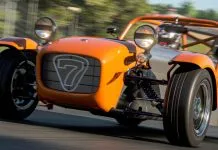



Gran Turismo creator Kazunori Yamauchi says tire simulation remains Polyphony Digital’s most difficult physics challenge, with contact-patch behavior and tire graining still not fully reproduced.
Almost three decades after the original Gran Turismo, Polyphony Digital is still trying to solve one of the most complex problems in racing simulation: how a tire behaves at the point where it meets the road.
Gran Turismo creator Kazunori Yamauchi discussed the subject in a wide-ranging interview with evo, published on August 22. Although the interview was conducted earlier in the year during the FAT Ice Race in Austria, Yamauchi’s comments provide a rare insight into the areas where Polyphony believes its current physics simulation still falls short of reality.
According to Yamauchi, suspension systems, transmissions, differentials and other mechanical components can now be simulated with relatively little discrepancy compared with the real world. Tires remain a fundamentally more difficult problem.
Tire Contact and Graining Remain Difficult to Simulate
Modern tire simulation involves significantly more than assigning a fixed amount of grip to each compound.
Polyphony must account for deformation, different tire dimensions and compounds, temperature changes, wear, track conditions and road surfaces. Complicating matters further, Yamauchi notes that tire manufacturers do not necessarily disclose everything about how their products behave, leaving developers to construct mathematical models from the information and measurements available to them.
One particularly difficult area is how the tire’s contact point with the road changes dynamically. Heat and wear alter the available grip, while different conditions can produce physical effects that are difficult to reproduce accurately in software.
Yamauchi highlighted tire graining as one example that Gran Turismo does not yet fully simulate:
“The level of grain that happens when you have certain conditions on the track, it’s something that we just don’t have yet.”
Graining occurs when stresses on the tire surface cause the compound to begin breaking up, creating small surface irregularities that reduce grip. It can be particularly significant in motorsport, where tire temperature, track conditions, car setup and driving style can determine whether the phenomenon develops.
For a physics engine, reproducing it means modeling not only tire wear as a general percentage but also the changing state of the rubber and its effect on the contact patch.
That is considerably more complicated than simply reducing grip as a tire becomes older.
Gran Turismo 7 Has Just Received Another Major Tire Physics Revision
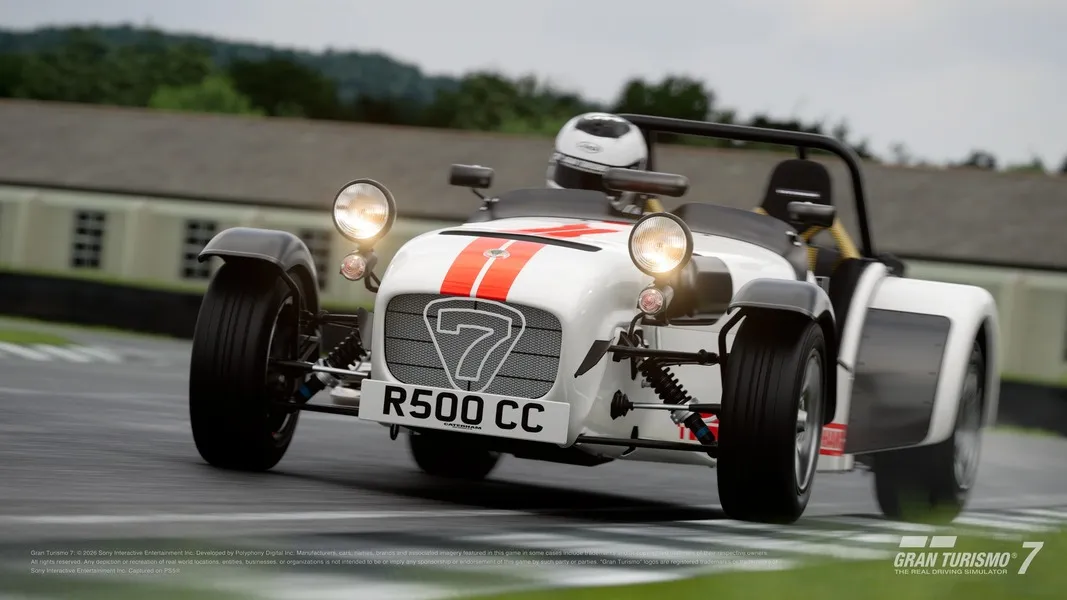
The timing of Yamauchi’s comments is particularly interesting because Gran Turismo 7 Update 1.71, released on August 20, introduced another substantial revision of the game’s physics simulation.
Polyphony’s official patch notes confirm that the tire physics algorithm was revised to improve behavior during wheel slip, optimize road-surface and rolling resistance, change tire heating and wear values, and refine grip loss when driving away from the racing surface with the realistic grip setting enabled.
Update 1.71 went considerably further than tires.
Polyphony also revised suspension and steering physics, including steering geometry and damper characteristics, while making changes to throttle behavior, differential and suspension setup values, traction control and ABS behavior. Steering-wheel users also received revised force-feedback torque and friction alongside improved understeer vibration effects.
However, the official notes make no reference to tire graining or a more detailed dynamic contact-patch simulation.
That distinction is important. The update demonstrates that Polyphony continues to develop Gran Turismo 7’s underlying vehicle dynamics, but Yamauchi’s comments suggest there are still deeper aspects of tire behavior that the studio wants to reproduce in the future.
It is also not a newly discovered challenge for the company. Yamauchi has spoken about the difficulty of tire modeling on previous occasions, making it one of the longest-running areas of physics research within Gran Turismo.
Vehicle Simulation Is Becoming More Complex
Tires are not the only area increasing Polyphony’s workload.
Yamauchi explained that modern vehicles increasingly rely on manufacturer-specific electronic management systems controlling drivetrains, differentials and all-wheel-drive systems. Electric vehicles add another layer of complexity because their power delivery and torque distribution can be controlled with an extremely high level of precision.
The amount of development required for an individual Gran Turismo vehicle reflects that increasing complexity.
According to Yamauchi, creating the visual model and physics implementation for a single car now takes around eight months. He also said recreating the Nürburgring Nordschleife required approximately four years of work. Yamauchi personally drives vehicles near the end of the development process to check whether their simulated behavior corresponds with the real car.
The interview also offers some insight into Polyphony Digital’s relationship with Sony. Asked whether the studio receives pressure to shorten development or cut corners, Yamauchi said that this occurred up to around the Gran Turismo 5 era, but is much less of an issue today.
That freedom may be particularly important as vehicle simulation becomes increasingly detailed.
What Does This Mean for the Next Gran Turismo?
Yamauchi did not mention Gran Turismo 8, and nothing in the interview confirms that a new tire model, graining simulation or another specific physics feature is being developed exclusively for the next game.
Any direct connection to GT8 would therefore be speculation. What the interview does establish is that Polyphony Digital considers its physics technology an ongoing development project rather than something finished with Gran Turismo 7. Update 1.71 provides a recent example, with significant changes arriving more than four years after GT7’s original release.
Tire graining and more sophisticated contact behavior therefore represent clear areas where Gran Turismo’s simulation could still evolve, whether through further GT7 updates or eventually as part of the technological foundation of the next Gran Turismo.
For a series that has carried “The Real Driving Simulator” label since its earliest days, Yamauchi’s comments are a reminder that the closer a simulation moves toward reality, the more difficult the remaining problems become.
You can purchase Gran Turismo 7 by clicking here for the PS4 version and here for the PlayStation 5 Pro and PS4 versions. Additionally, there’s the 25th Anniversary Edition available for PS5 and PS4.
This website uses affiliate links which may earn a commission at no additional cost to you.