
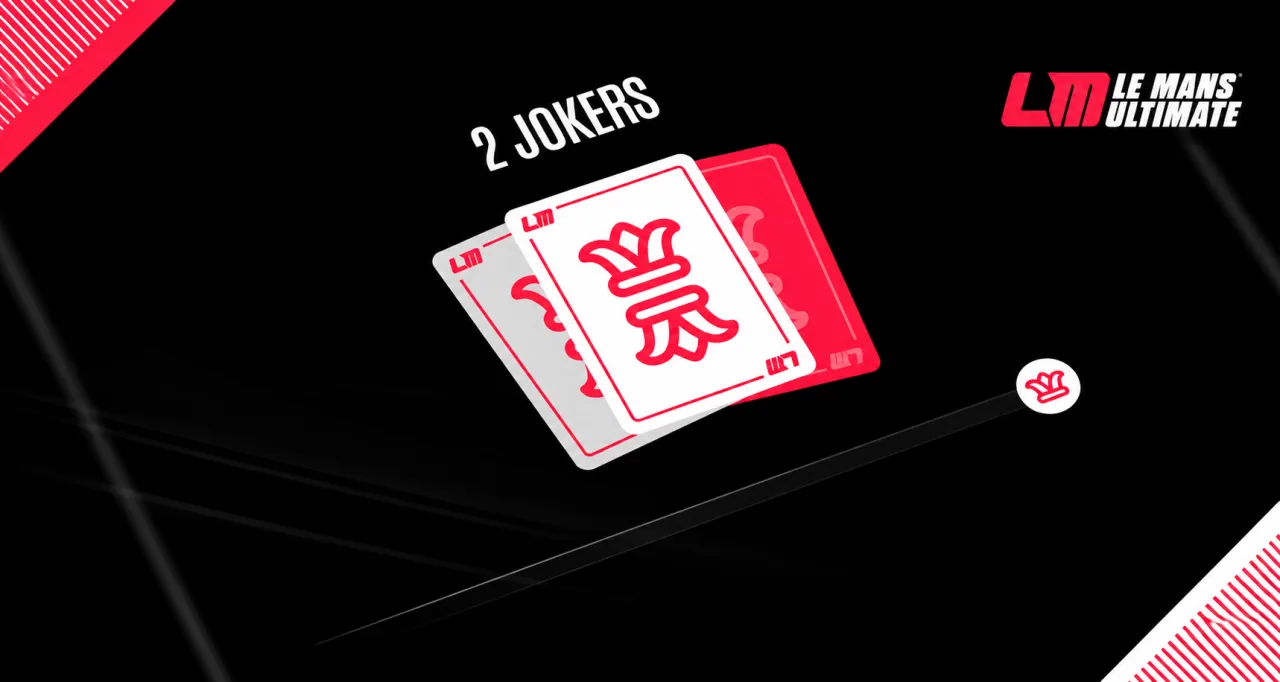

On 21 July 2026, Motorsport Games announced that paying subscribers would be able to erase a bad race from their Driver Rank and Safety Rating. Three days later, on 24 July, CEO Stephen Hood reversed the decision and opened the system to everyone. Here is exactly what the Event Joker does now, why the original plan drew such a fierce response, and what it reveals about how competitive sim racing is monetised.
Le Mans Ultimate’s Version 1.4 update arrives on 28 July 2026, and on paper it is the most significant release since early access: a rebuilt online backbone, a move from TCP to reliable UDP, a completely reworked protest system, and the debut of the US Track Pass with Daytona and Laguna Seca. For the best part of a week, almost none of that got discussed. One feature swallowed the entire conversation: the Event Joker.
What Is an Event Joker in Le Mans Ultimate?
An Event Joker is a card played from the Event Results screen that removes the Driver Rank (DR) and Safety Rating (SR) impact of a single race. The race itself still stands. It still counts as a championship attempt, so it cannot be used to farm a better result. Only the ranking damage disappears.
Under the original plan announced by Studio 397, Jokers were exclusive to RaceControl Pro ($7.99/month or $48/year) and RaceControl Pro+ ($13.99/month or $84/year) members. Subscribers would earn one every 10 races and could hold a maximum of three at a time. Jokers apply only to single-driver events, never to team endurance races.
The stated reasoning was sound enough. An internet dropout, a hardware failure, a first-corner pile-up you had no part in causing, a bug on the developer’s side any of these can wipe out weeks of careful, clean driving through no fault of the player. The idea was never the problem. The problem was who could afford it.
Why Was the Event Joker Paywall So Controversial?
The response across Reddit, X and Discord was immediate and close to unanimous. The label that stuck was not quite pay-to-win but something sharper: pay-to-not-lose.
The underlying argument is statistical, and it is worth setting out properly because everything else follows from it.
An Elo-style rating system rests on one assumption: every participant is exposed to the same variance. Everyone eventually gets punted at turn one. Everyone eventually loses a connection. Over enough races that bad luck distributes roughly evenly, and what is left is a reasonable measure of skill.
A Joker breaks that assumption. If one group of players defined by willingness to pay rather than by pace can truncate the bottom tail of their results distribution, their average rating inflates relative to everyone else. Not because they drive better, but because their worst outcomes are selectively deleted. And since DR and SR determine which split you race in and which events you can enter, the distortion propagates through the entire competitive structure.
Put plainly: the free player who drives impeccably for months ends up on the same grid as a subscriber whose record has been laundered. The system stops measuring the same thing for everybody.
The Second Problem: Moral Hazard
The parallel concern was behavioural. A driver who knows there is a Joker in their pocket recalculates risk. That impossible dive-bomb into the final chicane looks far more attractive when the ranking consequences are erasable. The driver on the receiving end statistically likely to be a non-subscriber absorbs the full SR hit regardless.
In a genre where online driving standards are the single most persistent complaint, introducing an incentive that quietly rewards aggression was, at minimum, counterintuitive.
How Did Motorsport Games Respond?
Roughly 72 hours after the announcement, Motorsport Games published a community update signed by Stephen Hood. It skipped the usual corporate hedging: the company said that in pushing to get more features into the product it got the implementation on this one quite wrong
, and acknowledged that unequal effects on ranking were not a fair way to handle the problem.
Two changes followed, and they work in complementary directions:
- Universal access. Event Jokers are now available to every player regardless of subscription status. The paid ranking advantage is gone entirely.
- Escalating scarcity. Progression is no longer linear. The first Joker takes 10 races, the second takes 20 more, and the third takes a further 30 — 60 races in total to fill the inventory.
Motorsport Games added that it will monitor real usage and adjust earn rates through RaceOS over the coming weeks and months. The company also clarified that standard practice servers were always free to everyone and are in fact doubling in length; the subscriber-exclusive element is the separate Practice+ tier.
Event Joker System: Before and After
| Parameter | Original plan (21 July) | Final system (24 July) |
|---|---|---|
| Access | RaceControl Pro and Pro+ only | All players, including free Lite |
| Earn rate | One every 10 races (fixed) | 10 / 20 / 30 races (escalating) |
| Maximum held | 3 | 3 |
| Effect | Wipes DR and SR for that race | Unchanged |
| Race result | Still stands, still counts as an attempt | Unchanged |
| Eligible events | Single-driver only | Unchanged |
How Long Does It Take to Earn an Event Joker?
This is the number that defuses the moral hazard argument. A full RaceControl entry sign-up, required practice, qualifying and the race itself typically runs 45 to 60 minutes of real time. Using a conservative 50-minute average:
| Joker | Additional races | Cumulative races | Estimated time |
|---|---|---|---|
| First | 10 | 10 | ~8 hours |
| Second | 20 | 30 | ~25 hours |
| Third | 30 | 60 | ~50 hours |
Nobody is going to burn 25 hours of clean racing to fund a dive-bomb. The opportunity cost dwarfs any tactical benefit, which is precisely what the rebalance was designed to achieve.
Motorsport Games also stressed a point worth repeating: a Joker protects your rating, not you. Badge bans, the new protest system and dedicated stewarding all remain in force. Wipe the SR from a race in which you wrecked half the field and your victims’ protests still proceed exactly as normal.
The Deeper Problem Nobody Has Solved
The most revealing part of this episode is not the reversal. It is what the whole affair says about Safety Rating design in the first place.
Le Mans Ultimate, like iRacing and Assetto Corsa EVO, uses a no-fault model. The rating is derived from how many corners you complete per incident point accumulated, and the algorithm makes no attempt to assign blame. If a rival misjudges a braking zone and rear-ends you into the barriers, the database logs a collision for both cars. Both lose Safety Rating.
The technical reason is computational cost: reliably determining fault would mean analysing multi-point telemetry in real time across hundreds of concurrent sessions. The philosophical defence is that, over a long enough horizon, the driver with good spatial awareness avoids trouble while the reckless one accumulates incidents faster. Statistically it holds up. Emotionally it does not.
Because for the player who drops from Gold to Silver because of three crashes they had no part in, the long run is cold comfort. Climbing back means days of driving at 80 per cent, avoiding every wheel-to-wheel opportunity which is to say, days of not racing.
That pain is the product the paid Event Joker was selling. Motorsport Games was, in effect, monetising relief from a condition its own software design creates. And that is the uncomfortable lesson here: the fix is not artificial forgiveness. It is sharpening LiveSteward and the protest pipeline until a no-fault collision becomes a genuinely rare event rather than a statistical certainty every Sunday night.
Why Motorsport Games Tried It: The Financial Context
The commercial incentive is worth understanding, if only because it explains the decision without excusing it. The company that once looked close to collapse is in a considerably healthier position today.
According to Motorsport Games’ official first-quarter 2026 results, revenue reached $4.0 million against roughly $1.8 million in the same period of 2025 a 129.3 per cent increase. Gross margin climbed to 87.2 per cent, adjusted EBITDA rose to $1.5 million from $0.6 million, and net income held at around $1.0 million.
The number that matters most to this story: RaceControl subscriptions now account for 19 per cent of total revenue. That is the figure the company needs to grow in order to fund development through to 2027, when the long-awaited single-player Career Mode and the PlayStation 5 and Xbox Series X|S versions are due.
Motorsport Games also strengthened its balance sheet with a $3 million revolving credit facility from Citibank nil drawn at quarter end, $1.2 million drawn as of 30 April and repurchased 904,395 Class A shares from Driven Lifestyle Group for $3.7 million, retiring all super-voting Class B stock in the process.
Translated: the business is viable, but every point of recurring revenue counts. Hence the temptation to package Jokers as a subscription selling point. And hence, equally, the speed of the retreat losing community trust would have cost far more than Jokers could ever have earned.
What Else Is in the Le Mans Ultimate V1.4 Update?
With the controversy settled, the 28 July release still stands as the most substantial in the sim’s history. The headline changes, as detailed by Studio 397:
- RaceOS. The third-party online services layer is replaced with an in-house platform governing driver swaps, championships, daily races, hosted servers and RaceControl. The studio has warned of an extended maintenance window at launch.
- TCP to reliable UDP. The old protocol paused the data stream to retransmit lost packets, producing the rubber-banding that ruins close racing. The new model verifies only critical state changes and lets the rest flow. Teething issues are expected in the first weeks at scale.
- Replay-based protests. Protests are now filed from inside the replay, flagging the timestamp and driver with video attached as context. The old cooldown is gone, replaced by a 24-hour submission window and three protest credits per month, with a credit refunded for every successful protest. Studio 397 disclosed that protests were averaging 700 per day at roughly five minutes of review each an unsustainable load, and the reason for the overhaul.
- Intentional wrecks only. Outside official online championships, only deliberate wrecking is protestable. Ordinary racing incidents are discarded automatically; championship events remain the venue for those.
- LiveSteward expansion. False positives reduced, experimental rules added, and stationary cars now automatically returned to the garage instead of sitting on the racing line. More than 4,500 temporary bans have been issued since Version 1.3, with repeat offenders receiving progressively longer sanctions.
- Alt+F4 loophole closed. Quitting mid-race to dodge damage or penalties no longer works consequences follow you.
- Rebuilt brake thermals. Disc surface and core temperatures are now simulated separately, improving braking consistency most noticeably in LMP3, LMP2 and some Hypercars.
- Free 2026-spec cars. The Alpine and Cadillac joker aero upgrades are modelled and in game, completing the work started in the previous season update.
- Automatic pit lane placement. Because Daytona and Laguna Seca lack drive-out garages, cars are placed directly in the pit lane on “start driving”, with a penalty for failing to join the fast lane promptly.
- Brazilian Portuguese added as a native language option.
US Track Pass: Price and Release Schedule
The first American pack lands the same day with Daytona International Speedway and WeatherTech Raceway Laguna Seca, both officially licensed and laser scanned. Each of the three packs costs $19.99; the full six-circuit season pass is $44.99, a 25 per cent saving, with a further 10 per cent launch discount in the first week. Packs two and three are expected in late Q3 and late Q4 2026. RaceControl Pro+ subscribers receive the content automatically.
We covered what the move across the Atlantic means for the sim’s ambitions when the pass was first revealed arguably the most consequential strategic decision Studio 397 has made this year.
See you on the track!
This website uses affiliate links which may earn a commission at no additional cost to you.