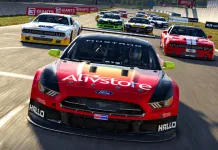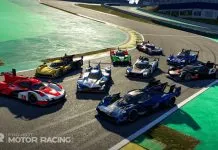



The arrival of Aris Vasilakos to the project has stirred something. That much is clear. His name carries weight in sim racing, not because of empty marketing, but because it’s tied to a very specific way of understanding virtual cars: physics, sensitivity, detail, communication with the community, and that beautiful, dangerous obsession with making a slow corner say something.
His return has sparked hope. And that’s understandable. In a genre where people can argue for forty minutes about whether a Porsche 962 should hint more at the front axle when hitting a kerb, the presence of someone with technical credibility matters.
But here’s the problem: trust doesn’t work like a 12GB patch.
You can’t download it, install it, or have it show up in a changelog with the line “improved public perception of the product.” Trust takes time to build and can be lost in an almost absurd way. One bad launch, promises that never quite feel fulfilled, a sense of an unfinished product and suddenly the player isn’t testing a simulator anymore. They’re conducting an emotional audit.
They boot up the game and think: “Alright, surprise me. But not too much, we’ve met before.” The big question isn’t whether Project Motor Racing can improve. Of course it can. Almost anything can improve. Even Windows Vista might have had a shot if it had gotten a blanket, some therapy, and three more years of development.
The real question is different: can it improve enough for people to start believing again? That’s where the shadow of “PMR 2” comes in. Not necessarily as an official sequel, but as a mental idea. As a psychological escape hatch. As a way of saying: “look, maybe this game is already too tainted, maybe the cleanest move would be to learn from all of this and start over.”

It’s a harsh idea, partly because it’s also unfair. There are studios that have rebuilt entire games after very rocky launches. There are communities that have forgiven when they saw honest work, steady improvements, and a clear direction. But sim racing has one particularity: here, adding nice-looking content isn’t enough.
It’s not just about throwing in legendary cars, tracks, DLCs, or shinier menus. In a simulator, people want to feel the car talking to them. They want the physics to be coherent. They want the force feedback to stop putting on an amateur theater performance. They don’t want the car’s behavior to feel like the result of an argument between a spreadsheet and a toaster. And when that initial feeling fails, it’s very hard to get it back.
The Problem With Fixing Something Already Judged
Some products launch badly, improve a lot, and still carry the label. It’s unfair, but it happens. A first impression in video games works like an ID photo: it might not represent you anymore, but it’s there forever, staring back with a face that says “I didn’t choose this lighting.”
Project Motor Racing now faces exactly that challenge. It doesn’t just need to improve. It needs to win back people who already left. And that’s far harder than winning over new players.
For PMR, every new piece of content isn’t received simply as “more cars.” It’s received as an exam.
- Do they handle well?
- Do they convey weight?
- Do they have personality?
- Do they feel different from one another?
- Is there aerodynamic sensitivity?
- Does low-speed behavior make sense?
- Does the car feel like a car, or like a rug with stats attached?
That’s the level of scrutiny the project now faces. And it’s not because the community wants to be cruel. Well, maybe a little, since the internet sometimes has nails for breakfast. But mostly it’s because sim racing thrives on that demand. Players aren’t asking for magic. They’re asking for coherence.

The game needs to move from “the product that disappointed” to “the product that’s finding its footing.” And that shift doesn’t happen with one grand statement. It happens through accumulation.
- A patch that actually improves something real.
- A car that finally feels alive.
- An honest explanation.
- A long-awaited feature that arrives without feeling like a gimmick.
- A DLC that doesn’t just look good, but drives well.
- A skeptical player who comes back and says: “hey, careful, this isn’t so bad anymore.”
That last point is worth gold. Because when a skeptic starts doubting their own cynicism, something is happening. That’s the moment a community can start to turn around. The team needs to act as if this were the decisive moment. As if it couldn’t afford to save the important fixes for a hypothetical sequel. As if every improvement had to prove that the current project deserves to exist, not just survive.
Because “PMR 2” can be an idea. It can be a joke. It can be a bitter prediction. But it can also become a mental trap: the perfect excuse not to demand that the current game be better right now. And if Project Motor Racing needs anything, it’s not a distant promise. It’s a visible transformation.
You can buy them with a discount by clicking here:
- Project Motor Racing
- Project Motor Racing Year 1 Bundle
- Project Motor Racing Group 5 Revival Pack
- Project Motor Racing GTE Decade Pack
It needs a deep, patient, demonstrable rebuild. It needs every new car, every patch, and every decision to tell the community: “yes, we understood the problem.”
This website uses affiliate links which may earn a commission at no additional cost to you.