

Straight4 Studios is trying to redeem its chaotic and low rated release with more content and several changes. Let’s see what they have to show this time.
Japan’s top-tier GT series has a rare kind of magic: homegrown, distinctly regional, not even vaguely concerned with outside trends, and yet somehow evolved into one of the most beloved tin-top racing championships in the world.
So why do fans adore it? The reasons aren’t hard to find.

Start with race weekends that regularly feature 40+ cars, split between the insanely fast GT500 class — factory silhouette machines turned up to eleven — and the wonderfully chaotic GT300 class, a mix of GT3 cars and home-grown specials, ranging from screaming V8s to improbably quick Priuses. The result? Non-stop battles, traffic management, and strategy playing out across the entire field, lap after lap.
Then there’s the cultural side. Itasha (anime-themed) liveries aren’t a gimmick here —they’re part of the DNA. Add in near-tribal fan loyalty and you’ve got grandstands divided between Nissan, Toyota, and Honda (the famous “J3”), with supporters waving giant flags, wearing team colours head to toe, and cheering like it’s a derby match.
In SUPER GT, like football, you choose a team and you don’t, ever, swap sides!
Oh, and yes — there’s the famous Race Queen culture. In SUPER GT, these brand ambassadors travel the calendar, have their own merchandise, and draw crowds for autograph sessions that sometimes rival the drivers themselves. It’s a uniquely Japanese blend of motorsport, pop culture, and fandom — and the Race Queens are unapologetically part of the show.

For a great primer on the series, check out this official SUPER GT overview from the organisers. Or you can sit back and watch the SUPER GT official YouTube channel
And now the good news for sim racers…
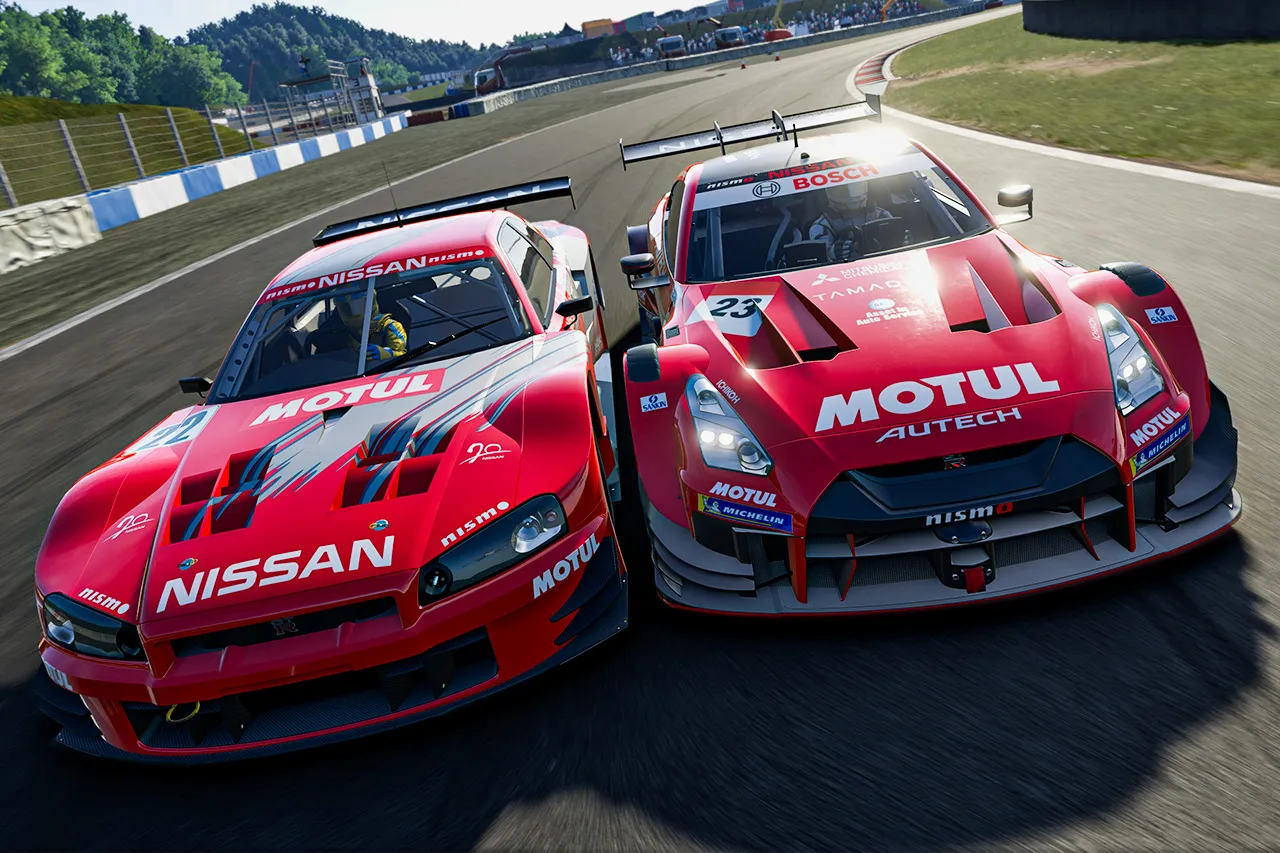
Project Motor Racing will be the first sim on any platform to bring the full flavour of modern SUPER GT to life with the Japanese GT500 Pack, featuring five current GT500 machines alongside four icons from the golden age of JGTC, and one new circuit.
What’s in the Japanese GT500 Pack
FIVE CURRENT SUPER GT CARS
- Honda Civic GT500 2024: A radical new GT500 silhouette that hides prototype-level aero and race engineering beneath a familiar production shape.
- Honda NSX GT500 2022: The final evolution of Honda’s NSX GT500 platform, prized for balance, precision, and high-speed confidence.
- Nissan Calsonic Impul Z GT500 2022: Nissan’s modern GT500 flagship, blending compact silhouette aggression with high-speed stability and relentless factory development.
- Nissan Motul Autech GT-R GT500 2021: The culmination of Nissan’s GT-R era in GT500, combining extreme downforce with race-hardened stability.
- Toyota GR Supra GT500 2022: Toyota’s GT500 spearhead, engineered for aerodynamic efficiency, tyre management, and relentless race pace.

FOUR CLASSIC JGTC GT500 ICONS
- Honda NSX JGTC 2003: Honda’s mid-engined GT icon, defined by balance, agility, and a decade of relentless top-class development.
- Nissan Fairlady Z (Z33) JGTC 2004: Nissan’s next-generation GT500 challenger, introducing a compact silhouette optimised for modern aero performance.
- Nissan Skyline GT-R (R34) JGTC 2003: The GT-R legend in its JGTC prime, marrying iconic silhouette with uncompromising factory racing pedigree.
- Toyota Supra JGTC 2002: Toyota’s golden-era GT hero, pairing aggressive aero with race-winning consistency in the peak years of JGTC.

ONE EPIC JAPANESE CIRCUIT
Takimiya Circuit, a circuit built for lap-by-lap immersion in true SUPER GT style.
This is a technical and flowing racetrack tucked into the hills of western Japan. At just over 3.7 kms (2.3 miles), the track combines tight hairpins, medium-speed sweepers, short straights, and tricky and off-camber corners.
It’s a circuit that favours precision and mechanical grip over brute power, and drivers who can keep it clean and disciplined will always be rewarded with lap time here.

Legends Are Forged by Steel… and Carbon
Born in 1993 as the All-Japan GT Championship (JGTC) and reborn as SUPER GT in 2005, this series isn’t just a race calendar — it’s a national event culture.
And no, this isn’t your grandma’s “GT” racing. These cars are characters.
GT500 has always been a rolling identity parade: Nissan, Honda, and Toyota building machines that look vaguely like road cars, but under the skin are basically prototypes — bespoke chassis, serious aero, and performance that wildly exceeds what the badges suggest.
So how fast are they?
While GT3 cars compete globally under Balance of Performance rules designed for customer racing, GT500 machines are factory-developed silhouette racers with far greater aerodynamic and mechanical freedom. Put them side by side on the same circuit and the gap is brutal: At Suzuka, GT500 has lapped around 15 seconds faster in qualifying than international GT3 machinery, and over 12 seconds quicker in race trim under comparable conditions.
That’s what happens when you mix serious downforce, manufacturer development budgets, and zero interest in playing nice.
Oh, and they do it without traction control or ABS. Because in SUPER GT, that kind of safety net is as welcome as a blue flag in qualifying.

Two Eras, One Obsession: Manufacturer Pride
For many fans, the early-2000s JGTC era is the one that burned itself into pop culture. The Skyline GT-R (R34), Honda NSX, and Toyota Supra weren’t just race cars — they were national symbols. Poster cars that turned up on Sundays to settle things at racing speed, with fan sections roaring like rival football terraces.
Watch: Classic JGTC highlights — 2003 battles.
The modern GT500 era took that energy and sharpened it. From around 2014, regulations pushed toward cost control and technical alignment—common tubs, tighter frameworks—but manufacturers still express themselves through aero philosophy and silhouette. The result is a grid of cars that look familiar yet behave like weapons.
Different shapes. Same obsession: winning.

Facts Worth Knowing
GT500’s performance philosophy is closer to DTM’s “Class One” than to GT3. The shift to 2.0-litre turbo fours placed GT500 in a performance and aero bracket well above customer GT racing.
Since 2014, manufacturers share a common monocoque, but identity still lives in aero packaging and silhouette. It’s controlled chaos by design.
Top Drivers! The Heroes of GT500
Current Heroes
Shō Tsuboi (Toyota): Modern benchmark for pace and consistency.
Tsugio Matsuda (Nissan): Nissan’s talisman, thrives under pressure.
Kenta Yamashita (Toyota): Qualifying weapon with race intelligence.
Yuji Kunimoto (Toyota): Relentlessly dependable across eras.
Nirei Fukuzumi (Honda): Raw speed, especially over one lap.
All-Time Legends
Ronnie Quintarelli: The modern (Italian!) GOAT of GT500.
Satoshi Motoyama: The bridge between JGTC and SUPER GT.
Kazuyoshi Hoshino: Foundational icon of Japanese GT culture.
Masahiro Kageyama: JGTC golden-era master.
Tsugio Matsuda: Rare crossover between modern dominance and all-time status.
…and a final nod to André Lotterer, whose success in Japan helped elevate GT500’s global reputation.
The Champs from the Japanese GT500 Pack
2003 Champion: Satoshi Motoyama & Michael Krumm in Nissan Skyline GT-R (R34).
2022 Champion: Kazuki Hiramine & Bertrand Baguette in Nissan Z GT500.
2023 Champion: Sho Tsuboi & Ritomo Miyata in Toyota GR Supra GT500.
2024 Champion: Sho Tsuboi & Kenta Yamashita in Toyota GR Supra GT500.
2025 Champion: Sho Tsuboi & Kenta Yamashita in Toyota GR Supra GT500.

The Japanese GT500 Pack
After reading all that, how can you not love this series?
In summary, this pack gives you two eras in one hit:
- Classic JGTC Legends: Loud shapes, iconic badges, raw energy.
- Modern GT500 Titans: sharper, faster, more precise silhouette racers.
- Takimiya Circuit: fast, flowing, and rich in Japanese motorsport history.
This isn’t “just more cars” added to Project Motor Racing. This is a slice of one of motorsport’s most distinctive cultures. Where manufacturer rivalry is personal, and every season feels like a rolling exhibition of Japanese performance identity.
Watch the Japanese GT500 Pack release trailer, and get ready to race side-by-side!
Discuss this news item in our forum or in Discord.
You can buy them with a discount by clicking here:
- Project Motor Racing
- Project Motor Racing Year 1 Bundle
- Project Motor Racing Group 5 Revival Pack
- Project Motor Racing GTE Decade Pack
This website uses affiliate links which may earn a commission at no additional cost to you.