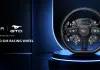

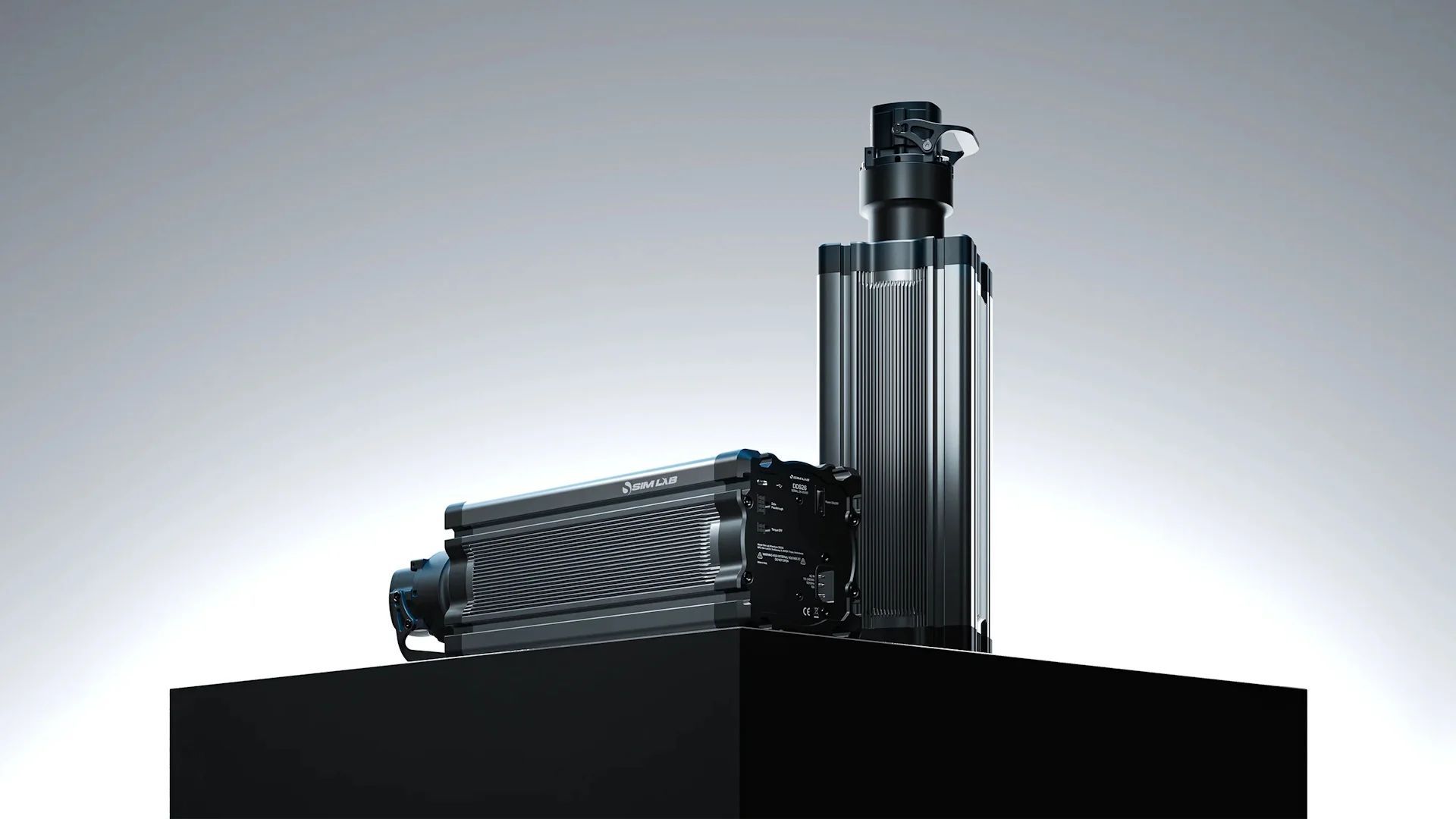

Yes, pre-orders are open. Sim-Lab opened the order books for its first-ever direct drive wheelbases on 1 August at 16:00 UTC, and as of today both models are still available to reserve. Here is everything that matters: pricing, specs, what makes the 350 V architecture different, and whether the 39 Nm version is worth the extra €500.
Pre-order the DDS TorqueSync Founders Edition →
| DDS26 TorqueSync | DDS39 TorqueSync | |
|---|---|---|
| Peak torque | 26 Nm | 39 Nm |
| Price (EU) | €1,499 | €1,999 |
| Price (US) | $1,499 | $1,999 |
| Housing length | 380 mm | 420 mm |
| Weight | 11.1 kg | 13.5 kg |
| Internal PSU | 1,500 W peak | 2,500 W peak |
| DC bus | 350 VDC @ 25 A | 350 VDC @ 40 A |
Every unit in the launch run ships as a Founders Edition, which is not a paid upgrade. It is simply what the first batch is. That means a serialised engraving, the new Xero-Play Quick Release V2 in the box, and a collector’s booklet. Sim-Lab normally sells the quick release separately, so the QR alone takes a meaningful bite out of the effective price.
Shipping is scheduled to begin in the last week of October 2026. Orders are placed with a refundable deposit rather than a locked-in full payment, which is a friendlier structure than some of the crowdfunded launches this hobby has endured.
Wait, wasn’t this called the DDX?
It was. When Sim-Lab first showed these bases at SimRacing Expo in Dortmund, they wore DDX badges and carried a €1,399 early-bird figure for the smaller model. Between the reveal and today the range was renamed DDS TorqueSync, and that €1,399 pre-order discount did not survive to launch. The 26 Nm base is €1,499 whether you order today or in December.
If you have a bookmark from last autumn pointing at a DDX page, it will redirect. And if you land on Sim-Lab’s older marketing page, ignore the FAQ line that still says pre-orders are coming soon. That section simply hasn’t been refreshed. The live product page is the one to trust.
What Sim-Lab actually built
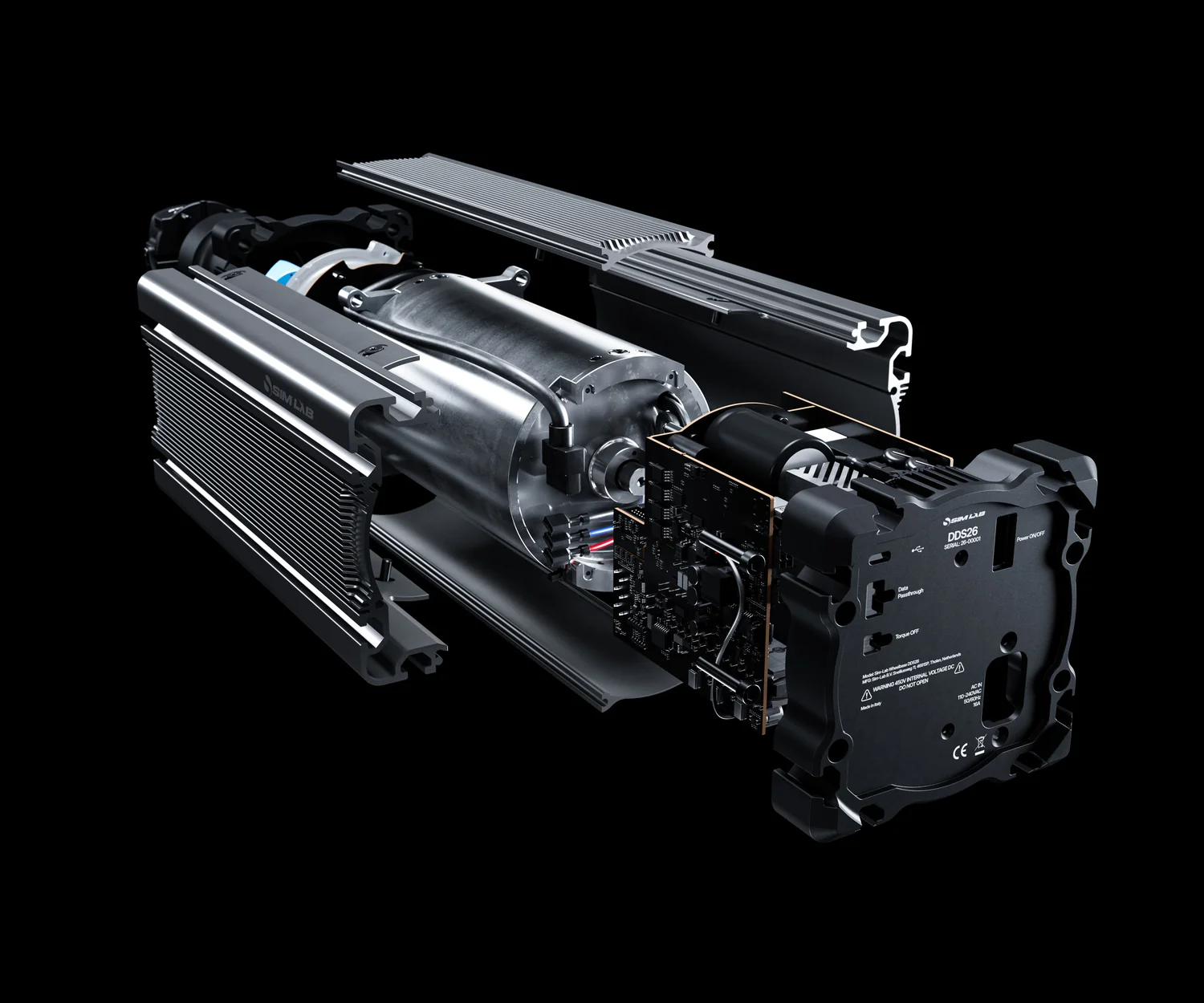
Sim-Lab has spent a decade as the aluminium-profile company. If you own a rig built from extrusion, there is a fair chance their logo is on it somewhere. Wheelbases are new territory, and rather than fake it in-house they partnered with SOLO Motorcontrollers, an Italian motor control specialist. The bases are engineered and manufactured in Italy at an ISO-certified facility and carry a TÜV SÜD approval mark, which is a detail worth noting in a category where “certification” often means a sticker.
The 350 V bus is the headline
Almost every consumer direct drive wheelbase runs a 48 V supply. Sim-Lab runs 350 VDC internally, and this is the single most interesting engineering decision in the product.
Here is why it matters in plain terms. Current produces torque; voltage determines how fast you can change that torque. As the motor spins it generates back-EMF that rises with speed, and a controller can only push current into the motor while its bus voltage stays comfortably above that back-EMF. A 48 V system hits that ceiling sooner, so torque tapers off at speed and transitions get slower. With 350 V of headroom, torque stays available across a wider speed range and the slew rate climbs substantially.
You feel slew rate at exactly the moments that matter: catching a snap of oversteer, clipping a kerb, recentring the wheel after a save. Those are short, violent demands for a torque reversal, and headroom is what lets the base deliver them without going mushy.
The trade-off is power delivery. You cannot run 350 V off a consumer power brick, so the PSU is integrated into the housing: 1,500 W on the DDS26, 2,500 W on the DDS39. One mains cable, no floor brick, fewer failure points. It also explains why these bases are heavier than most of their competition.
TorqueSync and the 100 kHz loop
TorqueSync is Sim-Lab’s patented signal translation layer, and the claim is a torque loop running at over 100,000 updates per second on a multi-core DSP. That is an order of magnitude above what most bases advertise. Paired with a 24-bit encoder (roughly 16.7 million counts per revolution), the control loop always knows precisely where the wheel is, which is what keeps commutation artefacts and cogging out of the feedback.
Sim-Lab also states the torque figures are true sustained numbers rather than momentary peaks, with no thermal derating partway through a stint. For endurance racers that consistency is arguably more valuable than the peak figure itself.
Open ecosystem and passthrough
This is where Sim-Lab is drawing a line against the closed platforms. The bases use a Ø70 mm M5 bolt pattern, accept any third-party wheel, and offer full USB 2.0 data passthrough to the PC via a USB 3.0 connector on the back. There is a dedicated 5 V rail at 2,500 mA (five times a normal USB port) for rims stacked with displays, LEDs and encoders.
The slipring is rated for 200 million cycles and, crucially, is user-replaceable from the front in about ten minutes. No RMA, no shipping a 13 kg base across a continent because a wear part wore.
RaceDirector software
Configuration runs through RaceDirector, built from scratch for these bases. Beyond the usual torque, damping, filter and slew rate controls, it offers a telemetry FFB view that overlays the incoming simulator signal against the motor’s actual torque output. Tuning by data instead of vibes is genuinely useful, and profile sharing is built in.
One caveat worth flagging: iRacing’s 360 Hz FFB mode is not in the day-one build. Sim-Lab says the control stack already supports it and it will arrive via firmware update, but if that mode is a must-have for you today, it isn’t there yet.
DDS26 vs DDS39: which one should you actually buy?
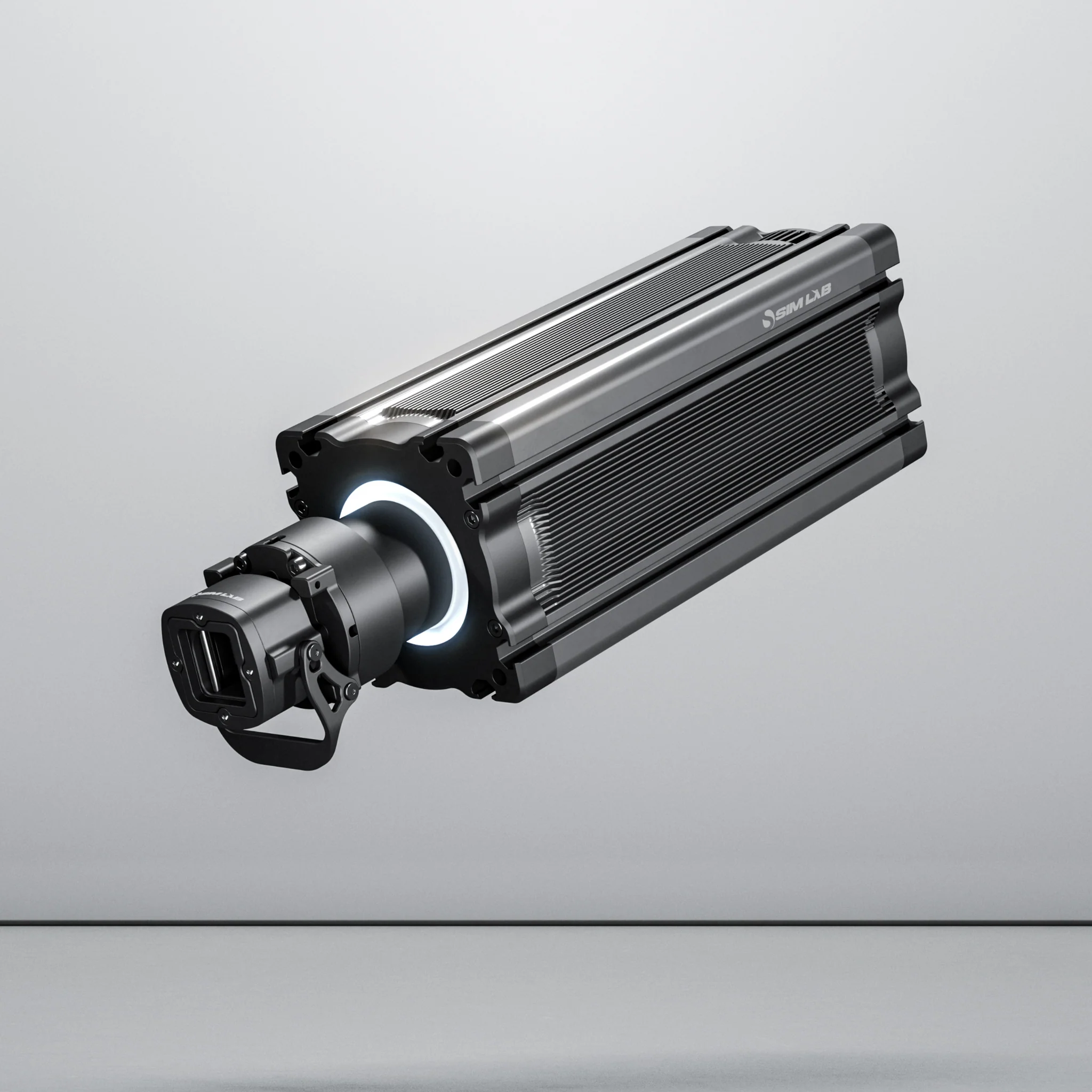
For the overwhelming majority of sim racers, the DDS26 is the correct answer, and it isn’t close.
Most drivers run somewhere between 8 and 15 Nm day to day. Owners of high-torque bases routinely dial them down after the novelty wears off. High peak torque doesn’t buy you an arm-wrestling match. It buys headroom, so the base never clips and never flattens a kerb strike because it ran out of ceiling. At 26 Nm you already have far more headroom than any GT, prototype or open-wheel car will ask for.
The DDS39 makes sense for a narrower group: commercial sim centres, professional teams doing driver-in-the-loop work, and enthusiasts who simply want the biggest number available and have the budget for it. No judgement here, but for everyone else that’s €500 which could go toward pedals, and pedals will do far more for your lap times than 13 extra Newton-metres.
Note also that the two bases are not otherwise identical. The DDS39 is 40 mm longer, 2.4 kg heavier, and carries the larger 2,500 W supply. Check your cockpit clearance before ordering if you are front-mounting into a tight bulkhead.
How it stacks up against the competition
At €1,499 the DDS26 lands directly on top of the Simucube 3 Pro and in the same neighbourhood as Asetek’s Invicta. Against that company it brings a materially different electrical architecture, an integrated PSU, a replaceable slipring, a genuinely open wheel ecosystem, and a four-year international warranty that is longer than most of the field offers.
What it does not bring yet is a track record. Simucube has years of firmware iteration behind it. Asetek and Fanatec have established RMA pipelines. Sim-Lab has a strong reputation in cockpits and an excellent Trustpilot history, but this is their first motor product, and first-generation hardware from any brand carries some risk. The refundable deposit structure and the 48-month warranty both soften that, and manufacturing in Italy with an established motor control partner is about as de-risked as a debut gets.
If you want to wait for independent reviews before committing, that is a perfectly rational position. Units don’t ship until late October, so the first hands-on impressions should surface well before anyone’s base is built.
Pricing, availability and where to order
- Europe: €1,499 (DDS26) or €1,999 (DDS39). Order from Sim-Lab EU
- United States: $1,499 or $1,999, shipped from Sim-Lab’s Pennsylvania warehouse with no import duties
- Australia: AU$2,499 or AU$3,599
- Rest of world: €1,238.84 or €1,652.06 ex. VAT
- Rest of the Sim-Lab catalogue: cockpits, pedals and mounts
Worth budgeting for on top: a side-mount or front-mount bracket if your rig needs one, and additional Xero-Play V2 wheel-side adapters if you run multiple rims. Sim-Lab deliberately put the expensive precision mechanism on the base side, so extra wheel-side modules are comparatively cheap. It is a sensible total-cost-of-ownership decision that most brands get wrong.
Should you pre-order?
Pre-order if:
- You’re already in the Sim-Lab ecosystem and want a rig that bolts together without adapters
- You want the Founders Edition QR and serial while the first batch lasts
- You value an open wheel ecosystem and repairable wear parts
- A four-year warranty matters to you
Wait if:
- You need iRacing 360 Hz FFB today
- You’re upgrading from an existing high-end base and have no urgent gap to fill
- You prefer to see third-party measurements before spending €1,500 on a debut product
For everyone else, the deposit is refundable and the first batch is finite. That combination usually makes the decision for you.
Reserve a DDS TorqueSync Founders Edition →
Frequently asked questions
Are Sim-Lab DDS TorqueSync pre-orders open right now?
Yes. They opened on 1 August 2026 at 16:00 UTC in both Europe and the United States and remain open as of 3 August.
When do the DDS TorqueSync wheelbases ship?
Sim-Lab lists the last week of October 2026 for the first shipments.
How much do they cost?
€1,499 for the 26 Nm DDS26 and €1,999 for the 39 Nm DDS39. US pricing mirrors those figures in dollars.
Is a quick release included?
Yes, for the launch run. Every Founders Edition unit includes the Xero-Play Quick Release V2, which Sim-Lab otherwise sells separately.
Do they work with third-party steering wheels?
Yes. The Ø70 mm M5 bolt pattern is an industry standard, and USB data passthrough supports rims with USB-C, USB-A or internal connectors.
Are the pre-order deposits refundable?
Sim-Lab states that units are reserved with a refundable deposit.
Is this the same product as the DDX shown at SimRacing Expo 2025?
Yes. DDX was the pre-production name, and DDS TorqueSync is the production range.
Does it support console?
No. These are PC-only bases, supporting iRacing and the other major PC titles.
This website uses affiliate links which may earn a commission at no additional cost to you.