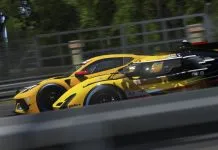


You are there, looking at the telemetry or the video of that guy who is one second faster than you. You watch him approach the corner and think: “Aha! The secret is that he keeps braking all the way into the kitchen.”
So you jump in the car, full of determination, you hit the braking zone and decide to apply the famous Trail Braking. You keep the brake pedal pressed while you turn and… disaster. The car goes crazy, the rear end tries to overtake you, you get scared, you lift off, you go wide, and you end up waving to the marshals from the gravel trap.
You feel stupid. And the worst part is you think: “I don’t have the talent for this, I better go back to braking in a straight line, releasing, and then turning.”
But I have some news for you: Your feet were doing it right. The problem is your hands.
The Syndrome of “Rookie Hands”
Here is the raw reality: If you brake like a professional (Trail Braking) but steer like a rookie (classic entry), you are begging for a crash.
When we don’t trail brake, we get used to a very safe technique: we brake everything in a straight line, we release the brake, and make a quick transition: Zap! We turn the wheel. Since the nose of the car isn’t loaded with weight (because you already released the brake), we rely on predictable understeer. It’s comfortable. It’s safe. But it is slow.

The mistake is that you are trying to apply that same aggressive and late steering input while you still have the brake pressed.
Think about it: you have all the weight of the car smashing down on the front tires. The car is hyper-reactive; it is a nervous squirrel. If you give it a quick “whip of the wheel” at that moment (like you used to), physics tells you: “See you later.” The car rotates too fast, you lose your line, and panic sets in.
The Solution: Flip the Switch (and the Line)
For Trail Braking to work, you have to understand that the geometry of your corner has changed. You are no longer doing a perfect “U”. You are doing a “V”. Or what I call a closing spiral.
If you want to stop fighting the car, you have to do something that will feel wrong to your brain at first:
You have to turn in earlier.
Yes, you heard that right. Turn earlier, but… turn slower.
Here is the million-dollar secret: In the entry phase, when you are still braking hard, your hands need to move in slow motion. You need an early entry but with a smooth and progressive steering input. Don’t hunt for the apex immediately. Simply indicate to the car where you want to go without stressing it.
By turning earlier and smoother, you compensate for that excessive reactivity of the car. You don’t give the suspension a scare; you invite it to dance.
The “Ramp Up”: Where the Magic Happens
Now comes the fun part. You entered early, your hands were smooth, and the car is rotating beautifully towards the inside because you are holding a bit of brake. The car is listening to you.

This is where the movie changes compared to traditional driving.
As you get closer to the middle of the corner (mid-corner) and the apex, the car’s rotation becomes more progressive. Instead of getting scared, this is where your hands need to wake up.
You switch from that initial smoothness to an aggressive “Ramp up.” Now you crank the wheel. Since you have taken a “V” line, you need to rotate the car a lot in the center of the corner to shoot out straight.
- Without Trail Braking: Aggressive initial turn, wait, exit.
- With Trail Braking: Smooth and early initial turn, increase angle aggressively in the center, exit like a rocket.
Stop blaming your feet or the car setup. If you feel stuck and the car feels “squirrelly” or unstable, look at your hands.
It is very likely that you are trying to force a “coasting” line with an advanced braking technique. It doesn’t work that way. If you change how you brake, you have to change how you steer.
The next time you hit the track, try it: Anticipate your entry, soften your hands at the start, and be aggressive in the middle. You will see how that second you were missing starts to magically appear. And best of all: you will stop mowing the lawn on the exit of the corners.
See you on the track!
This website uses affiliate links which may earn a commission at no additional cost to you.