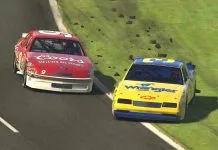


There is something sim racing drivers do constantly without even realizing it: we arrive at the apex too early, and then we wonder why the car seems determined to run off track as if it had a mind of its own and genuinely bad intentions.
And if there is one thing I have seen repeat itself with an almost comedic consistency across drivers of every skill level, it is this: people arrive at the apex too early, and then suffer the consequences on the exit like someone who made a life decision they can no longer take back.
Today I want to talk about something that sounds simple but has far more nuance than you might expect: exactly when should you be hitting that inside kerb?
The Great Apex Misunderstanding
First, let’s get our terms straight. When we talk about the apex, we are talking about the inside point of a corner that you hit during your line. You can arrive there early (before the geometric midpoint of the corner) or late (after that midpoint). That is it. No dark arts involved, even though it sometimes feels that way.
The logic behind each option is actually quite elegant:
- An early apex means you have less turning to do during corner entry, which lets you carry more entry speed. Sounds good, right? The problem is that the exit gets complicated: you have to keep turning more and for longer, which forces the car to slow down right at the moment you wanted to be pinning the throttle and charging toward glory.
- A late apex does the opposite: you enter slightly slower because you are turning more during the entry phase, but the exit opens up beautifully, clean, with the car pointing straight and the throttle practically begging you to floor it.
The key, and this is the heart of everything, is understanding which part of the corner actually matters most to you.
The Rule Nobody Told You About
You have probably heard the saying: “late apex on corners that lead onto long straights.” It is correct, but incomplete. And that incompleteness is exactly why so many people assume that on corners with no significant straight afterward, the early apex is the right call.
Wrong. Spectacularly wrong.
The real question is not whether the exit is long. The real question is whether the exit is longer than the braking zone. And here comes the stat that tends to catch people off guard: in 99% of normal corners, the exit is considerably longer than the braking zone. Which means that in practice, the late apex is the right answer almost everywhere.
Yes, you read that correctly. You almost always want to arrive late at the apex. That is not a typo.
So How Late Is “Too Late”?
Here is where it gets interesting, because there is a limit. If you arrive at the apex so late that you have essentially already finished the corner by the time you touch the kerb, it means you had to brake so hard on entry that the exit ends up under the limit. The car floats out on its own, effortlessly, no drama… and no speed. That is no use to anyone.
The golden rule is this: take the apex as late as possible while still being forced to use all the track on the exit.
If you have asphalt to spare on the exit, you went too late. If on the exit you have to delay the throttle or the car drifts to the outside before you can do anything about it, you went too early. The perfect point is that slightly tense, almost uncomfortable moment where the car uses every last centimetre of available track while you accelerate with conviction.
When you get it right, the delta bar turns green on the following straight as if by magic. Well, not exactly magic. Physics. But the feeling is pretty similar.
So the next time you are unsure where to place your apex, ask yourself one single question: am I using all the track on the exit? If the answer is yes, you are on the right track. If not, you already know what to adjust.
You will arrive late to the apex. And this time, arriving late will be exactly the right move.
Remember, you can join iRacing clicking here.
This website uses affiliate links which may earn a commission at no additional cost to you.