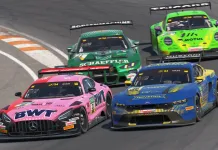


There is a type of driver who ruins your races in an almost artistic way.
I am not talking about the fast one. I am talking about the one who brakes late “just because”, dives to the inside as if physics were optional, and when everything goes wrong (because it usually goes wrong), rejoins the track as if he were playing Tetris with your racing line.
If you have ever shouted “How did he hit me there?!” at the monitor, this is for you.
In 30 Seconds
When the driver behind you is aggressive and inconsistent, slamming the door shut usually makes it worse: you force him to brake right behind you, and if he cannot control his own braking point, he is even less likely to control yours.
The alternative is simple: let him pass in the right place, with space, and take the position back when he out-brakes himself or exits the corner poorly.
The Treacherous Instinct: “I’m Not Giving Him the Inside”
We all do it. You see the kamikaze in the mirror and think:
“No way I’m gifting him the inside.”
So you close the door. A little more. A little more. Until the door is so shut that the only thing missing is a sign that says NO ENTRY.
And then the inevitable happens.
That driver does not brake where you brake. Sometimes he does not even brake where he should brake. He brakes where his adrenaline decides to brake, usually about 20 meters after common sense.
Result: he hits you from behind. You feel like you defended perfectly, but your rear bumper becomes his braking marker.
The Irony
You think: “But I gave him zero space to dive.” Exactly. That is why he hit you.
When you shut the door too much, you leave him only one option: braking right behind you. And if he cannot manage his own braking point, he is not going to manage yours either.
Defending against an inconsistent driver is like trying to dance closely with someone who has two left feet: synchronization is the trap.
How Your “Strong” Defense Gives Him the Perfect Stage
This is what frustrates the most: without meaning to, you help him.
An inconsistent driver has a superpower: he does not know what he is going to do, so you cannot know either.

If you defend the inside very aggressively, this usually happens:
- you brake earlier so you do not overshoot on the bad line
- you enter the corner off the ideal line
- you exit slower
- and the chaos that was barely surviving corner by corner suddenly finds you close enough
He passes you. He runs wide. He rejoins weirdly. He makes another mistake. You dodge him. And the whole loop starts again.
It is a toxic cycle: a reality show of automotive chaos where you are an extra, and you are not even getting paid.
Invite the Error
One day, tired of being part of that choreography of disaster, I tried something else.
I did not defend. I did not close the door. I did not block as if someone were going to give me a medal.
I simply let gravity do its job.
And I discovered something that sounds counterintuitive but works a lot:
You do not have to “stop” the aggressive driver. You have to let him fulfill his destiny.
If you let him pass without drama:
- he out-brakes himself
- he takes the corner like an abstract art project
- he runs wide
- and you, braking normally and holding the real line, appear beside or ahead of him at corner exit
It is beautiful. It is zen. It is like watching someone lose a fight with a revolving door.
This is not “being soft.” It is being smart. You let chaos remove itself.
“But If I Let Him Through, I’ll Hit Him When He Messes Up Again”
The classic objection, and it is real.
Yes: he can pass you and then tangle himself up in the next corner and “respawn” into your line as if the server forgot to interpolate him.
The key is simple:
Let him go, but give him air.
Do not follow him nose to tail. Do not chase him with your front bumper glued to his rear.
Give him a cushion:
- one or two car lengths in risky zones
- a bit more if you see erratic moves
- especially before slow corners where rejoins are more dangerous
Give him rope. He will get tangled in it.
With air, when the big mistake arrives (and it usually does), you are not inside his crash. You are watching from outside, thinking:
“Good thing I didn’t get involved in that.”
How to Apply It Step by Step Without Giving Away the Race

This is not “move aside and that is it.” It is choosing the place and the moment.
1) Identify the danger driver
- he arrives too fast to every braking zone
- he corrects late
- he changes lines without stability
- he dives into gaps that do not exist
2) Do not close the door to the last centimeter
On the straight, hold your line. If he draws alongside, avoid the late and aggressive defense. What you want is predictability, not heroism.
3) Give him a “cheap” pass where you can cross back
Ideally, let him complete the pass before the braking point (or early in the braking phase), so he can brake too late, overshoot, and you can use the switchback or get a better exit.
4) Keep your corner clean
Prioritize stable braking, good rotation, and traction on exit. Most of these drivers win the entry and lose the exit.
5) Open a small gap
After letting him go, do not stick to him. Give margin so his next mistake is not your problem.
When You Should Defend Hard
This strategy is for the aggressive and inconsistent driver.
If the driver behind is fast and clean, respects space, brakes similarly, and does not do chaotic rejoins, then yes, defending the inside can make sense.
The question is not “Can I defend?” It is: “Is it worth defending against this person?”
Quick Checklist for Your Next Race
If the driver behind is an uncontrolled missile:
- Do not shut the door to the millimeter
- Let him pass where you can cross back on exit
- Prioritize traction and exit, not corner entry
- Give him air after the pass
- Avoid being inside his rejoin zone
Do Not Fight Inside the Storm
Defending the inside works when the other driver respects physics, common sense, and the unwritten rule of not using your rear bumper as a brake pedal.
But when someone is driving faster than they can handle, a hard defense does only one thing: it pulls you into their cloud of chaos.
Sometimes the bravest thing is not to hold the position. It is to breathe, leave space, and think:
“Go ahead. Do your thing. I’ll pick you up after the chaos ends.”
- Remember, you can join iRacing clicking here.
See you on the track!
This website uses affiliate links which may earn a commission at no additional cost to you.