


There’s an age in life when strange things start to happen. One day you’re paying bills, checking whether there’s any milk left in the fridge, thinking you really should stretch your back more, and suddenly you catch yourself watching a video of some guy explaining, for twenty-seven straight minutes, why a load cell brake pedal can change your life.
And you, who used to laugh at this kind of thing years ago, nod quietly. I don’t know exactly when it happens. It might be at 35, at 42, at 51, or at 59. But it happens. And when it does, you no longer look at a steering wheel as a peripheral. You look at it the way you’d look at a second chance.
A second chance to compete. To feel something close to what you felt as a kid, back when you thought cars were magic. Sim racing is one of those hobbies that requires three things that rarely line up when you’re young: a bit of money, a bit of patience, and a fairly high tolerance for looking ridiculous.
At 20 you have energy, time, and maybe a chair that hasn’t injured you yet. But at 40 you have something just as powerful: the ability to spend money on something absurd and justify it with total seriousness.
There’s a fantasy a lot of us have carried since childhood. To be a racing driver. Not necessarily famous. Not necessarily a world champion. Just a driver. To enter a corner knowing exactly what you’re doing. To brake late. To feel the car getting away from you and bring it back.
To have a tenth of a second hidden somewhere and chase it as if the meaning of life were right there. Then you grow up and discover that real racing costs a fortune. That circuits aren’t exactly next door. That tires wear out. That brakes wear out. That the car breaks down. And so does your back. And that’s when sim racing shows up as a fairly reasonable pact with reality.
You don’t have a GT3 in the garage, but you can have one on screen. You’re not going to Spa this weekend, but you can wreck your self-esteem at Eau Rouge from your desk. You’re not wearing a fireproof suit, but you’re shirtless, sweating, with the fan pointed at your face and your partner asking from the other room whether “this is going to take much longer.”
And you answer: “just one more race.” A historic lie. It’s never just one more race.

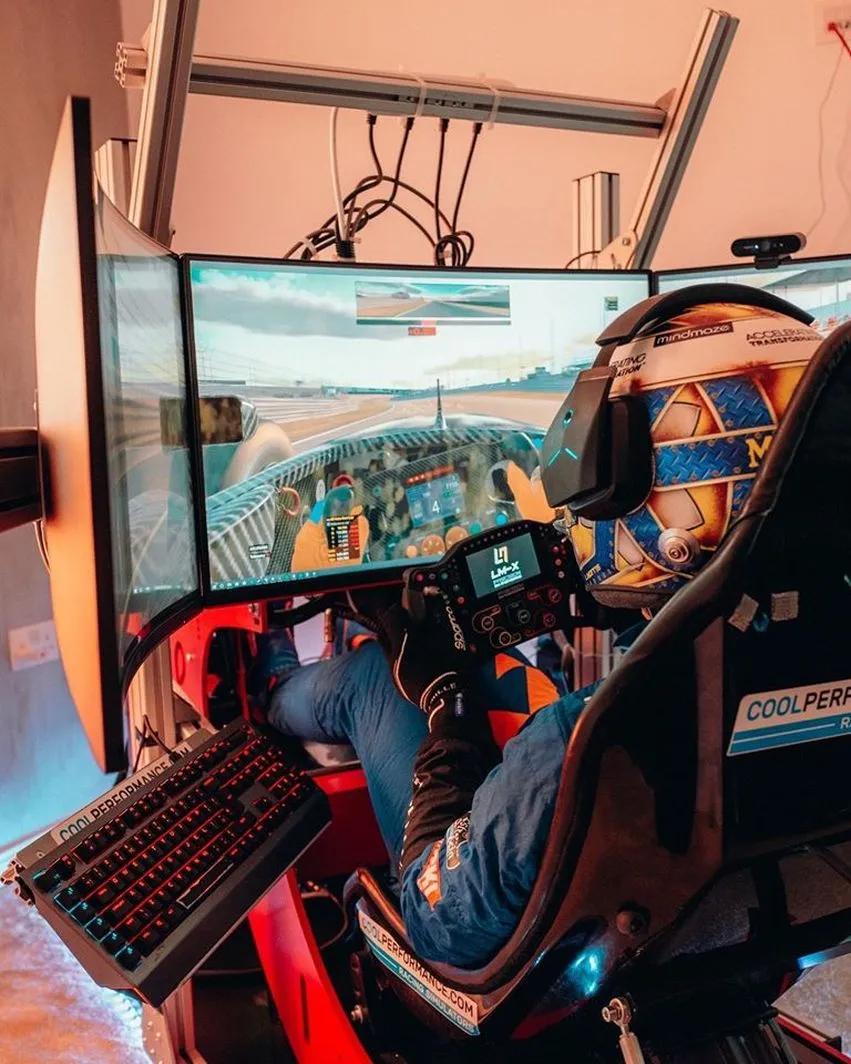
The best part of adult sim racing isn’t the perfect cockpit. It isn’t the triple monitors, or the direct drive wheelbase, or the pedals that look like they were designed by NASA. The best part is the improvised setup. The kitchen chair pulled up to the desk because the office chair on wheels rolls backward every time you brake. Old shoes wedged against the wheels to stop them. The wheel clamped to a table that creaks like a pirate ship. Cables crossing the floor with a worrying amount of confidence. The posture of a van driver. The shirt thrown over the backrest because it’s hot. The cat eyeing the throttle pedal like it’s prey. That’s sim racing too. Maybe even more so.
Then you sit down, put on your headphones, load the track, and at last there’s one clear thing in the world: brake at the 100 board. Even if you then brake at the 50, lock up, and shoot off in a dead straight line like some bureaucratic missile. But the intention was there.
At 40 what you want is good lumbar support, an hour of silence, and for nobody to touch the FOV settings. And this is wonderful. Because sim racing demands exactly that: giving up on looking good.
A grown adult, maybe with a receding hairline, maybe with a belly, maybe wearing a VR headset, moving their hands in front of a wall, talking to themselves over Discord, pointing at cars that don’t physically exist and complaining that someone “didn’t leave room in turn one.”
From the inside, though, this is epic. From the inside, you’re fighting for position. From the inside, you’re reading the tire wear. From the inside, you’re managing pressure. From the inside, you’re a strategist, a mental athlete, a tamer of digital inertia. From the outside, you’re a guy in socks insulting an imaginary Italian. And that’s where the magic is.
You start with a “fairly normal” wheel. Then you read about pedals. Then someone mentions direct drive. Then you find out that the whole rig can actually move. Then you start looking at cockpits. Then you say “I’m just looking.”
And we all know what “I’m just looking” means.
It means that in three weeks there’ll be an enormous box in the house, and you’ll have to explain why this thing that looks like a frame for interrogating astronauts is, in fact, a sensible purchase.
There’s something really beautiful about people who start late. The one who starts at 56. The one who starts at 40. The one who, at 59, says they enjoy it just as much as ever. The one who, at 51, insists they still look amazing, even though they’re probably sweating as if they’d pushed the car themselves.
Adult sim racing has less to do with being the youngest and more to do with still wanting it. Wanting to learn a racing line. Wanting to shave off half a second. Wanting to understand why on earth the car understeers in that corner. Wanting to improve without anyone forcing you to.
There’s enormous beauty in learning something difficult when you’re no longer at the age where you do it to impress anyone.
Learning as an adult is a form of rebellion.
It’s telling life: I’m not finished yet. I can still be a beginner. I can still make a fool of myself. I can still get excited about a clean lap. I can still shout “come on!” in an empty room because I finished eighth, but eighth with dignity.
At a certain age, free time gets strange. Not just strange as in scarce, but strange in quality. You can have a free hour and not know what to do with it. You can be too tired to go out, too awake to sleep, too burned out to watch another series, and too grown-up to admit that you need to play.
Maybe your 20s are better for reflexes. Maybe your 30s are better for starting to buy things. But your 40s have something special: a dangerous mix of nostalgia, judgment, accumulated tiredness, and a bank card. At 40 you already know you’re not going to be a professional driver. And that’s precisely why you can enjoy it more.
You’re no longer chasing a career. You’re chasing a feeling. The feeling of nailing a corner. Of finding a rhythm. Of racing cleanly.
Of switching off the world for a few laps.
This website uses affiliate links which may earn a commission at no additional cost to you.