

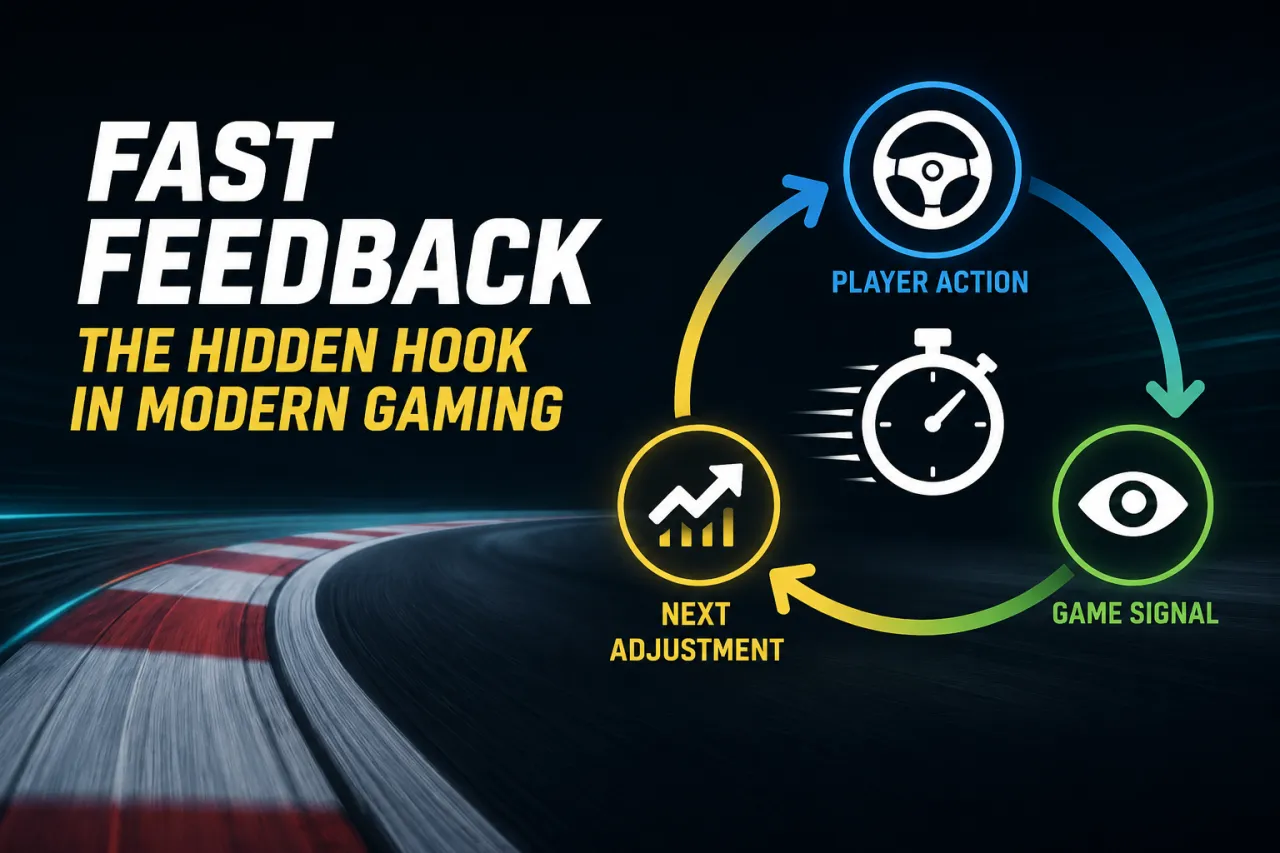

Many games prioritize hands-on teaching over lengthy explanations. Take a racing game where you begin with a few laps of an easy track, just so you can get a feel for how the car handles and how the dynamics work. You brake late, the front tires slide, the wheel goes light, and the exit disappears. The lesson is almost immediate. Fast feedback is the invisible layer that makes a game feel responsive, readable, and worth another attempt.
In research on action video games and attention, the useful point is not that players see more flashing things. Skilled play depends on selecting the right signal under pressure while ignoring clutter. Sim racing makes that visible on every lap. The braking marker, delta bar, tire sound, and steering load become the language of the car.
Fast Feedback Travels Across Game Types
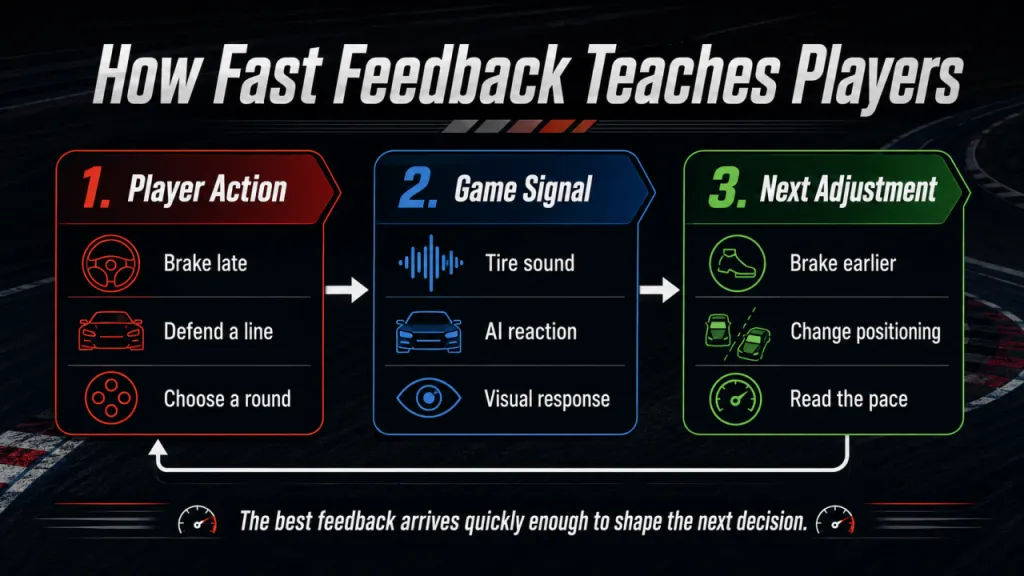
The cleanest example is racing. A simulator tells you when you have overloaded the front axle, clipped too much curb, or carried speed that the tires cannot hold. The better the feedback, the earlier you feel the mistake forming. That is why discussions around wheels, pedals, and physics become discussions about communication.
Other game types create the same effect in different ways. A shooter uses sound direction, recoil, and hit markers. A fighting game uses animation recovery, impact sparks, and spacing. Short-session casino-style games use compact rounds, clear game states, and fast visual response to make each moment easy to read.
For players comparing how these formats feel online, dedicated gaming platforms that offer the best online casino games can help you grasp this idea through concrete examples. You can play poker and get a feel for the table dynamics, with fast feedback on how you’re handling the cards. You can play roulette and get a swift idea of how outside and inside bets work. You can opt for one of the specialty games, and you’ll still find that feedback is immediate and gives you an easy “in” to the game, even if you’ve never played it before.
Even slots, although they are luck-based, do contain feedback for players. When you’re learning how a new mechanic, such as expanding wilds, works, the way the game unfolds will help you pick up the nuances faster. Casino games are very different from racing games, but they serve as a demonstration of how digital play is built around pacing, immediate response, and visible changes from one decision to the next.
What’s more, players now have more opportunities than ever before to engage with games and their feedback on a different level. Channels like Discord have created a platform for players to discuss, dissect, and learn from each other.
Readability Is the Real Hook
The word feedback can sound technical, but players usually feel it as readability. A readable game lets you understand why something happened. The car rotated because you released the brake too sharply. The lap improved because you opened the steering sooner. The opponent got past because you left the inside open too early.
This is why fast feedback matters more than raw spectacle. A game can be beautiful and still feel distant if its signals arrive too late or feel inconsistent. Sim racers understand this immediately. A wheelbase with strong force but vague detail is less useful than one that shows weight transfer, grip loss, and recovery. The same principle applies to visuals and sound. More effects do not automatically mean more information. Good effects tell the player what changed.
There is also an emotional side to this. Fast feedback makes improvement feel possible. It turns a vague failure into a specific adjustment. Instead of thinking the sim is impossible, the player sees a smaller truth: the brake point was wrong, the curb upset the chassis, or the exit speed fell because the car was pointed too late.
The Best Signals Arrive Before the Next Lap
Post-session data still matters. Lap charts, sector deltas, and replay tools can reveal patterns that are hard to notice while driving. Yet the strongest feedback often arrives before the result screen. A slight tire scrub, a lift in steering load, or a small shift in delta can change the next corner while the lap is still alive.
That is why games such as Assetto Corsa EVO, iRacing, and Gran Turismo 7 fit the discussion so well. Assetto Corsa EVO shows the value of force feedback and tire behavior through the wheel. iRacing turns lap data, incident-tracking, Safety Rating, and iRating into readable session feedback. Gran Turismo 7 is a demonstration of how much the game’s own programming matters, with GT Sophy providing a superhuman player to compete against.
Research on video games and cognition supports the broader idea that different games can develop different task-specific skills. For players, the simplest takeaway is that responsive games do not just react quickly. They respond clearly.
This website uses affiliate links which may earn a commission at no additional cost to you.