


That NASCAR 26 was already in development was one of those open secrets that just needed to be written out in big letters, like when someone says “I don’t want to give anything away” and then immediately gives away half the story. After NASCAR 25, its year-stamped title, and iRacing’s takeover of the official license, thinking there wouldn’t be a new entry was almost stranger than watching a race finish without contact on the final lap.
After years of turbulence for the franchise, iRacing faced a delicate mission: restore some credibility to NASCAR’s official console and PC games. There was no need to reinvent the wheel, though in NASCAR, going in circles always has a certain poetic logic. What mattered was laying a foundation. And that’s what NASCAR 25 was: a foundation.
Not perfect. Not revolutionary. Not the definitive simulator some had dreamed of playing in their living room, controller growing damp with anxiety. But a reasonable starting point. A return with an official license, multiple categories, a career mode, and an overall sense of “okay, there’s something here.”
The problem is that when you put a year on the cover, you also start a clock.
NASCAR changes every season. Drivers, teams, calendars, liveries, rules, sponsorships, and expectations all shift. For an official license, selling an annual edition is commercially sound. Every new year is the perfect excuse to sell the product again.

New cover. New soundtrack. New rosters. New cars. New marketing. A new trailer with intense music and shots of cars trading paint at 300 km/h as if they’re arguing over the last parking spot. From a business perspective, it’s clean, recognizable, and predictable.
An annual release keeps the license alive. That matters. Nothing is worse for a sports franchise than disappearing for years and then coming back as if nothing happened, expecting everyone to still be sitting on the sofa with their helmet on.
There’s also a clear financial upside: recurring revenue. Rather than relying on a single game for several years, each season brings a new commercial opportunity. It’s a publisher’s dream: sell excitement once a year, preferably with a Deluxe Edition, a pre-order bonus, and some promise of “the most authentic experience to date.” Marketing also becomes simpler. There’s no need to over-explain. The message is direct: “this is this year’s NASCAR.” Like a calendar, but louder.
But the Risks Come Along for the Ride
The problem with the annual model is that it can go from asset to trap very quickly. A community can accept an annual release if it feels genuine evolution is happening. But if people start to sense that each game is little more than a lightly touched-up version of the last one, a dangerous word emerges: saturation.
And with it comes the familiar suspicion: Am I buying a new game, or just an update with a different box? That’s the central challenge for NASCAR 26. Existing isn’t enough. It has to justify its existence. If NASCAR 25 was the foundation, NASCAR 26 needs to be more than a fresh coat of paint. It needs to show that iRacing listened, corrected course, and understood what worked and what didn’t. Having an annual strategy is one thing. Getting people to open their wallets every year without feeling like they’re paying for the same car with new stickers is quite another.
Interestingly, much of the criticism aimed at NASCAR 25 doesn’t seem to come from people who hated the idea. Quite the opposite. It comes from players who wanted it to succeed. That’s the key. Many weren’t asking NASCAR 25 to be iRacing 2.0. They knew it was a console-focused product, more accessible and less intimidating. But accessible doesn’t mean simple. And it certainly doesn’t mean careless.
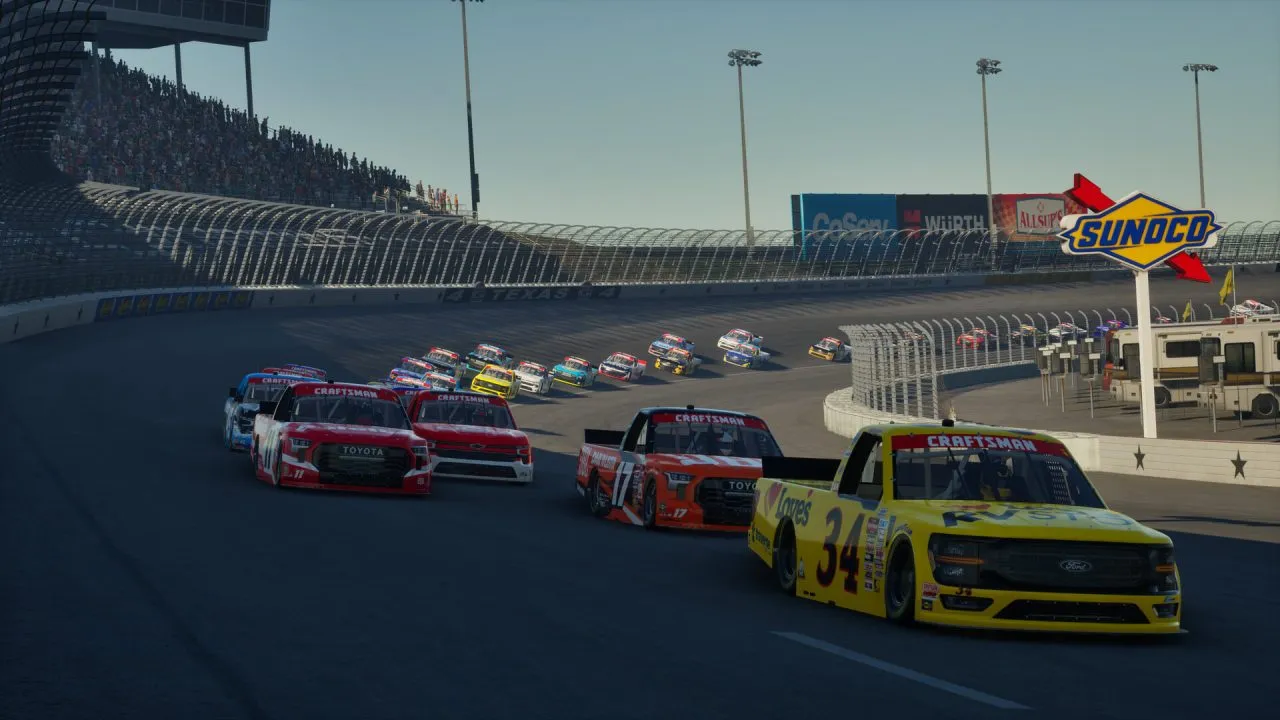
The community wants stable performance. A convincing AI. A career mode with more depth. Logical options, smooth saving, better strategy systems, and fewer “why did that just happen?” moments. In other words: they want the game to stop feeling like a promise and start feeling like a mature franchise.
If the game is too arcade-y, some will say it wastes the license. If it’s too sim-heavy, it risks alienating the console audience. If it tries to please everyone, it risks landing in that no-man’s-land where nobody is truly angry but nobody is fully happy either — the gaming equivalent of trying to pick a restaurant as a group.
That’s why NASCAR 26 doesn’t just need to improve. It needs to define more clearly what it wants to be.
The annual strategy can work. On paper, it makes a lot of sense. NASCAR is a competition with a calendar, a clear identity, and constant change. One release per season fits naturally. But success will hinge on one simple word: trust.
If NASCAR 26 arrives with clear improvements, better performance, more depth, and a tangible sense of progress, the annual model can take root. People will understand that each entry builds on the last. But if it arrives with timid changes, inherited problems, and the feeling that NASCAR 25 was left behind too quickly, the conversation will be very different. The talk won’t be about evolution. It’ll be about fatigue.
Because releasing an annual game isn’t hard. The hard part is convincing people that coming back every year is worth it.
See you on the track!
This website uses affiliate links which may earn a commission at no additional cost to you.