


The first time I put on a virtual reality headset to drive, I had two thoughts. The first was, “This is a lot bulkier than it looked in the videos.” The second came a few seconds later, when the cockpit appeared and the steering wheel stopped looking like an image and became something almost real.
I looked to my right and saw the door. Then I raised my eyes toward the rearview mirror and, for the first time, I did not feel as though I were watching a car from the outside.
I was inside it.
That moment explains almost everything about the debate surrounding virtual reality in sim racing. It also explains why it is so difficult to convince someone to try it. A screen can show resolution, smoothness, reflections and rain. What it cannot communicate is the sensation of scale, that instant when a corner stops being a drawing and becomes a place.
Trying to explain it is like describing a roller coaster with a photograph. The picture may look fantastic, but your stomach receives none of the information. That is where the paradox begins. Virtual reality offers one of the most intense experiences in sim racing, yet it demands something a monitor never asks for: willingness. You have to put on the headset, adjust the straps and accept that the real world is about to disappear. The keyboard vanishes. The bottle of water becomes part of a search and rescue mission. Any nearby pet becomes a mechanical hazard.

With a monitor, you sit down and drive. That simplicity may seem unimportant until you come home tired and only want to complete a few laps. At that moment, the headset can feel like a ceremony that begins with enthusiasm and ends with you blindly searching for the correct button. That is why the choice between virtual reality, triple screens and an ultrawide monitor also depends on the life surrounding the simulator.
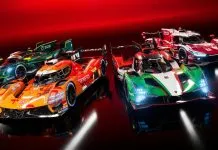
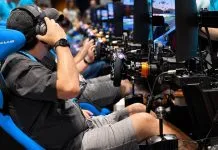
Triple monitors remain a remarkable tool. When positioned correctly, they surround your field of vision and allow you to detect a car beside you without looking away from the apex. In multiclass racing, where a prototype can arrive with all the subtlety of a moving truck, that peripheral vision can prevent an accident. The information remains visible, stable and permanently available.
Triple monitors are also comfortable for long sessions. They add no weight to your head, trap no heat around your face and allow you to see the wheel, button boxes and telemetry. That freedom becomes valuable during long races, when the driver needs a drink or wants to confirm that the button they pressed was the pit limiter and not the windshield wiper.
The cost of that comfort is space. Three large screens and their supporting structure can turn an ordinary room into something halfway between a racing cockpit and a mission control centre. Calibrating them also requires patience. When everything is aligned correctly, the result is excellent. When it is not, a straight may appear to have three conflicting opinions about where it is supposed to end.
An ultrawide monitor seems like the sensible solution. It offers a continuous image, a generous field of view and a relatively straightforward installation. It cannot match the side visibility of triple screens or the depth of virtual reality, but it removes bezels and allows you to drive without negotiating with three menus and a measuring tape.
Virtual reality is playing a different game. It is not trying to enlarge the window. It is trying to remove it.
The difference lies in how the brain calculates distance. On a screen, depth must be inferred from shadows, size and visual references. Inside a headset, each eye receives a slightly different image and the brain calculates space naturally. Braking distance, the height of a kerb and the proximity of another car stop being interpreted data and become sensations.
It also changes the way you look. On a monitor, it is easy to stare straight ahead and allow the car to arrive at the apex. In virtual reality, the head turns instinctively. Your eyes search for the exit before your hands finish steering. You learn to look through the corner because the environment encourages you to do so.

This does not automatically turn anyone into a professional driver. Talent is still not included in the box, unfortunately. But it does bring your visual behaviour closer to the way people drive in the real world. That creates an obvious question. If virtual reality offers depth, scale and a more natural relationship with the car, why does competitive sim racing still rely so heavily on monitors?
The answer has everything to do with repetition. A professional driver earns results by eliminating variables. On a monitor, the camera remains fixed. A shadow, a crack in the asphalt or a point on the dashboard can become an exact braking reference. In virtual reality, the perspective changes with every movement. Breathing, leaning or adjusting your posture slightly changes the angle of the track.
For most people, that feels natural. For someone chasing a thousandth of a second, it can feel unacceptable.
Fatigue is another factor. Training for several hours with additional weight, heat and pressure around the face is not particularly kind to the body. In endurance racing, the driver may also need to move immediately from driving to studying telemetry, calculating fuel or helping the rest of the team. Moving between a completely isolated environment and a desk filled with information adds friction.
That is why monitors dominate professional competition. They are predictable, durable and easy to integrate into a broader working environment. Virtual reality wants you to feel more. Competition wants fewer things to change. The greatest physiological obstacle remains motion sickness. The eyes perceive acceleration, rotation and elevation changes while the inner ear insists that the body is sitting still. The brain receives two incompatible versions of reality and responds with cold sweat, nausea or a headache.
It is not weakness. It is a sensory conflict.
The worst possible strategy is to endure it through force of will. When discomfort begins, the session should stop. Pushing through it can teach the brain to associate the headset with a negative experience. Eventually, seeing it resting on the desk may be enough to make you feel uneasy.
Adaptation should be gradual. Short sessions, slower cars, enclosed cockpits and simple circuits are the best place to begin. Spins, reversing and violent crashes should be avoided at first. Closing your eyes during an impact may not look heroic, but it is preferable to leaving the simulator in search of fresh air and dignity at the same time. One of the most important settings is horizon stabilisation. If the virtual camera is attached rigidly to the chassis, every bump moves the entire visual world. Locking the horizon allows the outside environment to remain stable while the car moves underneath you.
A fan can also help. The airflow reduces heat and provides a physical point of reference. It is a remarkably effective solution, although in this hobby any simple fan is always at risk of evolving into a telemetry-controlled wind simulation system with six motors and its own power supply. Smooth performance matters even more than visual quality. A beautiful image with stutters is worse than a modest image that remains stable. Frame drops and latency create inconsistencies that the brain detects immediately. It is usually better to reduce shadows, reflections or crowd detail than to sacrifice stability.
The hardware itself is also changing. For years, the industry chased resolution and field of view while occasionally forgetting that the device was still resting on a human head. Now we are seeing lighter headsets, more compact optics and Micro-OLED panels. Reducing weight may ultimately matter more than adding another increase in resolution.
A headset that seems to disappear from your face changes the experience. When you stop thinking about the device, you start thinking only about the track. Eye tracking and foveated rendering also help use graphical power more intelligently. The system detects where you are looking and concentrates maximum detail in that area while reducing quality in the periphery. It is an elegant way of reducing the workload on a graphics card whose price suggests that it should solve emotional problems as well as render cars.

Even so, no headset works in isolation. The final experience depends on the computer, the connection, the simulator and the configuration. Some titles offer clean integration and reliable performance. Others turn the start of every session into a test of patience. When everything works, it feels like magic. When it does not, you spend more time restarting applications than practising braking points.
Perhaps that is why this debate can never be settled by a specification table. We make the decision with our heads, but also with our necks, our stomachs, the available space in the room and our tolerance for complication. Each system reveals the kind of experience we are really looking for.
In the end, there is no universally superior solution. Triple monitors provide stability and peripheral awareness. An ultrawide monitor offers simplicity and excellent image quality. Virtual reality provides presence.
And that presence leaves a mark.
After driving from inside the car, returning to a screen feels strange. The image may be sharper and the session more comfortable, but the cockpit is once again trapped behind a surface. The depth becomes flat. The track stops surrounding you.
The strength of virtual reality is not found only in its pixels. It lives in the moment you turn your head to look at a mirror that does not exist, in the tension you feel when another car pulls alongside you and in the way your eyes search for the corner exit before you reach the apex. When we are no longer thinking about lenses, resolutions or algorithms. When we hear only the engine, see only the track and feel that the next corner is waiting for us.
Even though we are still sitting in a room.
Even though the car does not exist.
And even though the cat is still underneath the brake pedal.
This website uses affiliate links which may earn a commission at no additional cost to you.