

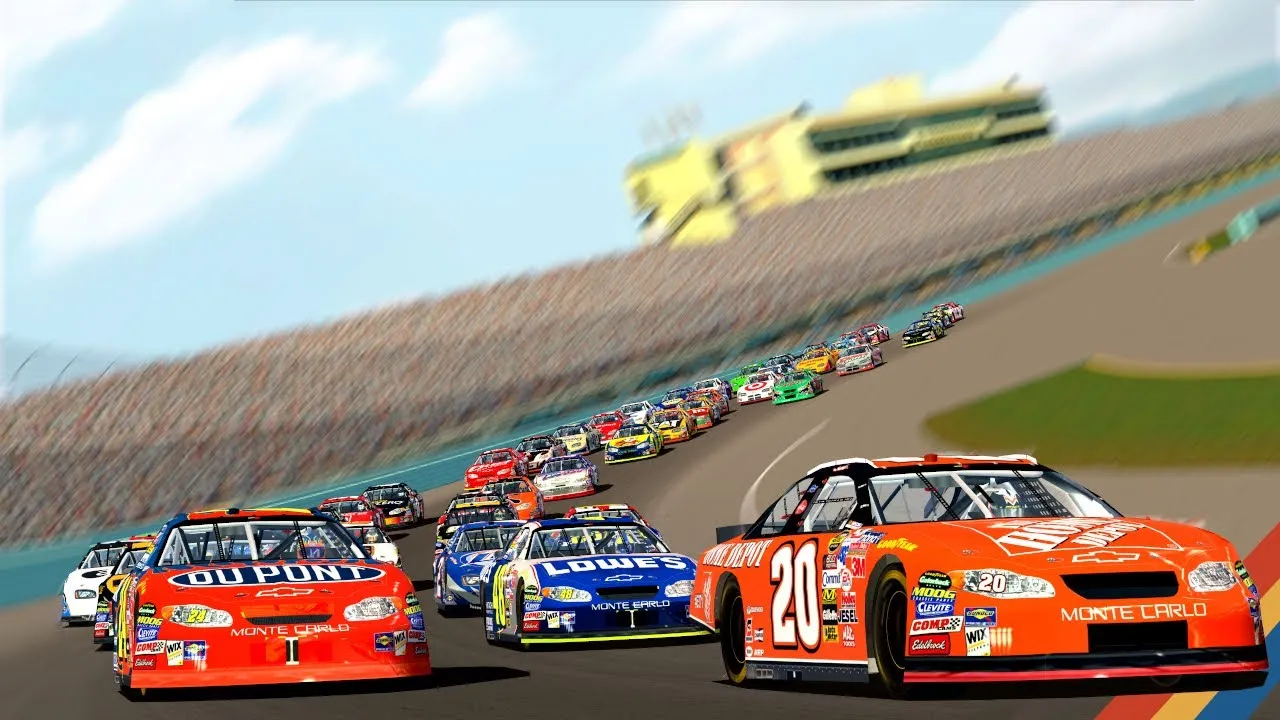

There are video games that age. Then there is NASCAR Racing 2003 Season, which seems to have signed a lifetime contract with the collective memory of fans.
Every time a new official NASCAR game is announced, something almost ritualistic happens. The excitement builds, the promises roll in, talk of physics, licenses, consoles, career modes, sound, graphics, and AI fills the air, and then someone, from some corner of the digital paddock, drops the inevitable line:
“Sure, but NASCAR Racing 2003…” And there goes modernity.
It doesn’t matter that more than two decades have passed. It doesn’t matter that today’s consoles can render the emotional reflection of a lug nut. It doesn’t matter that tracks can be laser-scanned, that cars have spectacular 3D models, or that menus look like they were designed by people who apparently sleep eight hours a night. For a significant part of the community, the true rival of any modern NASCAR game is not last year’s title.
It’s a game from 2003.
And that, honestly, is as fascinating as it is mildly absurd. Like if every new superhero movie had to compete with a VHS tape someone keeps in the garage next to a box of cables they’re “definitely going to use someday.”
NASCAR Racing 2003 Season remains an uncomfortable measuring stick not just because it’s remembered as “a good old game,” but because it’s remembered as a game that understood what it wanted to be.
It wasn’t trying to please everyone. It didn’t seem to apologize for being demanding. It wasn’t holding up a glowing sign saying “relax, you can play with your left thumb while eating chips.” It was tough, dry, serious, sometimes brutal. Like a conversation with your mechanic after destroying the car on lap three.
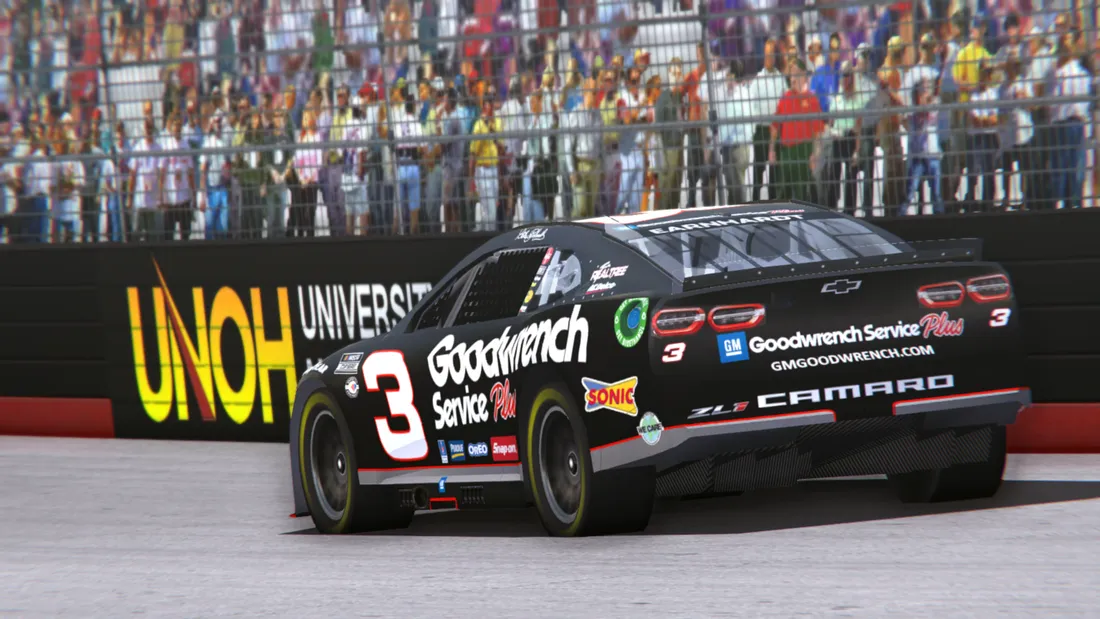
And that’s precisely why so many people still respect it. Because when people bring up NASCAR Racing 2003, they’re usually not talking about its graphics. Nobody is claiming its textures are better than today’s. Nobody, I hope, is arguing that the future of gaming lies in returning to pilot faces with the expression of a worried wax dummy.
What people miss is something else entirely.
They miss the feeling that the car had weight. That a long race wasn’t just a sequence of laps, but a small story of patience, mistakes, tires, traffic, strategy, and survival. They miss an AI that, for all its flaws, could make a race feel organic. They miss the kind of game that didn’t treat you like an impatient customer, but like a clumsy driver who needed to be taught with care. Or without care. More like without care.
That is the standard many modern games have still not fully surpassed.
Today you can have prettier tracks, more detailed cars, more complex physics, and lighting effects that make a Daytona sunset look like a movie scene. But none of that guarantees a race will feel alive. And that’s what stings.
Because when a modern game fails at the basics, comparison with a classic becomes inevitable. If the AI pits like it has privileged information from the universe, if penalties seem decided by a steward having a bad day, if career mode doesn’t allow for a convincing sense of progression, if you can’t save mid-race weekend without feeling like you’ve signed an employment contract with the game, then the years weigh differently.
The Career Mode Everyone Imagines and Almost Nobody Gets
One of the most frequently raised points when discussing modern NASCAR is career mode. And it makes sense, because NASCAR is a discipline perfectly suited to storytelling. Not just races. Stories.
The driver who starts from the bottom. The small team scraping by however they can. The sponsor demanding results. The unexpected call from a big organization. The rivalry born from a stupid tap on lap 42. The car that doesn’t shine in qualifying but comes alive in long runs. The season that falls apart. The comeback that seems impossible.
That is narrative gold.
And yet, career modes often feel like a to-do list with a helmet. Race here, win this, unlock that, repeat. There’s no dirt. No drama. No sense that you’re part of a world rather than a spreadsheet with tires.
NASCAR Racing 2003 didn’t have all the answers, but it conveyed one very clear idea: racing was the center of everything.
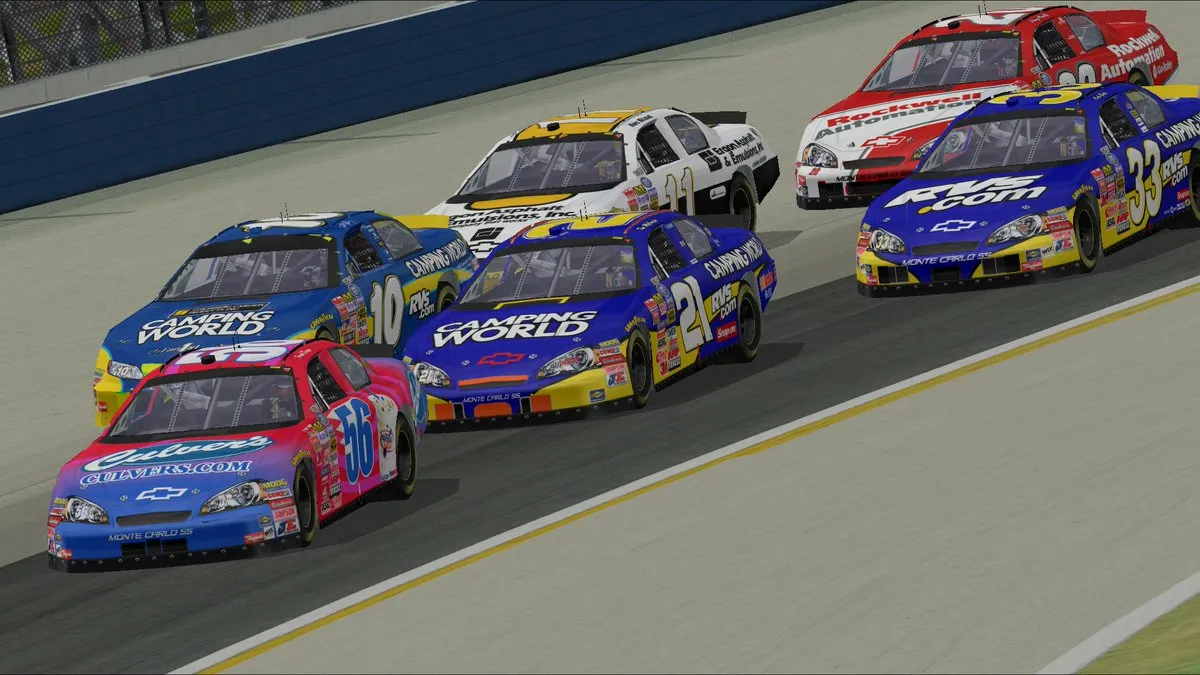
And when the driving, the AI, and the race structure work, the player does the rest with their imagination. The game doesn’t need to tell you that you have a rivalry with someone. It’s enough for the same car to cut you off three times at Talladega for you to mentally write a complete biography of your enemy all on your own.
Nostalgia Cheats Too
That said, we shouldn’t turn NASCAR Racing 2003 into a marble statue.
Nostalgia is an elegant cheat. It pours you a drink, puts on soft music, and suddenly convinces you that everything before was better. And it wasn’t always. Old games had their quirks too, technical limits, rough learning curves, and design decisions that would seem unacceptable today.
Besides, part of what makes NASCAR Racing 2003 great comes from something modern official games can rarely easily replicate: its afterlife. The community, the mods, the recreated seasons, the tuning, the decades of accumulated love. We’re not just comparing a game from 2003 against a current game. We’re comparing an ecosystem that has matured over decades against products that arrive on the market under commercial pressure, locked schedules, and immediate expectations.

That isn’t a fair fight. It’s like pitting a teenager who just got their driver’s license against someone who has spent 23 years lapping the same circuit and also knows the guy at the gas station. But even so, the comparison exists. And it exists for a reason.
The challenge is not to copy NASCAR Racing 2003. That would be a mistake. The audience has changed, the platforms have changed, the market has changed, and the patience of the average player has too. Today many people want to jump in, race, have fun, and not feel like they’ve failed a telemetry exam. But NASCAR 26 can learn from the old king.
And above all, it can learn that a game lives on in memory not because it has the right name on the cover, but because it makes the player finish a race and think: “Alright, one more.”
This website uses affiliate links which may earn a commission at no additional cost to you.






Thanks for the trip down memory lane Alberto. I played NASCAR 2003 a lot and kept the paints current (or desired) for at least a decade afterwards.
I spent hours running longer length races against the AI and tinkering with the settings to be prepared for LAN (Network) parties on the weekend with my mates where we would all take our PC’S, Monitors and steering wheels to the hosts house to race or war etc. We always started at the rear and hopefully work to the front just before the end of the race. It took a lot of adjusting and trial and error. I don’t miss the tinkering.
The things I fondly remember are the amount of tracks available and the ability to keep paints current. I had more tracks than what the game could display in the track choice menu. This was the 1st time I got to race NASCAR at Le Mans.
I eventually gave it up for iRacing and it was a lot easier to just work on me and getting me to be a better driver and have no control over the other drivers.
IRacing is so humbling because you go from winning LAN races on Nascar 2003 to not winning at all very much.
It’s the big fish in the small pond evolving into a little fish in a big pond theory.
I have great memories of Nascar 2003 but I couldn’t go back now. IRacing has everything I want and offers so much more than NASCAR 2003 ever did.
I’m glad Steve Meyers had the vision for iRacing considering EA got the Nascar rights but then butchered it. That is what kept people playing Nascar 2003 for so long. There was no netcode issues with N2003 either. You could race as close to others as you needed to. So smooth.
Thanks for the memories Alberto.
Can you share your iRacing name with me please ? I’d like to have a look at your career stat’s.
Cheers
BRAD