

Automobilista 2 has spent years standing out for something that has also been one of its biggest contradictions: it offers an enormous variety of cars, eras, and circuits, but it still does not have a fully implemented official career mode. Reiza Studios confirmed in February 2026 that its Career Mode remains in development and that the intention is to introduce it in stages, with an initial implementation planned for the second half of 2026.
Into that gap has come Zero to Apex, an application created by developer Josh — known as jozeed1 on OverTake — that is trying to do something considerably more ambitious than simply saving the results of a few races: build around Automobilista 2 a persistent, automated career and a motorsport world that evolves season after season. Its first public version appeared on July 21, 2026 and, barely a month later, the project is already on version 0.6.4, released on August 19.
And that is the key to understanding what Zero to Apex really is. It is not a traditional story mode. There is no scripted campaign in which every player meets the same characters and goes through the same scenes. It is, rather, a dynamic single-player career mode that uses Automobilista 2 as the driving simulator and adds around it the professional progression system that the game still does not provide natively.
The problem Zero to Apex is trying to solve
Automobilista 2 allows players to create custom races and championships, but turning them into a coherent professional career requires a fair amount of work from the player. You have to choose categories, configure events, keep track of results and, with less integrated external solutions, constantly switch between the simulator and other applications.
Zero to Apex was born precisely to remove that friction. Its developer explains that he wanted to be able to sit in the cockpit, select the next event and race without having to manually rebuild every race. The proposed workflow is simple: choose the next event from the application, press Play, and Zero to Apex automatically prepares elements in AMS2 such as the car, the grid, session weather conditions or the type of start. When the race is over, it retrieves the result and updates standings, money, reputation and progression without requiring the player to enter that data manually.
That automation is probably the feature that most clearly sets the project apart. It is not intended to be merely a nice-looking database living alongside the simulator; it tries to minimize the boundary between “managing the career” and “driving it.”
From amateur driver to the top categories
The Zero to Apex concept starts with a classic idea behind any good career mode: begin at the bottom and earn the right to move up.
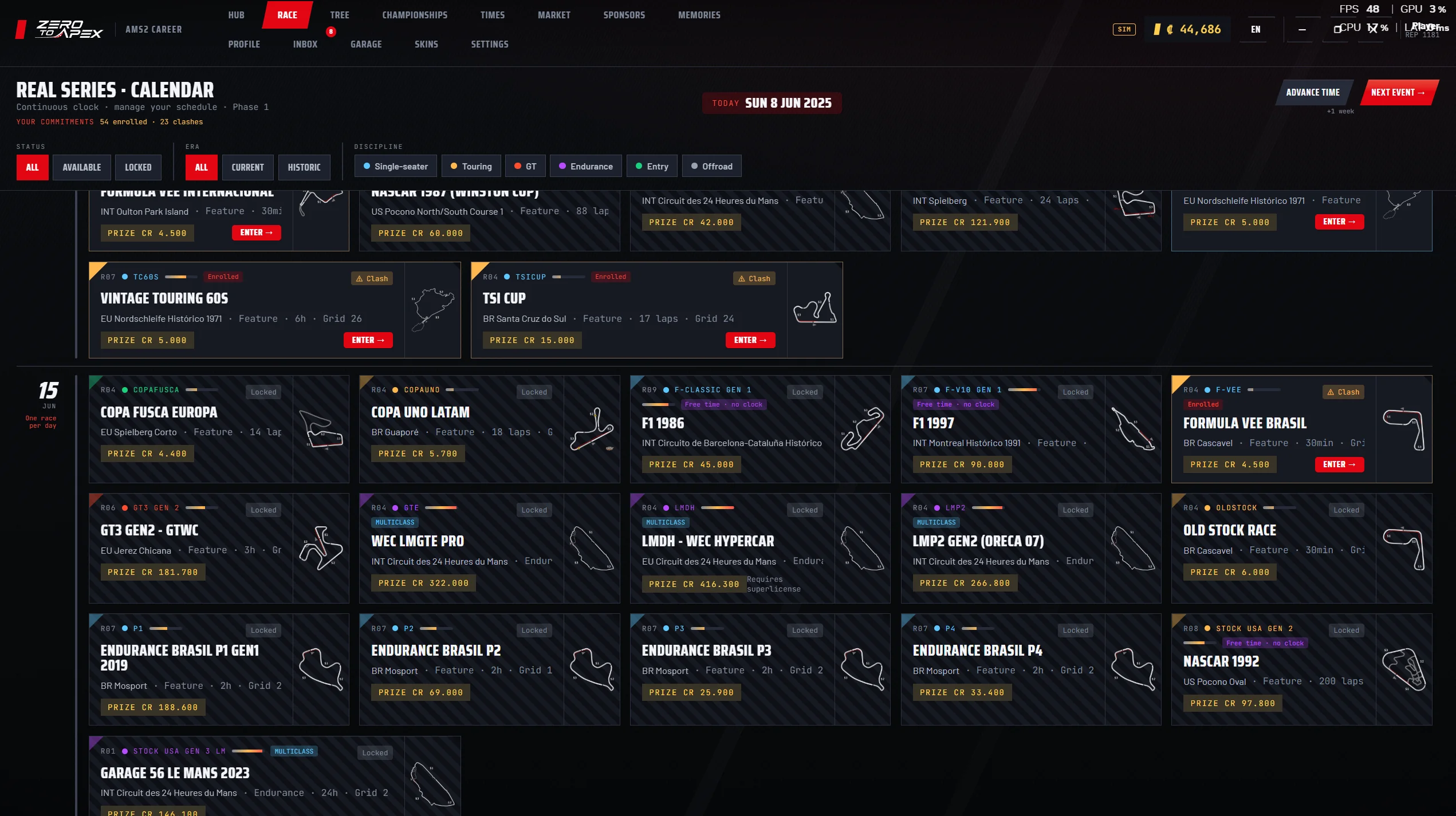
According to the project’s own documentation, its structure includes more than one hundred championships from different eras, ranging from entry-level categories to some of the most powerful classes available in AMS2. The application uses calendars, teams and drivers associated with different historical periods and also offers support for skin packs. The developer puts the number of drivers included in the system at around 1,300.
What is interesting, however, is not simply the quantity.
Zero to Apex tries to turn those championships into a connected ecosystem. Not every seat is available from the beginning. The reputation earned through results influences the opportunities that appear, while certain teams may require tests before offering a seat. There are also contracts, promotions between related teams and decisions that shape the next stage of the career.
The result aims to feel less like a linear selection of unlockable championships and more like an actual sporting career.
Your rivals have careers too
One of the biggest changes introduced during August arrived with the 0.6.x branch.
Since version 0.6.0, AI-controlled drivers have an age, a contract and their own career progression. They can move up, move down or retire, while new drivers enter through the lower levels of the system. The Paddock screen lets you see who occupies each seat and when their contract expires. The driver market also has a transfer window and a week in which certain decisions are resolved.
This changes the nature of a long-term career considerably.
A rival who appears during your first seasons does not have to remain frozen forever in the same category. They may end up progressing alongside you, disappear from the top level or leave open a seat that you may later want to occupy yourself.
This is precisely where Zero to Apex comes closest to the idea of a “living world” rather than that of a simple championship manager.
Money, contracts and sponsors
Progression does not depend exclusively on winning races either.
Zero to Apex includes an economy with credits, entry fees, vehicle rental and ownership, and prize money adapted to the type of competition. Sponsors work as another layer of progression: they can appear after certain results and pay according to objectives completed on track.
Contracts have additional consequences. In version 0.6.4, it is already possible to leave one early from My Contracts, but the application first displays the financial and reputation cost and requires a second confirmation before carrying out the decision.
There is even a messaging system from the driver’s agent that reacts to what is happening in the career. The developer’s intention is for those communications to respond to actual events in that save rather than being limited to a fixed sequence of messages.
Adaptive difficulty has just received one of its biggest changes
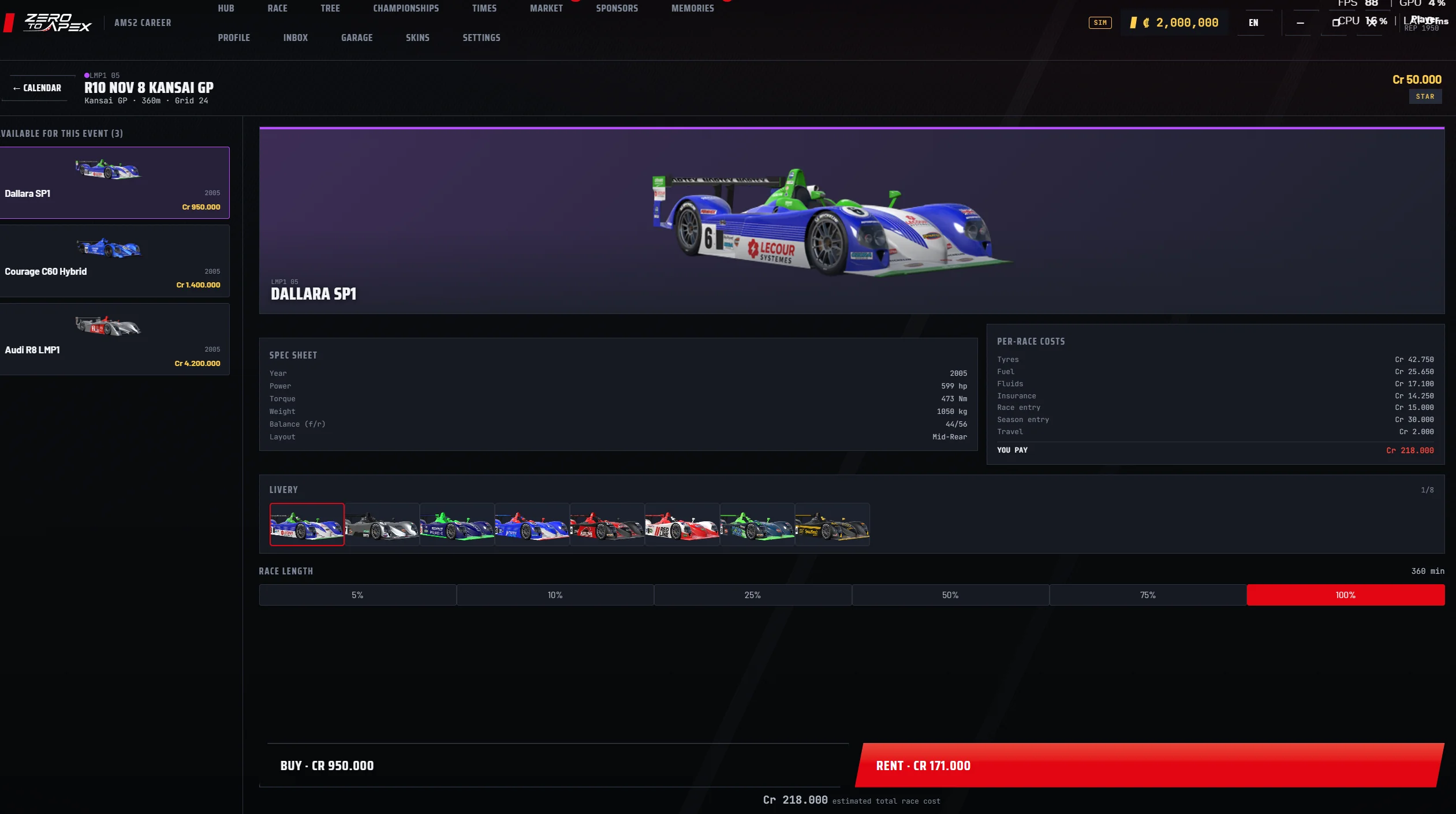
AI difficulty has been one of the areas that has evolved the most since the initial release.
The first implementations received criticism from players because a single level could work reasonably well with one type of car and become completely wrong when switching to another. The developer himself acknowledged that the system was still being adjusted and used post-race feedback to refine it.
Version 0.6.4 substantially changes that approach. Each category now keeps its own difficulty value within the 70–120 scale. The player’s overall level is calculated from the categories in which they have competed, but racing a GT3 no longer has to directly alter the difficulty later used with a single-seater.
In addition, a category can be locked once the player believes the balance is correct. Unusual results are also treated more cautiously: if a race falls too far outside the expected pace, the system asks for confirmation before using it to automatically change the difficulty.
It is an especially important correction because it highlights one of Zero to Apex’s strengths as well as one of its risks: it is evolving very quickly, but it is still maturing in front of its own users.
Virtual reality integration is a central part of the project
Automobilista 2 has a particularly active VR community, so a career application that forced players to constantly remove the headset would lose much of its appeal.
Zero to Apex began introducing specific virtual reality support in version 0.5.0 and expanded that integration considerably with 0.6.0. The project currently supports both SteamVR and the Oculus runtime, with an application panel accessible from inside the headset.
SteamVR later added the ability to look directly at an item on the panel and activate it using the configured key, preventing the player from having to pick up a motion controller while already seated behind the wheel. Version 0.6.4 also fixed a performance issue related to the panel when using the Oculus runtime.
Those kinds of decisions help explain why many users talk about Zero to Apex as though it were an extension of the game itself: it has been designed specifically with the cockpit experience in mind.
Does it modify Automobilista 2 files?
An important distinction needs to be made here.
The developer describes Zero to Apex as an external application that runs alongside a normal copy of AMS2 and states that it does not modify the game’s files. The automation has nevertheless required deep technical integration with the simulator. In the first versions, a helper and a DLL were used to operate certain game functions, which caused warnings or false positives from some antivirus programs.
Since version 0.6.0, the developer states that the installer is signed and that the component capable of writing inside another program was removed. The public release repository also provides the officially distributed versions, and SHA-256 hashes were added in early versions so downloaded files could be checked.
That does not automatically make every download found on the Internet trustworthy. The prudent option remains to use only the Zero to Apex page on OverTake or the release repository associated with the developer and verify the source before installing it.
It is still a young project
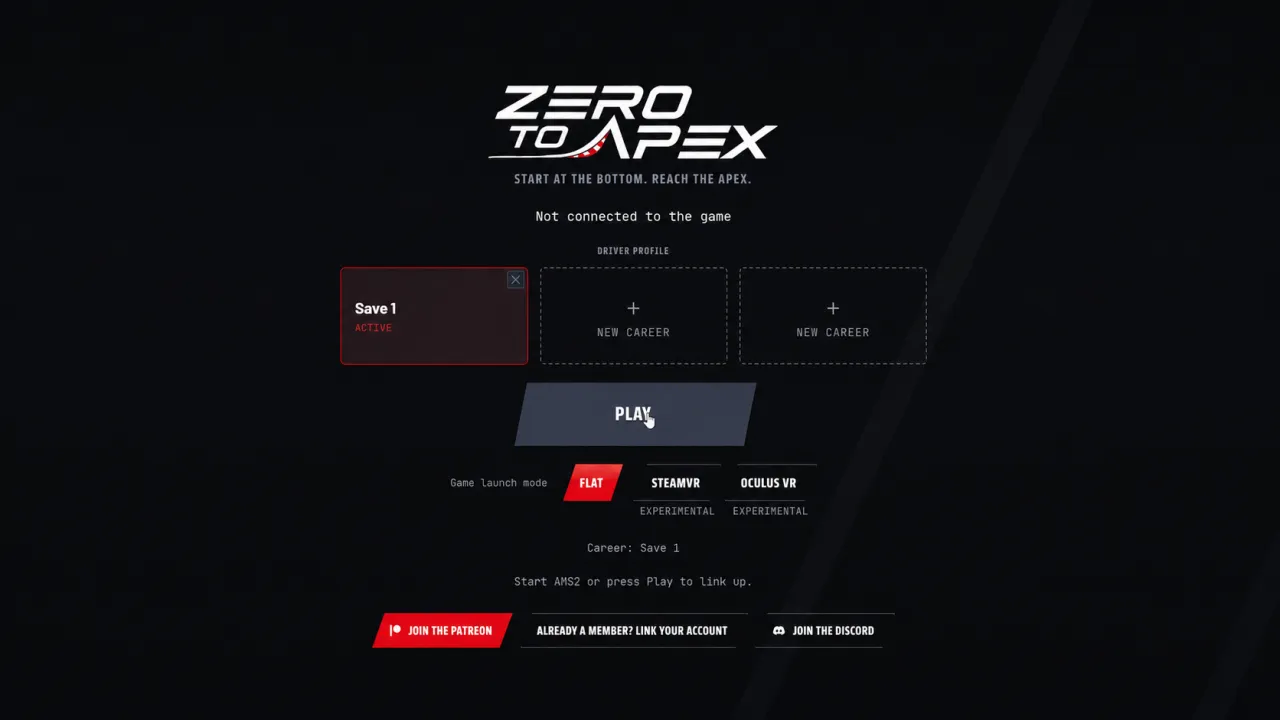
This is the point worth remembering most before presenting Zero to Apex as “the definitive career mode.”
The application has only been publicly available for a few weeks. The author himself described it from the beginning as an early release and has been fixing problems at a very fast pace. Version 0.6.3, for example, fixed issues related to drivers appearing in the wrong cars, contracts assigned to the wrong season, standings containing rivals the player had not actually encountered on track and offers being sent outside the transfer window.
Version 0.6.4 continued that work with improvements for teams where automatic configuration did not complete successfully, low-RAM mode, slow AMS2 startups and the save system. According to the release notes, career files are now replaced atomically to prevent a failure during the writing process from leaving the user without their previous progress.
Community reports also continue to appear about particular configurations that do not connect properly with AMS2 or that experience installation problems. These are user accounts, not a statistical measure of reliability, but they are useful as a reminder that this is software under active development.
Why has it attracted so much attention?
Because Zero to Apex arrived at exactly the right moment.
Reiza has spent years holding back its official Career Mode until a more advanced stage of Automobilista 2’s development. The studio’s explanation is understandable: it wants to have the necessary sporting rules, content and systems in place before building a career that would otherwise have to be repeatedly broken and rebuilt with every expansion of the simulator. In February 2026, it maintained the goal of beginning its implementation during the second half of the year, without giving a specific date.
In the meantime, Zero to Apex shows just how much demand there is for a structure that gives meaning to individual races.
The initial community response has been especially positive. Around the time of this update, the OverTake page shows a rating close to 4.86 out of 5 with more than 80 reviews, while the project is approaching 8,000 downloads on that platform barely a month after its publication. Those figures can change quickly, but they help measure the interest generated during its first few weeks.
A similar assessment appears repeatedly on Reiza’s own forum: players particularly highlight the fact that races are configured automatically and that VR integration reduces the need to leave the simulator. These are community opinions, not an official validation from Reiza, but they show quite clearly which problem the project is solving.
So, is Zero to Apex Automobilista 2’s story mode?
Only if we use “story mode” in a very broad sense.
Zero to Apex is better defined as a persistent and dynamic career mode. It does not tell a predetermined story: it creates the conditions for each player to build their own through results, contracts, rivalries, money, reputation, category changes and seasons that gradually reshape the paddock.
And that difference matters.
Its appeal does not lie in knowing which scene will appear after winning a championship, but in not knowing which team will call, which rival will manage to move up alongside you, when a better seat will become available or whether a poor season will force you to rethink your entire career path.
Zero to Apex still should not be judged as a finished product. Its 0.6.4 version number, the frequency of its updates and the developer’s own release notes make it clear that it remains very much under construction. But it has already achieved something more difficult than accumulating a long list of features: it has turned many isolated Automobilista 2 races into events that have consequences after crossing the finish line.
Until Reiza’s official Career Mode arrives, that may be precisely the ingredient many AMS2 players have been waiting for.
And when the official mode finally appears, Zero to Apex will also have left another interesting question on the table: it will no longer be enough for Automobilista 2 simply to have a career mode. It will have to demonstrate what a native integration can do that this community, working from outside the game, has not already managed to build.
This website uses affiliate links which may earn a commission at no additional cost to you.