



There’s a moment every new sim racer goes through when shopping for a wheel base: a number appears next to the letters Nm and the brain just stops. What is a Newton Meter? Does it matter? How many do I need? Is more always better?
Let’s cut through the noise, get grounded, and talk about this with the kind of honesty the topic deserves. No unnecessary jargon, but no oversimplification either because the wrong decision here costs real money.
The technical definition says a Newton Meter (Nm) is the unit of measurement for torque. In plain terms: it’s the rotational force a motor can apply at a pivot point. Hold a one-meter stick and push with 1 Newton of force at the end that’s 1 Nm. Feel free to Google the full definition if you want to go deeper, but what actually matters in this hobby is this:
The Nm rating tells you how much force the wheel base can apply at the point where it connects to the steering wheel meaning how much resistance you’ll feel in your hands when the simulator tells the wheel to push back.
More Nm = more force at the wheel. Simple as that. But it gets more nuanced quickly, and that’s exactly where most guides fall short.
When you’re comparing Nm ratings between bases to choose one over another, that comparison only makes real sense with Direct Drive technology. Belt-driven or gear-driven wheels from previous generations are a different category entirely they have mechanical losses, filtered feedback, and an indirect way of transmitting force.
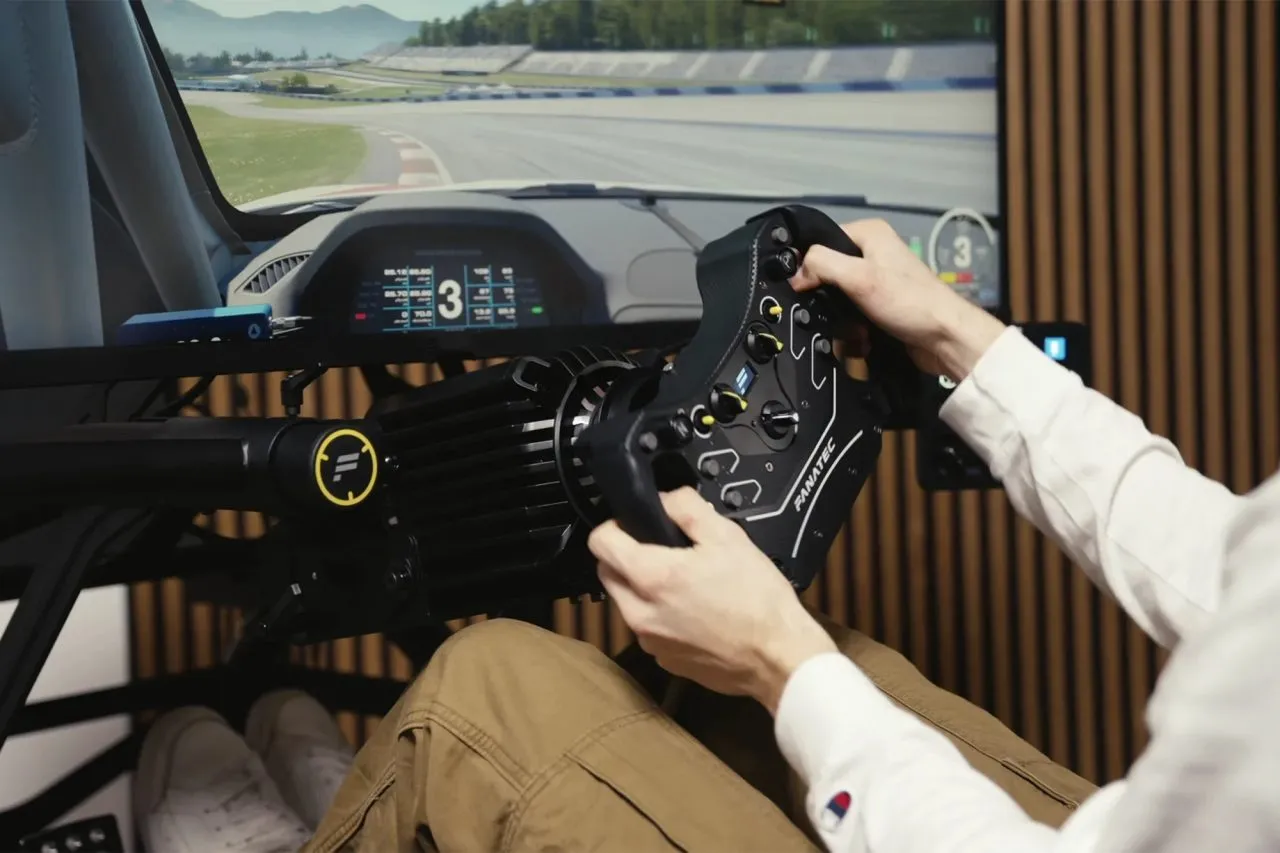
With Direct Drive, the motor connects directly to the wheel shaft. Whatever the simulator sends, you feel. No middlemen. No losses. And in 2026, the market has shifted so firmly toward this technology that it makes complete sense to focus on it exclusively.
This is one of the most misunderstood points out there. When a base advertises, say, 9 Nm, it’s usually referring to sustained Nm the force it can deliver continuously without overheating or degrading. That’s the number that counts.
Some brands also advertise a higher peak force: an extra burst the base can produce for a fraction of a second, like the sharp hit of a kerb strike. If you see two different numbers in the specs, the lower one is sustained and the higher one is peak. Always focus on the sustained figure when comparing bases fairly.
This is the concept most people don’t fully grasp, and it completely changes how you understand Nm ratings.
A simulator is constantly sending information to the base: bumps, corners, slides, grip changes, kerbs… All of that arrives as force signals, ranging from very gentle to very intense. The problem with a low-Nm base isn’t just that it has less force it’s that it has less range to work with.
Imagine a 4 Nm base. The simulator sends effects spanning from subtle to aggressive. But that base has very little room to distinguish between gentle and strong changes. The result: the nuances disappear. With a 12 Nm base, the simulator has far more range to spread all that information across, and your hands can feel differences that simply didn’t exist before.

Clipping is the technical term for a very specific problem: the base is already delivering its maximum force, but the simulator is asking for even more. Since it can’t give more, that additional information is simply lost.
The clearest example: you’re mid-corner with the wheel at full resistance. At that exact moment, you ride over a kerb that should give you a sharp impact. If you’re already clipping, you won’t feel a thing. The base has nothing left to give. The more force your base has and the better your simulator is configured, the less likely you are to hit that ceiling.
This is something that gets overlooked surprisingly often: the steering wheel you attach to the base directly affects the quality of feedback you receive. This isn’t opinion it’s physics.
The larger and heavier the wheel, the harder the base has to work to move it, and therefore the worse the feedback quality you’ll get. This applies to every base without exception. A small, lightweight formula wheel demands far less from the base than a 35 cm NASCAR wheel. And diameter matters even more than weight: a larger wheel creates more leverage, forcing the base to work significantly harder.
That said, the more powerful the base, the less noticeable this effect becomes. With a high-torque base, switching from a small to a large wheel still makes a difference but it’s hard enough to perceive that it stops being a real concern.
Most simulators offer an option to boost the softest feedback signals, bringing them closer in intensity to the stronger effects. In iRacing, this is called Minimum Force.

Is it useful? Yes, especially with bases below 8 Nm where the range is more limited. But you need to understand that this artificially distorts the feedback: it amplifies subtle effects and pushes them toward something they’re not. Ideally, you’d have enough range to never need it. If you’re using it out of necessity, go ahead just be aware of what it’s actually doing.
The honest answer is that only you can know, after trying different options. But since that’s not useful to most people, here’s a practical guide based on a lot of time spent with a lot of different bases:
12 Nm is the sweet spot for the vast majority of sim racers. There’s enough force to feel power and authority through the wheel. The range is wide enough for the simulator to communicate with real clarity. And with most standard-sized wheels, the difference between using one or another isn’t substantial enough to be a problem.
Up to 9 Nm works very well with small formula wheels. If that’s the only type of wheel you’ll ever use, this can be your ceiling without issue.
15 Nm or more makes sense if you regularly use very large wheels (NASCAR, truck sim, 35 cm diameter), where the leverage created by that size starts to show up even on powerful bases.
This comes up constantly. The answer is straightforward: if you have a 12 Nm base and you’re running it at 75% force in the software, you’re essentially paying for capacity you’re not using. It would make more sense to buy a 9 Nm base and run it at 100%. Use the Nm you have, not the ones you could have.

That said, there is one scenario where running below 100% makes sense: when you’re switching between very different wheel sizes. If a large wheel feels like it’s getting away from you, dialing back the force for that specific setup is perfectly reasonable. But as a general rule if you bought a base for its Nm rating, use them.
Before wrapping up, something worth saying clearly: two bases with the same Nm rating can feel completely different. Motor build quality, the software driving it, the ecosystem of compatible wheels, connectivity options, available configuration… all of it plays a role.
Nm are a fundamental metric for comparison, but they’re not the only buying criterion. Research the ecosystem of each brand thoroughly before committing. Newton Meters measure the force a wheel base can apply at the wheel. More Nm doesn’t just mean more raw power it means more range for the simulator to communicate the nuances of driving with greater precision.
With Direct Drive technology, 12 Nm is the ideal balance point for most sim racers: enough power, enough range, and no scenario where wheel size becomes a serious problem. Below that, you may need artificial software help to perceive certain details. Above it, the improvements are real and very noticeable but for typical use, they’re not essential.
And if someone tells you they can’t tell the difference between 8 and 25 Nm… well, they’re probably the same person who used to say the human eye can’t see more than 30 frames per second.
This website uses affiliate links which may earn a commission at no additional cost to you.







When these 15-25Nm owners turn their power/force down to 30% is that “ah but you get extra detail” not affected?
I think I’d need a lie down or a shower after a vigorous race/stage at anything more than a (peak) 7Nm wheel at 100% for 15 to 20 minutes.
Details are minimized too, but still there.
Most of the heat generated during a race is usually by ourselves. You heart pumping like a mad due to stress and pressure (not only exercise) is not something to be overlooked.