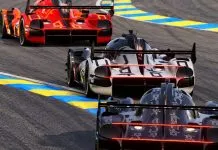



There are experiences that, strictly speaking, should not work. A long, multiclass race with tyre management, constant traffic, and lengthy stretches without direct battle sounds, to many, like the perfect recipe for switching off early. And yet the opposite happens: you finish the session feeling like you could have kept going for another sixty minutes. That contradiction is not coincidence, nor luck. It is design.
What is interesting is not that the format works, but that it works precisely for someone who has never been fully convinced by it. And that is where an uncomfortable question arises: perhaps the problem was never the length, or the complexity, or even the multiclass format. Perhaps the problem has been, for a long time, the way other simulators have tried to build that experience.
It Is Not the Content, It Is How It Is Organised
Many simulators boast variety: dozens of cars, extensive calendars, multiple categories. On paper, it is hard to compete with that. But in practice, that abundance tends to dissolve into unbalanced grids, deserted categories, or combinations that simply never quite work. The lingering feeling is one of taking part in something incomplete.
This is where Le Mans Ultimate makes a decision that seems simple but changes everything: it prioritises grid coherence over superficial variety. Rather than distributing categories without criteria, it ensures that each one has a genuine presence within every race. The result is not just better balance, but something far more important: competitive density. Every class makes sense, every car has context, and above all, the whole thing feels like a living event rather than a collection of isolated elements.

One of the great dilemmas in sim racing has always been how to handle damage. If it is too permissive, the experience loses credibility; if it is excessively strict, frustration arrives too soon. Finding that middle ground is extraordinarily difficult.
Here, without being perfect, the system achieves something fundamental: it sustains tension without punishing too harshly. A contact does not go unnoticed, but it does not automatically ruin the entire race either. This creates a very interesting domino effect: more cars stay on track, more situations unfold, and the race retains its narrative until the end. Rather than emptying out in the first few laps, as often happens in other titles, the action is redistributed across the full duration.
And that, even when not consciously perceived, is what transforms a decent session into a memorable experience.
When the Grid Has a Life of Its Own
There is a direct relationship between the number of cars on track and the perceived quality of a race. It is not just about quantity, but about what that quantity produces: constant traffic, continuous decisions, unpredictable situations. A large grid does not only add difficulty, it adds meaning.
In this context, every lap ceases to be an isolated exercise and becomes a sequence of microdecisions. Overtake, yield, anticipate, survive. Especially in multiclass racing, where pace differences demand permanent alertness, driving becomes less mechanical and more strategic. You are no longer simply lapping; you are interacting with a dynamic environment that changes at every moment.
That slight, well-contained chaos is what gives the feeling of taking part in something that goes beyond yourself.
There is a factor that gets less attention but that conditions absolutely everything: the player base. A well-designed system needs to be constantly fed in order to work as intended. Without sufficient participation, even the best ideas remain on paper.
When a simulator manages to maintain a critical mass of players, several things happen at once: splits fill up, skill levels distribute naturally, and races appear with regularity. There is no need to hunt for specific time slots or wait for special events. You simply log in and there is a race.

That continuity builds trust, and trust builds habit. And when playing stops being an exception and becomes something accessible at any moment, the experience gains enormous value.
Another element that makes a real difference is the way the track evolves and how tyre behaviour changes throughout a race. In many simulators, after a few laps, driving tends to stabilise: you find your rhythm and simply replicate it. Here, the feeling is different.
The opening laps demand caution, because everything is cold and grip is limited. Gradually the car begins to respond better, but that extra margin also invites mistakes. Later, wear enters the equation and forces a rethink of your driving approach. It is a continuous process of adaptation, where each phase of the race has its own personality.
This turns the experience into something organic. You are not executing a series of identical laps; you are reacting to a changing environment. And that constant need to adapt keeps the mind engaged in a way that few systems manage to achieve.
Less Can Be More
When all is said and done, the conclusion is not especially complex, but it is uncomfortable for a certain approach to the genre. More content, more categories, or more options are not always the answer. Sometimes, what truly makes the difference is how what already exists is implemented.
Le Mans Ultimate does not try to cover everything or compete on volume. Its proposition is more focused, more limited if you want to see it that way, but also far more refined. And when every part of the system is designed to reinforce the overall experience, the result is hard to ignore.
And perhaps that is the real difference: not in what it offers, but in how it makes it work.
See you on the track!
This website uses affiliate links which may earn a commission at no additional cost to you.