

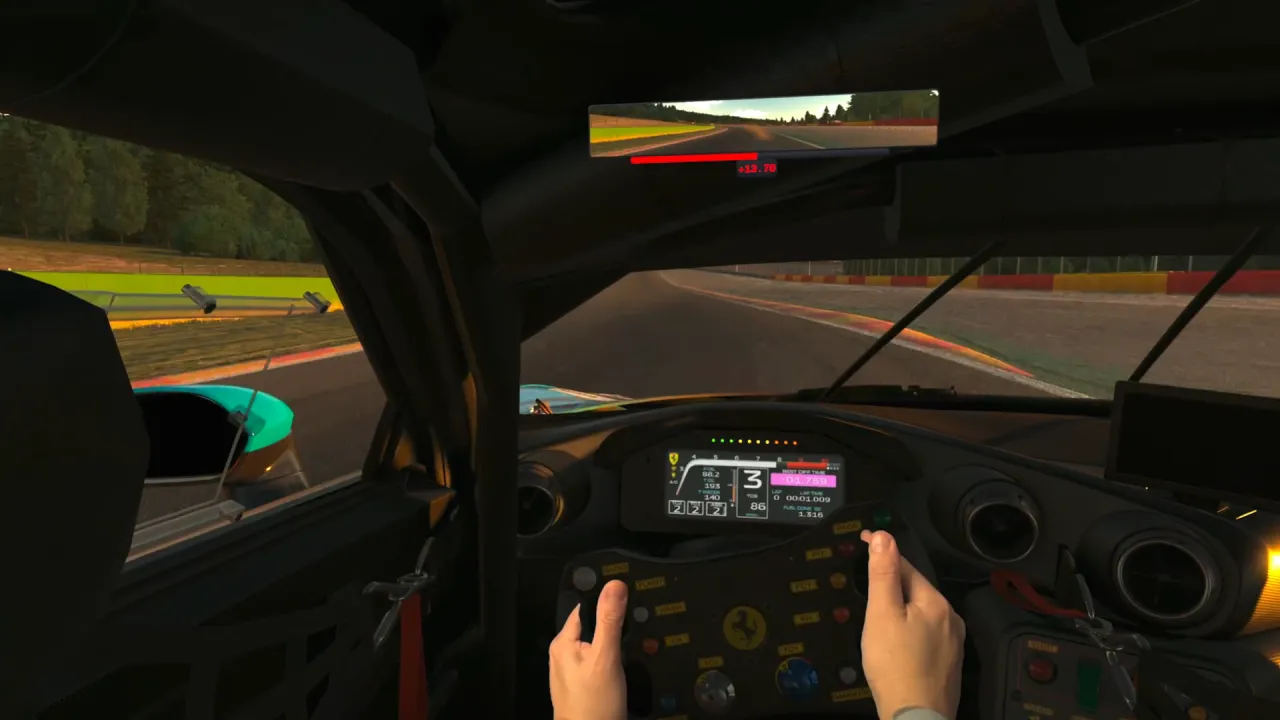

It’s eleven at night. I’m wearing a headset that costs more than my first car, my hands are gripping a plastic wheel pretending to be a Formula 4, and I’m staring at my own arms while racing against guys from all over the world I’ll never meet. This isn’t science fiction.
There are moments in life when two things you love crash into each other, and your brain makes that weird little noise that goes “wait, is this allowed?” Like when you find out your favorite pizza place now also makes ice cream. Or when your favorite show drops a new season the same weekend as a long holiday. This was that, but for steering wheel nerds.
iRacing, that sort of church of racing simulators where thousands of people take a Sunday afternoon lap time way too seriously, just released its native app for the Apple headset. And the community, as always, split into three camps in roughly fourteen minutes:
- The believers: “I have seen the light, I sold my couch.”
- The skeptics: “$3,500 to turn virtual wheels? Cool, cool.”
- The bystanders: “Is this still iRacing?”
There’s a guy in the community, let’s call him The Veteran, who’s been at this for years. He started with a Samsung, moved on to a Rift S, then a Quest 3. He runs an RTX 4090, which for the uninitiated is the digital equivalent of having a Ferrari parked in the living room just in case. And even so, he hadn’t raced in months. Life, you know how it goes. And then the new app dropped.
What he describes is almost suspiciously easy. He downloaded it. Opened it. Sat down. Put his hands on the wheel. And everything just clicked. His real arms, his real hands, his real feet on the real pedals, perfectly aligned with the virtual cockpit. No weird calibrations. No drawing exclusion zones by hand like you’re making a mandala.
“Wow, it’s so cool to see MY arms, MY hands, MY feet line up perfectly with the sim.”
That’s the line that defines the whole thing. And here’s the kicker: you can adjust how much of the real world you see. Look to the right and you see your office. To the left, your coffee mug. Straight ahead, Spa-Francorchamps in the rain. It’s like having a car cockpit peeking into your living room. Or your living room peeking into a car cockpit. Philosophically, this could be a whole Black Mirror episode.
The $3,500 problem?
Let’s talk about money, because we have to talk about money. $3,500. Before tax. For a headset.
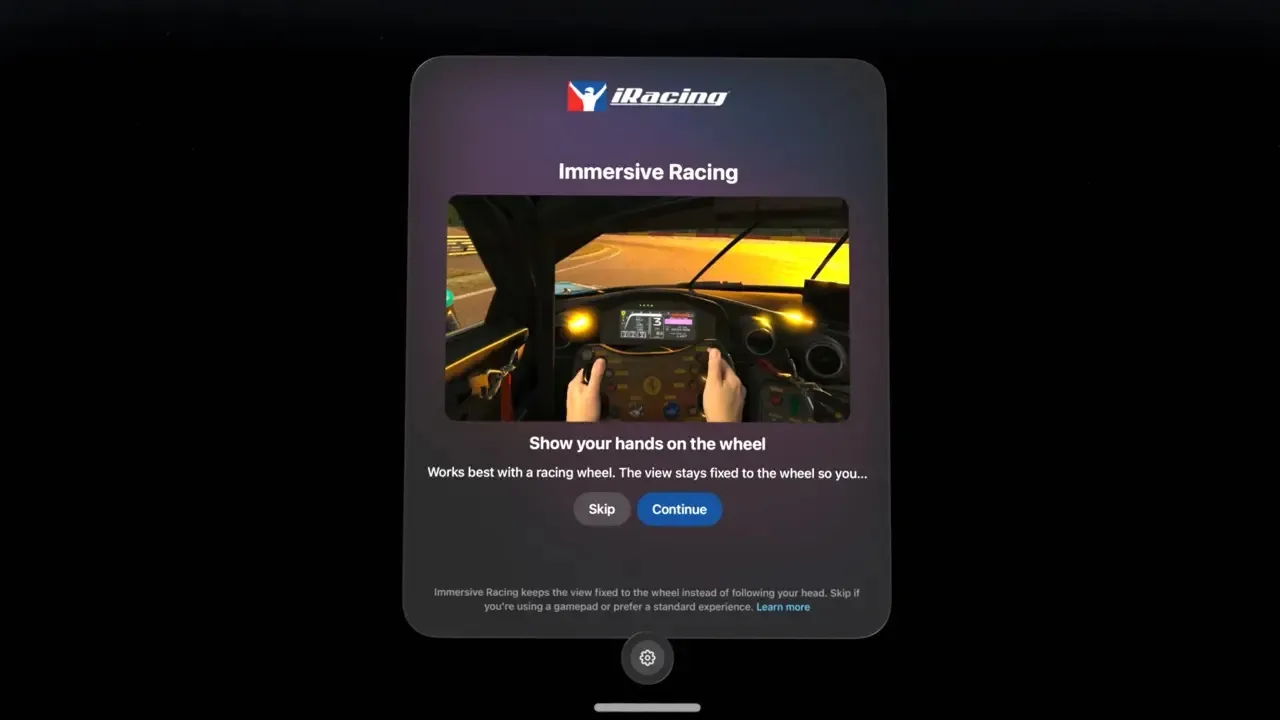
There are people in the community, and let’s be fair, a lot of people, who argue, with reasoning that genuinely holds up, that this is probably the worst price-to-performance ratio you can get if all you’re going to do is sim racing. For that kind of money you could buy a Quest 3, wait for the upcoming Steam Frame, or if you really want to throw the house out the window, go for a Bigscreen Beyond 2.
And they’re right. They’re absolutely right. But. (There’s always a “but.” If there were no “but,” we wouldn’t be having this conversation.)
The defenders’ argument is elegant in its simplicity: you don’t buy this thing for iRacing. You buy it because you already had it for working with your laptop on a floating ultrawide screen, or for watching NBA games with that “I’m courtside” view that’s almost unsettling in how good it is. You buy it because you’re the kind of person who lives in the bitten-apple ecosystem and breathes its updates. And then, on top of all that, now you can also race. It’s the cherry on top. It’s the bonus track. It’s the Easter egg of a product you were already justifying for other reasons.
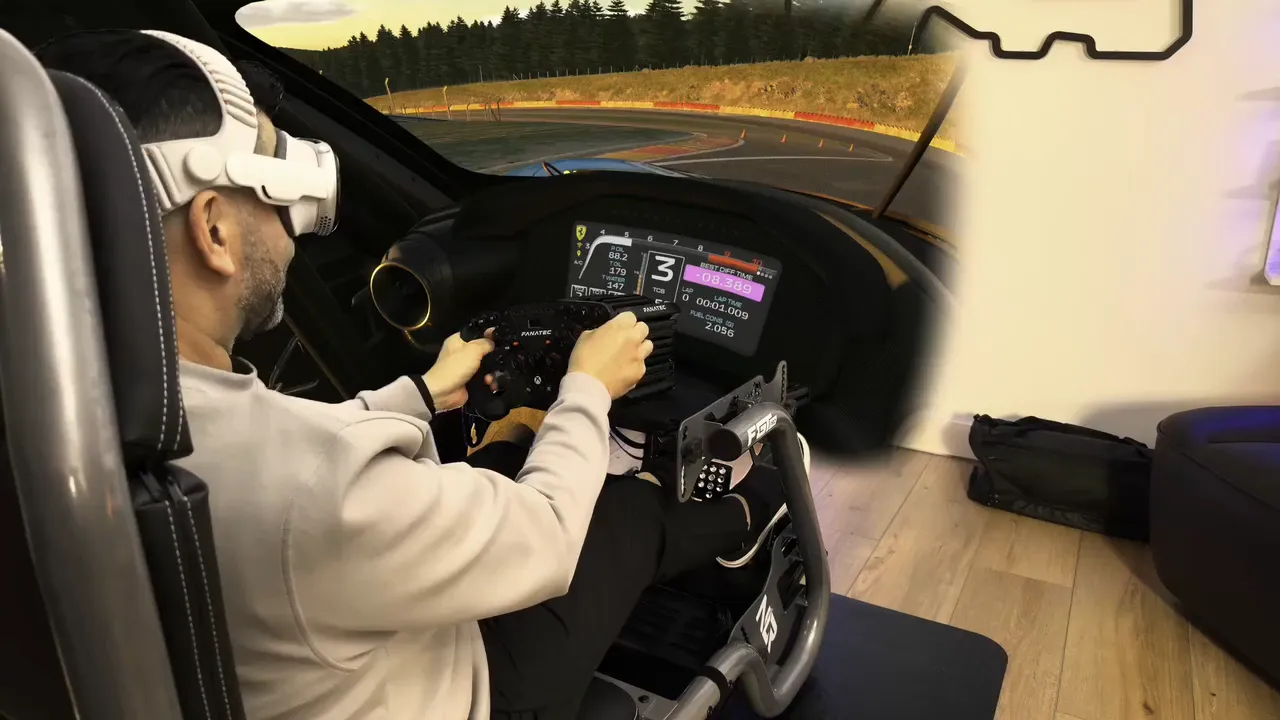
As someone out there put it perfectly: this is a niche inside a niche inside a niche. You have to like virtual reality. And Apple. And racing simulators. If you fail at one of those three, this isn’t for you, and that’s fine. There’s life outside virtual cockpits. So they say.
What works surprisingly well
Let’s talk about the good stuff, because there’s plenty.
- The resolution is among the best you’ll see in any headset. Colors look natural right out of the box, without those weird distortion profiles other headsets have where colors look washed out like an old t-shirt.
- The comfort, even though the thing has weight, is well distributed. It’s compact, you can press it against your face, and although your neck will have an opinion about all this, it doesn’t feel like wearing a brick held on with zip ties.
- The head tracking works without the classic hiccups of base-station systems, those mid-race moments when your view suddenly does a “warp” and for a split second you wonder if you’ve died and are seeing the light.
- And then there’s passthrough, that ability to see the real world through the headset. You can reach out, grab your water bottle without knocking it over, look at your keyboard, wave at your partner who walks in asking if you’re eating dinner tonight or not. Small things that remind you that you’re still a human being and not a low-quality cyborg.
What doesn’t work as well (let’s be adults about this)
It’s wireless. And being wireless means latency. There’s no magic that fixes that physics. You’re looking at around 40-50 milliseconds of delay, which, if you’re the kind of person who counts milliseconds the way other people count calories, is going to sting.
- The app comes limited in resolution (3800×3800 per eye) and in bandwidth (100 Mbps), due to decisions made in the underlying software stack. Some of the more technical users are doing the digital equivalent of modding their garage car: editing config files, tweaking parameters, bragging about it on forums. There’s a guy who managed to push it to 4800×4800 by messing with yaml files. Because of course there is.
- The foveated streaming, that technology that only renders in full detail where you’re looking, is aggressive. Sometimes, when you move your eyes quickly, there’s a split second where the image gets stuck in “dishwasher that didn’t rinse properly” mode. Then it recovers. But you notice.
- And the weight. Ah, the weight. There are people who say the design got compromised by trying to cram in that slightly creepy front display that shows your eyes to whoever’s in front of you. If you’ve seen someone wearing one, you know what I mean. It’s like looking into the bottom of a fish tank where someone left two boiled eggs.
The question that matters
Should you buy it? It depends on who you are when nobody’s watching.
- If you’re someone who already owns the headset, uses it for work, watches sports on it, flies simulated airplanes on Sunday mornings while the coffee gets cold, then yes. Try it. It’s one of the most polished and immersive experiences out there right now in this little universe. It is, according to people who have tried just about everything you can try, the most convincing way to do sim racing today. Period.
- If you’re someone who just wants to race, who has a budget, who counts every dollar, get a Quest 3, or wait for the Steam Frame, or build a triple-monitor setup and live happily. You’re not missing out on anything that will fundamentally change your life.
- And if you’re someone on the fence, well, that person is usually the most interesting. Because being on the fence means you understand the arguments on both sides. That you know it’s expensive but you also know the experience is good. That you suspect you’re rationalizing a luxury but you also suspect the rationalizers have a point. If you’re on the fence, my humble opinion: listen to the veteran user who sold everything else and kept this. Those people don’t lie about gadgets.
The most beautiful thing about this whole story isn’t the headset. Or the simulator. Not even the technology.
It’s that somewhere in the world there’s a father of two, or an engineering student, or a retired gentleman, who’s going to sit down in his homemade cockpit, strap that ridiculously expensive thing onto his face, look at his own hands virtually perfectly aligned with a Formula wheel, and for twenty minutes he’s going to forget about the bills, the boss, Sunday’s match. He’s going to be, simply, racing.
And hey, if that costs $3,500, well. There are people who pay that for a bicycle. And the bicycle doesn’t take you to Spa-Francorchamps.
See you on the track!
This website uses affiliate links which may earn a commission at no additional cost to you.






Get a second hand M2 Apple Vision Pro; Less than $2000, or 50% off a brand new M5 AVP. Practically does the same thing in terms of streaming CloudXR.